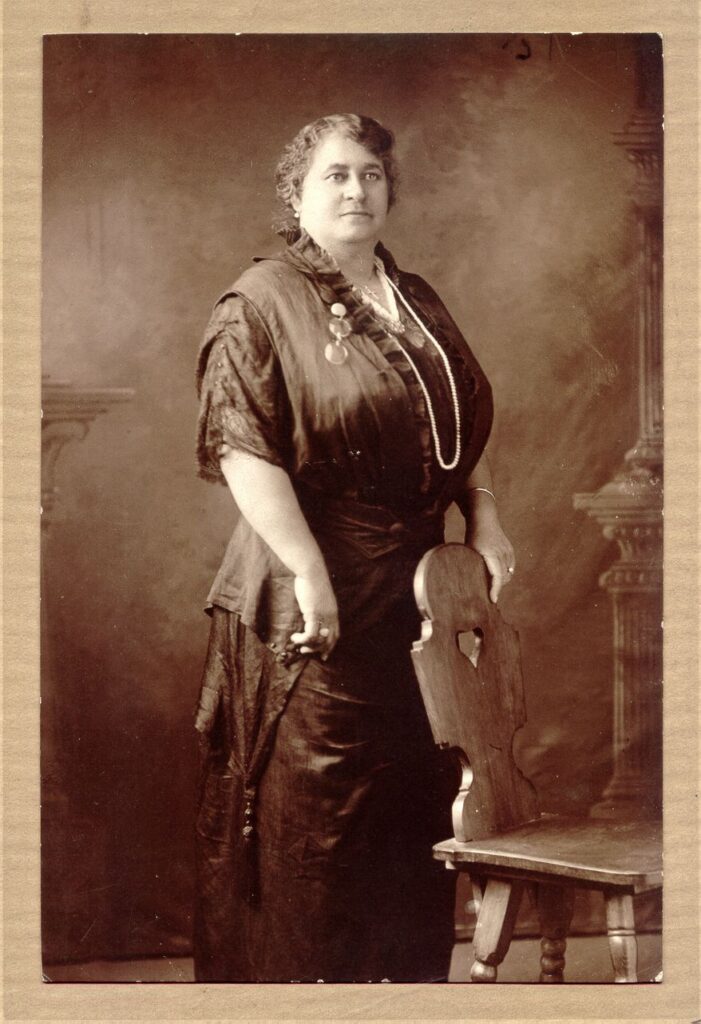
Profile №5 BEHI-P005-MLW
Maggie Lena Walker
1864–1934
Bank President, Publisher, Fraternal Leader
Overview
TAKEAWAY: Maggie Lena Walker connected banking, publishing, and retail to the Independent Order of St. Luke. Each institution’s operations and outcomes require its own evidence.
BEHI PROFILE — RESEARCH IN PROGRESS — UPDATED OCTOBER 28, 2026. EVIDENCE IS CLASSIFIED CLAIM BY CLAIM; ATTRIBUTED ACCOUNTS AND UNRESOLVED RESEARCH QUESTIONS ARE IDENTIFIED THROUGHOUT.
WHY SHE IS IN THE RECORD
Maggie Lena Walker joined banking, publishing and retail enterprise to the organizational network of the Independent Order of St. Luke in Richmond, Virginia.
Her record asks how a community organization built institutions for economic participation—and what the surviving records can establish about their operation.
A network with distinct economic institutions
Order · membership
The Independent Order of St. Luke supplied an organizational setting and relationships. Membership and benefit funds require their own records.
Herald · communication
The newspaper connected the organization with readers. Publishing activity is distinct from bank accounts or retail sales.
Bank · savings and credit
The bank organized financial participation through separate depositor, shareholder, and borrower relationships. Those categories must remain distinct.
Emporium · retail work
The store pursued opportunities in commerce and employment. Its operating history and results should be examined separately from the bank’s.
BEHI institutional map based on the NPS histories and Library of Virginia biography linked below. It connects activities without treating them as a consolidated balance sheet or a measure of Walker’s personal fortune.
EXACT ACCOMPLISHMENTS
First Black woman to charter and preside over a U.S. bank, according to NPS; bank opened November 2, 1903.
The St. Luke Herald began in 1902, according to the Library of Virginia.
The St. Luke Emporium operated during 1905–1911, according to institutional histories.
What Would Move This Profile Forward?
These are the next evidence priorities for strengthening this Profile. Each identifies a concrete research step and what it could help establish.
- Inspect the July 15, 1922 bank statement
Obtain NPS IOSL Records, Box 015, Folder 011, control 0096, with all pages. This would allow assets, deposits, liabilities and paid-in capital to be transcribed and distinguished.
- Establish the bank’s original governance
Acquire the approved 1903 charter, board minutes and ownership register. These would document the legal founding sequence and ownership rather than relying on a draft or later narrative.
- Measure the newspaper and retail operations
Recover Herald and Emporium sales, subscriptions, payroll, expenses and related payment records. These would establish each enterprise’s operating results separately.
- Reconcile the consolidation sequence
Inspect merger agreements, approvals and opening notices for the 1929–1931 stages. These would resolve differing institutional date labels and identify what occurred at each stage.
Read the Research Gaps & Open Questions for the unresolved issues and evidence limits. New material is reviewed before claims or classifications change.
THE RECEIPTS OR EVIDENCE SUPPORTING THIS PROFILE
Evidence labels apply to individual claims. Read the evidence guide and content-condition definitions.
| SOURCE / LOCATOR | RECORD / CONTEXT | DATE / PERIOD | EVIDENCE STATUS | SUPPORT / LIMITS |
|---|---|---|---|---|
| NPS · St. Luke Penny Savings Bank | Institutional interpretation | See repository | ATTRIBUTED | Bank chronology and segregation context; underlying charter, minutes and statements remain to be inspected. |
| Library of Virginia · Walker biography | Institutional interpretation | See repository | ATTRIBUTED | Biographical, newspaper and retail chronology; financial quantities are not independently verified here. |
| NPS · Maggie L. Walker Papers finding aid | Finding aid | 1922 locator / 2025 finding aid | ATTRIBUTED | IOSL Records, Box 015, Folder 011: financial statement dated July 15, 1922, archival control 0096. Original not yet inspected. |
| Library of Virginia · fundraising broadside | Repository catalog / interpretation | See repository | ATTRIBUTED | Read Every Word Carefully: Act at Once, Richmond, 192-. Broadside 192- .W3 BOX. Appeal does not establish funds received. |
BANKING, PUBLISHING & COMMUNITY ORGANIZATION
Walker’s record extends beyond founding a bank. The St. Luke network connected membership, benefits, communication, saving, lending, and retail work. BEHI examines each institution separately before interpreting how the system supported economic participation.
Background
TAKEAWAY: Walker’s organizational leadership grew from education, teaching, and work within St. Luke. Institutional histories provide the biographical framework.
EARLY LIFE & ORIGINS
Born in Richmond in 1864, Walker trained as a teacher before becoming an organizational leader. The Library of Virginia traces her education, teaching and work within the Independent Order of St. Luke.
Preparation for institutional leadership
Work & education
Helping her mother’s laundry business preceded graduation in 1883, three years of teaching, and business courses.
Organizing beyond Richmond
During the 1890s she organized local St. Luke councils and developed a Juvenile Department, extending the organization to younger members.
Learning the banking business
Before becoming bank president, she studied daily procedures at Merchants National Bank. Community leadership was paired with practical operating knowledge.
Attributed to the Library of Virginia biography and NPS bank history. BEHI analysis: teaching, organizing, and operational training help explain the skills she brought to institution building; they do not by themselves establish financial performance.
HISTORICAL & ECONOMIC CONTEXT
Place, institutions and neighborhood networks provide context for the business record.
The Order linked membership, communication and economic projects.
Education and administration supplied skills relevant to institution building.
FORMATIVE EXPERIENCES
Richmond Colored Normal School graduate, 1883, according to LVA.
Walker became the Order’s senior secretary in 1899, according to LVA.
Publishing, banking and retail became distinct organizational projects.
Place, institutions and neighborhood networks provide context for the business record.
The Order linked membership, communication and economic projects.
Education and administration supplied skills relevant to institution building.
PLACES, PEOPLE & INFLUENCES
| SOURCE | DESCRIPTION | DATE | EVIDENCE CLASSIFICATION | NOTES |
|---|---|---|---|---|
| NPS · St. Luke Penny Savings Bank | Institutional interpretation | See repository | ATTRIBUTED | Bank chronology and segregation context; underlying charter, minutes and statements remain to be inspected. |
| Library of Virginia · Walker biography | Institutional interpretation | See repository | ATTRIBUTED | Biographical, newspaper and retail chronology; financial quantities are not independently verified here. |
| NPS · Maggie L. Walker Papers finding aid | Finding aid | 1922 locator / 2025 finding aid | ATTRIBUTED | IOSL Records, Box 015, Folder 011: financial statement dated July 15, 1922, archival control 0096. Original not yet inspected. |
| Library of Virginia · fundraising broadside | Repository catalog / interpretation | See repository | ATTRIBUTED | Read Every Word Carefully: Act at Once, Richmond, 192-. Broadside 192- .W3 BOX. Appeal does not establish funds received. |
WORK, EDUCATION & LEADERSHIP
The Library of Virginia describes Walker helping her mother’s laundry business, graduating from Richmond Colored Normal School in 1883, and teaching before advancing within St. Luke. She became Grand Secretary in 1899. These experiences place administration and community organizing alongside her later banking career.
Source: Library of Virginia biography.
The Problem
TAKEAWAY: Walker’s initiatives responded to segregated access to banking and employment. The scale of lending, participation, and job opportunities requires operating records.
THE ECONOMIC PROBLEM
Institutional histories place Walker’s initiatives within segregated access to banking and employment. BEHI examines the mechanisms of exclusion without treating every later outcome as a proven result of one enterprise.
Four operating needs behind institution building
Financial access
Segregated banking conditions shaped the context for community banking. Deposits, credit, and stock participation were different ways of engaging with an institution.
Professional work
A bank, newspaper, and store each required staff and administrative skills. Payroll and employment records are needed to measure the opportunities they provided.
Information and trust
An organizational newspaper could support communication across councils. Reader contact and confidence still depended on reliable information and institutional practice.
Viable operations
The bank needed accounting and governance; the store needed inventory and customers; publishing required production and distribution. Shared aims did not guarantee identical results.
BEHI operating diagram grounded in the linked institutional histories. It explains the business questions rather than assuming a quantified effect on every household or a guaranteed return from each venture.
DIMENSIONS OF THE PROBLEM
Access to financial services affected household and enterprise decisions.
Enterprise could create roles for workers otherwise facing exclusion.
Members needed information and an organizational voice.
HOW THE PROBLEM SHOWED UP
Deposit-taking and credit required a functioning institution.
Staffing records are needed to measure employment.
Retail operations required stock, customers and accounting.
Access to financial services affected household and enterprise decisions.
Enterprise could create roles for workers otherwise facing exclusion.
Members needed information and an organizational voice.
EVIDENCE & CONTEXT
| SOURCE | DESCRIPTION | DATE | EVIDENCE CLASSIFICATION | NOTES |
|---|---|---|---|---|
| NPS · St. Luke Penny Savings Bank | Institutional interpretation | See repository | ATTRIBUTED | Bank chronology and segregation context; underlying charter, minutes and statements remain to be inspected. |
| Library of Virginia · Walker biography | Institutional interpretation | See repository | ATTRIBUTED | Biographical, newspaper and retail chronology; financial quantities are not independently verified here. |
| NPS · Maggie L. Walker Papers finding aid | Finding aid | 1922 locator / 2025 finding aid | ATTRIBUTED | IOSL Records, Box 015, Folder 011: financial statement dated July 15, 1922, archival control 0096. Original not yet inspected. |
| Library of Virginia · fundraising broadside | Repository catalog / interpretation | See repository | ATTRIBUTED | Read Every Word Carefully: Act at Once, Richmond, 192-. Broadside 192- .W3 BOX. Appeal does not establish funds received. |
THE PRACTICAL RESPONSE
A bank required more than an appeal for solidarity: governance, trained staff, reliable accounting, customers, and capital. A newspaper could coordinate dispersed members; a store required inventory and regular sales. Each venture addressed a different operating problem, and each needs its own evidence of results.
What She Built
TAKEAWAY: Walker connected a fraternal organization with a bank, newspaper, and store. Their separate finances must not be combined into a personal fortune.
WHAT SHE BUILT
Walker’s initiatives connected a fraternal organization with a bank, newspaper and retail venture. Each requires its own operating record; their finances must not be combined into a single fortune.
One network, distinct economic functions
Herald · communication
The newspaper connected dispersed St. Luke councils, circulated organizational information, and offered a forum for financial advice and civil-rights commentary.
Bank · savings & credit
Councils and individual members were encouraged to open accounts and purchase stock—different relationships between participants and the bank.
Emporium · commerce & work
The store created retail opportunities for Black workers and customers. Its closure shows that the ventures did not share an identical operating history.
Sources: NPS Herald history, NPS bank history, and Library of Virginia biography. BEHI analysis: these ventures linked communication, financial participation, and trade. Their distinct accounts must be preserved; membership, deposits, stock purchases, and sales cannot be added into one wealth total.
THE INSTITUTIONAL SYSTEM
St. Luke Penny Savings Bank connected deposits and lending with a Black fraternal network.
The St. Luke Herald communicated with members and readers.
The St. Luke Emporium pursued purchasing and employment opportunities.
The Independent Order of St. Luke supplied a membership network and administrative setting.
HOW THE SYSTEM WAS STRUCTURED
Charter and board minutes are needed to map legal authority.
Ledgers, reports and correspondence can establish daily activity.
Bank funds, fraternal funds and personal assets need separate treatment.
St. Luke Penny Savings Bank connected deposits and lending with a Black fraternal network.
The St. Luke Herald communicated with members and readers.
The St. Luke Emporium pursued purchasing and employment opportunities.
EVIDENCE & CONTEXT
| SOURCE | DESCRIPTION | DATE | EVIDENCE CLASSIFICATION | NOTES |
|---|---|---|---|---|
| NPS · St. Luke Penny Savings Bank | Institutional interpretation | See repository | ATTRIBUTED | Bank chronology and segregation context; underlying charter, minutes and statements remain to be inspected. |
| Library of Virginia · Walker biography | Institutional interpretation | See repository | ATTRIBUTED | Biographical, newspaper and retail chronology; financial quantities are not independently verified here. |
| NPS · Maggie L. Walker Papers finding aid | Finding aid | 1922 locator / 2025 finding aid | ATTRIBUTED | IOSL Records, Box 015, Folder 011: financial statement dated July 15, 1922, archival control 0096. Original not yet inspected. |
| Library of Virginia · fundraising broadside | Repository catalog / interpretation | See repository | ATTRIBUTED | Read Every Word Carefully: Act at Once, Richmond, 192-. Broadside 192- .W3 BOX. Appeal does not establish funds received. |
THE HERALD AS AN OPERATING BUSINESS
NPS dates the first Herald issue to March 29, 1902. The Order’s own printing department produced it, combining organizational news with financial advice and civil-rights commentary. This was both a communication system and skilled employment; subscription counts do not establish newspaper profit.
Source: NPS history of the St. Luke Herald.
Accomplishments
TAKEAWAY: Institutional sources describe Walker’s founding and organizational achievements. Precise financial outcomes remain open where original records have not been examined.
DOCUMENTED ACCOMPLISHMENTS
The profile attributes founding and operating chronology to identified institutions. Precise financial outcomes remain open until original records can be examined.
The operating work behind the milestone
Organizing governance
NPS describes the Order’s Executive Committee becoming the bank’s initial board, with meetings to arrange stock sales and staffing.
Building professional roles
Bank preparation included appointed cashiers and specified compensation, placing employees and administrative decisions behind the familiar founding story.
Sustaining an institution
NPS reports that the bank passed the state examination in 1910. Later consolidation required another form of leadership beyond opening a new enterprise.
Attributed to NPS bank history; original minutes, payroll, examination reports, and merger instruments remain research targets. BEHI analysis: founding, staffing, oversight, and adaptation are distinct accomplishments, each requiring its own evidence.
ACCOMPLISHMENT CATEGORIES
St. Luke Penny Savings Bank connected deposits and lending with a Black fraternal network.
The St. Luke Herald communicated with members and readers.
The St. Luke Emporium pursued purchasing and employment opportunities.
Administrative continuity deserves investigation alongside enterprise formation.
ACCOMPLISHMENT LEDGER
First Black woman to charter and preside over a U.S. bank, according to NPS; bank opened November 2, 1903.
The St. Luke Herald began in 1902, according to the Library of Virginia.
The St. Luke Emporium operated during 1905–1911, according to institutional histories.
St. Luke Penny Savings Bank connected deposits and lending with a Black fraternal network.
The St. Luke Herald communicated with members and readers.
The St. Luke Emporium pursued purchasing and employment opportunities.
EVIDENCE & CONTEXT
| SOURCE | DESCRIPTION | DATE | EVIDENCE CLASSIFICATION | NOTES |
|---|---|---|---|---|
| NPS · St. Luke Penny Savings Bank | Institutional interpretation | See repository | ATTRIBUTED | Bank chronology and segregation context; underlying charter, minutes and statements remain to be inspected. |
| Library of Virginia · Walker biography | Institutional interpretation | See repository | ATTRIBUTED | Biographical, newspaper and retail chronology; financial quantities are not independently verified here. |
| NPS · Maggie L. Walker Papers finding aid | Finding aid | 1922 locator / 2025 finding aid | ATTRIBUTED | IOSL Records, Box 015, Folder 011: financial statement dated July 15, 1922, archival control 0096. Original not yet inspected. |
| Library of Virginia · fundraising broadside | Repository catalog / interpretation | See repository | ATTRIBUTED | Read Every Word Carefully: Act at Once, Richmond, 192-. Broadside 192- .W3 BOX. Appeal does not establish funds received. |
THE BANK’S FIRST DAY
NPS reports 280 deposits and $1,247 in stock sales on November 2, 1903, totaling $9,340.44. This combines distinct cash inflows; it is not paid-in capitalization, earnings, or Walker’s personal wealth. The opening ledger and stock register remain acquisition targets.
Source: NPS bank history.
Economic Impact
TAKEAWAY: Banking, publishing, and retail offered distinct forms of participation. Deposits, loans, assets, membership receipts, sales, and profit are different measures.
ECONOMIC IMPACT
Banking, publishing and retail suggest different channels of economic participation. BEHI does not treat lending, deposits, assets or membership receipts as interchangeable indicators of impact.
The Herald’s reported reach
Dated subscriber counts offer one measure of the newspaper’s reach:
The reported count increased by 50% between these two dates. Readership connected organizational communication with a wider audience for economic and civic information.
Attributed figures from NPS Herald history. Percentage calculated from the published counts; original subscription records have not been inspected by BEHI. Subscribers are not membership totals, newspaper receipts, or profit. Revenue requires dated prices, collections, and expense records.
KEY ECONOMIC INDICATORS
Each measure identifies its entity, period, source and evidence limits. Dollar amounts are nominal historical U.S. dollars. Assets, revenue, profit, transaction amounts and employment measures are distinct. “Not yet established” identifies a research gap, not zero or “not applicable.”
| MEASURE / VALUE | ENTITY / PERIOD | SOURCE / LOCATOR | CONTENT CONDITION / EVIDENCE CLASSIFICATION | INTERPRETATION / LIMITS |
|---|---|---|---|---|
| Reported subscribers 4,000 | St. Luke Herald 1916 | NPS, St. Luke Herald account cited in this profile. | Documented ATTRIBUTED | Reported readership subscription measure; not verified paid circulation or revenue. |
| Reported subscribers 6,000 | St. Luke Herald 1924 | NPS, St. Luke Herald account cited in this profile. | Documented ATTRIBUTED | Separate dated observation; subscriber payments and renewals not established. |
| First-year gross sales $32,951.89 | St. Luke Emporium First operating year; exact reporting dates pending | Library of Virginia, Maggie Lena Walker biography. | Documented ATTRIBUTED | Gross sales, not net earnings or Walker’s personal income. |
| Bank assets and deposits Not yet established | St. Luke Penny Savings Bank Reporting period not established | Research gap; see Evidence & Context and Receipts. | Not yet established Evidence classification: not assigned to an unresolved answer. | 1922 statement locator: IOSL Box 015, Folder 011, control 0096. Amounts require document inspection. Research Gap: Bank assets and deposits |
For evidence-label definitions, see the Receipts evidence guide.
CHANNELS OF ECONOMIC IMPACT
Loan records could show borrowers, terms and collateral.
Statements and deposit ledgers could establish balances.
Payroll could establish workers, compensation and duration.
Sales and expense accounts could establish the venture’s scale.
HOW IMPACT CAN BE MEASURED
Obtain the July 15, 1922 statement identified by the finding aid.
Inspect loan-level records before interpreting mortgage counts.
Distinguish bank assets from the Order’s funds and Walker’s personal estate.
Loan records could show borrowers, terms and collateral.
Statements and deposit ledgers could establish balances.
Payroll could establish workers, compensation and duration.
EVIDENCE & CONTEXT
| SOURCE | DESCRIPTION | DATE | EVIDENCE CLASSIFICATION | NOTES |
|---|---|---|---|---|
| NPS · St. Luke Penny Savings Bank | Institutional interpretation | See repository | ATTRIBUTED | Bank chronology and segregation context; underlying charter, minutes and statements remain to be inspected. |
| Library of Virginia · Walker biography | Institutional interpretation | See repository | ATTRIBUTED | Biographical, newspaper and retail chronology; financial quantities are not independently verified here. |
| NPS · Maggie L. Walker Papers finding aid | Finding aid | 1922 locator / 2025 finding aid | ATTRIBUTED | IOSL Records, Box 015, Folder 011: financial statement dated July 15, 1922, archival control 0096. Original not yet inspected. |
| Library of Virginia · fundraising broadside | Repository catalog / interpretation | See repository | ATTRIBUTED | Read Every Word Carefully: Act at Once, Richmond, 192-. Broadside 192- .W3 BOX. Appeal does not establish funds received. |
RETAIL SALES & PRINT CIRCULATION
The Library of Virginia reports first-year Emporium sales of $32,951.89. This is attributed gross sales, with operating costs and profit unverified.
NPS reports Herald subscribers of 4,000 in 1916 and 6,000 in 1924. These dated readership measures must not be converted into revenue without subscription prices and collection records.
No undated membership total, insurance-fund valuation, or personal net-worth claim is adopted here.
Source: NPS Herald history; retail figure from the linked Library of Virginia biography.
Timeline
TAKEAWAY: Proposals, incorporation, opening, and consolidation are separate milestones. Conflicting merger-year labels require reconciliation with original instruments.
KEY DATES & SEQUENCE
The chronology distinguishes proposals, incorporation, opening and later consolidation. NPS and LVA accounts give different year labels for merger stages; original instruments are needed to reconcile them.
From preparation to operating institutions
- 1883Educational preparation
Graduates from Richmond Colored Normal School.
- 1899Organizational leadership
Becomes St. Luke’s Grand Secretary.
- 1901Institutional proposal
Presents a program of economic ventures.
- 1902Publishing begins
First Herald issue appears March 29.
- 1903Bank opens
Charter approval in July precedes the November 2 opening.
- 1905–1911Retail operation
Emporium opens April 10, 1905; operations end in 1911.
Chronology attributed to the Library of Virginia biography, NPS bank history, and NPS Herald history. This sequence distinguishes preparation, proposal, publication, legal approval, and operation. Later consolidation stages remain separately qualified below.
PHASES OF THE RECORD
Teaching and fraternal leadership preceded enterprise development.
Newspaper, bank and retail operations had different start and end dates.
Resolution, legal approval and opening may fall in different years.
CHRONOLOGICAL LANDMARKS
Birth, education, teaching and organizational advancement.
Herald launch and bank opening, attributed to institutional accounts.
Emporium operation; exact financial results unresolved.
Bank consolidation stages require charter and merger records.
Walker died in Richmond on December 15, according to LVA.
Teaching and fraternal leadership preceded enterprise development.
Newspaper, bank and retail operations had different start and end dates.
Resolution, legal approval and opening may fall in different years.
EVIDENCE & CONTEXT
| SOURCE | DESCRIPTION | DATE | EVIDENCE CLASSIFICATION | NOTES |
|---|---|---|---|---|
| NPS · St. Luke Penny Savings Bank | Institutional interpretation | See repository | ATTRIBUTED | Bank chronology and segregation context; underlying charter, minutes and statements remain to be inspected. |
| Library of Virginia · Walker biography | Institutional interpretation | See repository | ATTRIBUTED | Biographical, newspaper and retail chronology; financial quantities are not independently verified here. |
| NPS · Maggie L. Walker Papers finding aid | Finding aid | 1922 locator / 2025 finding aid | ATTRIBUTED | IOSL Records, Box 015, Folder 011: financial statement dated July 15, 1922, archival control 0096. Original not yet inspected. |
| Library of Virginia · fundraising broadside | Repository catalog / interpretation | See repository | ATTRIBUTED | Read Every Word Carefully: Act at Once, Richmond, 192-. Broadside 192- .W3 BOX. Appeal does not establish funds received. |
MORE PRECISE FORMATION DATES
August 20, 1901: institutional accounts date Walker’s proposal for the St. Luke ventures.
March 29, 1902: Herald’s first issue, according to NPS.
July 28, 1903: charter approval reported by NPS; November 2: bank opens.
April 10, 1905: Emporium opening reported by LVA. The precise closing event requires contemporary documentation.
Source: NPS bank history; Herald and Emporium dates from their linked institutional accounts.
CHRONOLOGICAL RECORD
-
1902
MLW — St. Luke Herald
Maggie Lena Walker / St. Luke institutions
LVA dates the newspaper’s launch to 1902. -
1903-11-02
MLW — St. Luke Penny Savings Bank opens
Maggie Lena Walker / St. Luke institutions
NPS dates the bank’s opening to November 2, 1903; original charter and minutes remain research targets. -
1905–1911
MLW — St. Luke Emporium
Maggie Lena Walker / St. Luke institutions
Institutional histories describe this retail venture’s operating period; accounts remain to be inspected. -
1922-07-15
MLW — Financial statement archival lead
Maggie Lena Walker / St. Luke institutions
The NPS finding aid lists a bank financial statement dated July 15, 1922. Its figures are not yet verified. -
1929–1931
MLW — Bank consolidation stages
Maggie Lena Walker / St. Luke institutions
NPS and LVA year labels differ. Original instruments are needed to reconcile agreement, approval and opening.
Myths & Disputes
TAKEAWAY: Financial and founding claims must identify the institution, date, and measure. Deposits are not stock subscriptions or profit, and sales are not net earnings.
MYTHS, DISPUTES & QUALIFICATIONS
A precise claim should identify the institution, date and measure being discussed. The surviving catalog does not itself verify the contents of every document.
Keep the economic measures separate
A deposit is not bank income
Money placed in an account is a depositor’s balance and a bank liability. It is not equivalent to a stock subscription or an earned profit.
Gross sales are not net profit
The Emporium’s reported first-year sales describe turnover. Expenses, cost of goods, and losses require the store’s operating accounts.
A merger is not an unchanged institution
Agreement, legal approval, and opening can have different dates. A successor bank’s name alone does not establish continuous ownership or control.
BEHI evidence-reading guide. Apply these distinctions to figures and chronology attributed to the NPS bank history and Library of Virginia biography. The bank milestone should retain its supported qualification: first Black woman to charter and preside over a U.S. bank, rather than a universal first-woman claim.
COMMON SOURCES OF CONFUSION
Preserve the racial qualification in the supported bank claim.
Institutional assets do not equal personal net worth.
A finding aid establishes a locator, not verified statement totals.
Distinguish agreement, approval and opening dates.
CLAIM CHECKS
Maggie Lena Walker and Madam C.J. Walker are different people.
An announced factory proposal does not prove an operating factory.
A request for donations does not establish funds collected.
Preserve the racial qualification in the supported bank claim.
Institutional assets do not equal personal net worth.
A finding aid establishes a locator, not verified statement totals.
EVIDENCE & CONTEXT
| SOURCE | DESCRIPTION | DATE | EVIDENCE CLASSIFICATION | NOTES |
|---|---|---|---|---|
| NPS · St. Luke Penny Savings Bank | Institutional interpretation | See repository | ATTRIBUTED | Bank chronology and segregation context; underlying charter, minutes and statements remain to be inspected. |
| Library of Virginia · Walker biography | Institutional interpretation | See repository | ATTRIBUTED | Biographical, newspaper and retail chronology; financial quantities are not independently verified here. |
| NPS · Maggie L. Walker Papers finding aid | Finding aid | 1922 locator / 2025 finding aid | ATTRIBUTED | IOSL Records, Box 015, Folder 011: financial statement dated July 15, 1922, archival control 0096. Original not yet inspected. |
| Library of Virginia · fundraising broadside | Repository catalog / interpretation | See repository | ATTRIBUTED | Read Every Word Carefully: Act at Once, Richmond, 192-. Broadside 192- .W3 BOX. Appeal does not establish funds received. |
RESEARCH CORRECTIONS
Earlier research treated some institutional figures as verified. Here, the opening-day total, store sales, and subscriber counts remain attributed to the named sources until their originals are examined.
A proposed factory is not an established operating company. Draft incorporation articles are not an approved charter. Likewise, a later transcription of the 1901 address must not be described as its original manuscript.
Claim Review & Corrections
| CLAIM / ASSERTION | HISTORICAL CLARIFICATION & CORRECTION | CLAIM STATUS | RECEIPT |
|---|---|---|---|
|
◆
MLW — Bank founding distinction
“Maggie Lena Walker was the first Black woman to charter and preside over a U.S. bank.”
|
NPS attributes this distinction to Walker. Preserve the qualification; do not broaden it to first woman of any race. |
Attributed | |
|
◆
MLW — Separate St. Luke enterprises
“The Herald and Emporium were distinct ventures associated with Walker’s organizational leadership.”
|
LVA supplies operating chronology. Their accounts must be examined separately from bank and personal finances. |
Attributed | |
|
◆
MLW — 1922 statement locator
“The NPS finding aid lists a St. Luke Penny Savings Bank financial statement dated July 15, 1922.”
|
IOSL Records, Box 015, Folder 011, control 0096. This establishes an archival lead; statement contents and figures remain unverified. |
Attributed | |
|
◆
MLW — Fundraising broadside
“LVA catalogs a Walker fundraising broadside from the 1920s.”
|
A fundraising appeal does not establish the amount collected. Original and associated accounting records are still sought. |
Attributed |
Legacy
TAKEAWAY: Walker’s legacy includes institution-building and civic leadership. Later successor-bank history requires separate evidence of ownership and organizational continuity.
LEGACY & CONTINUITY
Walker’s legacy can be examined through institutional development and the preserved archival record. Later successor-bank history needs its own evidence and should not imply unchanged ownership across every merger.
Economic leadership beyond the bank
Women’s civic institutions
Walker founded Richmond’s Council of Colored Women in 1912; its work included support for public health and education.
Voting & public leadership
She organized voter education in 1920 and ran for state superintendent of public instruction in 1921.
Continued leadership
She maintained institutional work as her mobility declined, adapting her home and transportation to support continued participation.
Attributed to the Library of Virginia biography. BEHI analysis: these activities connect economic organization with education, health, political participation, and leadership by women. They broaden her legacy without assigning an unsupported monetary value to civic outcomes.
CHANNELS OF LEGACY
St. Luke Penny Savings Bank connected deposits and lending with a Black fraternal network.
The St. Luke Herald communicated with members and readers.
The St. Luke Emporium pursued purchasing and employment opportunities.
Cataloged papers enable new questions and corrections.
LEGACY IN THE RECORD
Trace each organization separately through its records.
Investigate access, employment and readership using contemporary evidence.
New documents can revise both chronology and interpretation.
St. Luke Penny Savings Bank connected deposits and lending with a Black fraternal network.
The St. Luke Herald communicated with members and readers.
The St. Luke Emporium pursued purchasing and employment opportunities.
EVIDENCE & CONTEXT
| SOURCE | DESCRIPTION | DATE | EVIDENCE CLASSIFICATION | NOTES |
|---|---|---|---|---|
| NPS · St. Luke Penny Savings Bank | Institutional interpretation | See repository | ATTRIBUTED | Bank chronology and segregation context; underlying charter, minutes and statements remain to be inspected. |
| Library of Virginia · Walker biography | Institutional interpretation | See repository | ATTRIBUTED | Biographical, newspaper and retail chronology; financial quantities are not independently verified here. |
| NPS · Maggie L. Walker Papers finding aid | Finding aid | 1922 locator / 2025 finding aid | ATTRIBUTED | IOSL Records, Box 015, Folder 011: financial statement dated July 15, 1922, archival control 0096. Original not yet inspected. |
| Library of Virginia · fundraising broadside | Repository catalog / interpretation | See repository | ATTRIBUTED | Read Every Word Carefully: Act at Once, Richmond, 192-. Broadside 192- .W3 BOX. Appeal does not establish funds received. |
CONTINUITY NEEDS ITS OWN RECORD
Later banking mergers connect Walker’s initiative with successor institutions, but a surviving name or business does not establish unchanged ownership or control. BEHI will reconstruct those stages using dated agreements, approvals, and share-exchange records.
Company Records
TAKEAWAY: The register identifies institutional accounts and archival leads. Catalog descriptions and draft documents do not substitute for inspected financial statements or approved charters.
COMPANY RECORDS
This draft links institutional interpretations and catalog leads. No original financial statement, charter, patent or audited account is represented as inspected evidence.
Show All includes linked sources. Sources without a company-record category can appear there without increasing a category count; records assigned to multiple categories can count more than once.
Follow each institution through its own records
Authority & ownership
Approved charters, amendments, board minutes, and stock registers can establish the legal institution and decision-making powers. Draft articles or an organizational title cannot substitute for approval.
Balances & transactions
The July 15, 1922 statement is cataloged at IOSL Records, Box 015, Folder 011, control 0096. Inspection should distinguish assets, deposits, liabilities, capital, and the statement’s exact scope.
Retail & publishing accounts
Emporium checks, sales and inventory records, and Herald subscriptions and expenses would answer different operating questions. A catalog entry identifies a target rather than a completed transaction.
Continuity & succession
Merger resolutions, approvals, agreements, and opening notices can reconcile institutional chronology. A successor name alone does not establish unchanged ownership or control.
BEHI research map to the eight existing record categories below. The NPS finding aid provides acquisition locators; original statements, instruments, and accounts remain pending. Existing source counts and custody distinctions are preserved.
| SOURCE | DESCRIPTION | DATE | EVIDENCE CLASSIFICATION | NOTES |
|---|---|---|---|---|
| NPS · St. Luke Penny Savings Bank | Institutional interpretation | See repository | ATTRIBUTED | Bank chronology and segregation context; underlying charter, minutes and statements remain to be inspected. |
| Library of Virginia · Walker biography | Institutional interpretation | See repository | ATTRIBUTED | Biographical, newspaper and retail chronology; financial quantities are not independently verified here. |
| NPS · Maggie L. Walker Papers finding aid | Finding aid | 1922 locator / 2025 finding aid | ATTRIBUTED | IOSL Records, Box 015, Folder 011: financial statement dated July 15, 1922, archival control 0096. Original not yet inspected. |
| Library of Virginia · fundraising broadside | Repository catalog / interpretation | See repository | ATTRIBUTED | Read Every Word Carefully: Act at Once, Richmond, 192-. Broadside 192- .W3 BOX. Appeal does not establish funds received. |
COMPANY RECORDS — EVIDENCE COVERAGE
| CATEGORY | AVAILABLE BASIS / NEXT RECORD |
|---|---|
| Incorporation | NPS chronology; approved charter and amendments sought. Cataloged draft articles are not approval. |
| Financial | 1922 statement locator; original figures pending. |
| Operational | Institutional accounts of bank, printing and store; originals sought. |
| Contracts & Transactions | Cataloged 1908 checks involving Emporium; originals not inspected. |
| Legal & Regulatory | Charter, examinations and merger approvals needed. |
| IP | No patent asserted; investigate documented publication and business rights. |
| Ledgers & Accounts | Deposit, stock, loan, sales, expense and payroll books needed. |
| Reports & Correspondence | Finding-aid leads, annual reports and addresses; classify transcription and interpretation separately. |
Category coverage describes research status; it does not claim new downloadable originals or change existing filter counts.
ARCHIVAL CERTIFICATION & PUBLIC RECORD INTEGRITY
All company records presented in this repository have been cataloged according to the BEHI Company Records Classification System. Documents marked as Primary Sources are drawn from certified state and county archives, corporate filings, and recognized institutional repositories. Where physical scans are currently in the acquisition pipeline, verified archival metadata, source citations, and holding locators are provided to facilitate scholarly research.
| Document & ID | Evidence Type | Date | Description & Location | Source Repository | Action |
|---|---|---|---|---|---|
|
MLW — NPS · St. Luke Penny Savings Bank
BEHI-P005-S001
Maggie Lena Walker / St. Luke institutions
|
Repository Authority
Formation & Governance
|
Bank chronology and segregation context; underlying charter, minutes and statements remain to be inspected.
|
|||
|
MLW — Library of Virginia · Walker biography
BEHI-P005-S002
Maggie Lena Walker / St. Luke institutions
|
Repository Authority
Reports & Correspondence
|
Biographical, newspaper and retail chronology; financial quantities are not independently verified here.
|
|||
|
MLW — NPS · Maggie L. Walker Papers finding aid
BEHI-P005-S003
Maggie Lena Walker / St. Luke institutions
|
Finding Aid
Financial
|
IOSL Records, Box 015, Folder 011: financial statement dated July 15, 1922, archival control 0096. Original not yet inspected.
|
|||
|
MLW — Library of Virginia · fundraising broadside
BEHI-P005-S004
Maggie Lena Walker / St. Luke institutions
|
Repository Authority
Financial
|
Read Every Word Carefully: Act at Once, Richmond, 192-. Broadside 192- .W3 BOX. Appeal does not establish funds received.
|
No verified records are currently published in this category.
Receipts
TAKEAWAY: The 1907 letter and 1909 speech are available as inspected reproductions. Separate financial-statement, charter, payroll and other catalog targets remain uninspected.
RECEIPTS & EVIDENCE
HOW TO READ THE EVIDENCE
BEHI interprets the institutional relationships separately from verified transactions. A founding date does not establish profitability; a catalog locator does not verify a financial total.
Follow the claim to its source, then read the evidence status and limits. A source may support one narrow fact while leaving a larger conclusion unresolved.
Content condition describes whether the question can currently be answered. Evidence classification describes the support for a documented finding.
- Documented: A finding is presented with its source, evidence classification and limits. Documented does not automatically mean Verified.
- Not yet established: The answer remains unresolved. The entry identifies missing evidence and connects to Research Gaps.
- Not applicable: The measure does not fit the person or enterprise being examined; an explanation must state why. Missing evidence alone never makes a question not applicable.
Shared section headings remain visible. Relevance that is uncertain is treated as Not yet established until resolved.
Evidence labels and source access
- Verified
- The specific fact or record described has been checked against the cited material. Read the limit: an inspected reproduction, index or catalog entry does not mean every underlying document or broader claim has been verified.
- Attributed
- The statement is credited to the named source. Independent confirmation or the underlying original may still be outstanding.
- Disputed
- Sources or interpretations conflict. Read the competing evidence and the unresolved question.
- Estimated
- The figure is an approximation or qualified valuation, not an exact measured total. Read its basis, date and uncertainty.
- Institute Analysis
- BEHI’s interpretation or calculation from identified evidence. It is separate from what the historical source directly states.
Source access: A link may lead to an original scan, a published transcription, a finding aid, or a repository page. Use the source ID, collection, box, folder and page locator where supplied. A catalog listing or repository confirmation is not inspection of the item itself.
Images and permissions: Historical support and reproduction permission are separate questions. Read each image credit and rights note; a source link does not itself grant permission to republish.
Open questions: See Research Gaps & Open Questions below for missing records and unresolved claims.
These linked sources make the current evidence boundaries visible. Institutional interpretation, archival finding aids and inspected original documents receive distinct treatment.
DOCUMENTS
Original Documents — Maggie Lena Walker
National Park Service, Maggie L. Walker Papers. Select an image to enlarge it. Both complete original PDFs are preserved in the BEHI media library.
Letter to Tabitha Collins, April 20, 1907
Readable text — Selected transcription
Opening body paragraph of the April 20, 1907 letter to Mrs. Tabitha Collins:
We have your registered letter and $7.00 for Sister Lane’s purse of $1,000, which we have banked to your credit, and will keep this letter as a receipt for the same.
Checked against the displayed page; line breaks and spacing normalized. Address, salutation, later sentences, overtyped wording and closing initials are omitted. The letter reports receipt and banking of $7 toward the purse; it is not an independently audited bank record. Checked against the source images by BEHI, October 28, 2026.
Preview: Supplied document image; see citation for coverage.
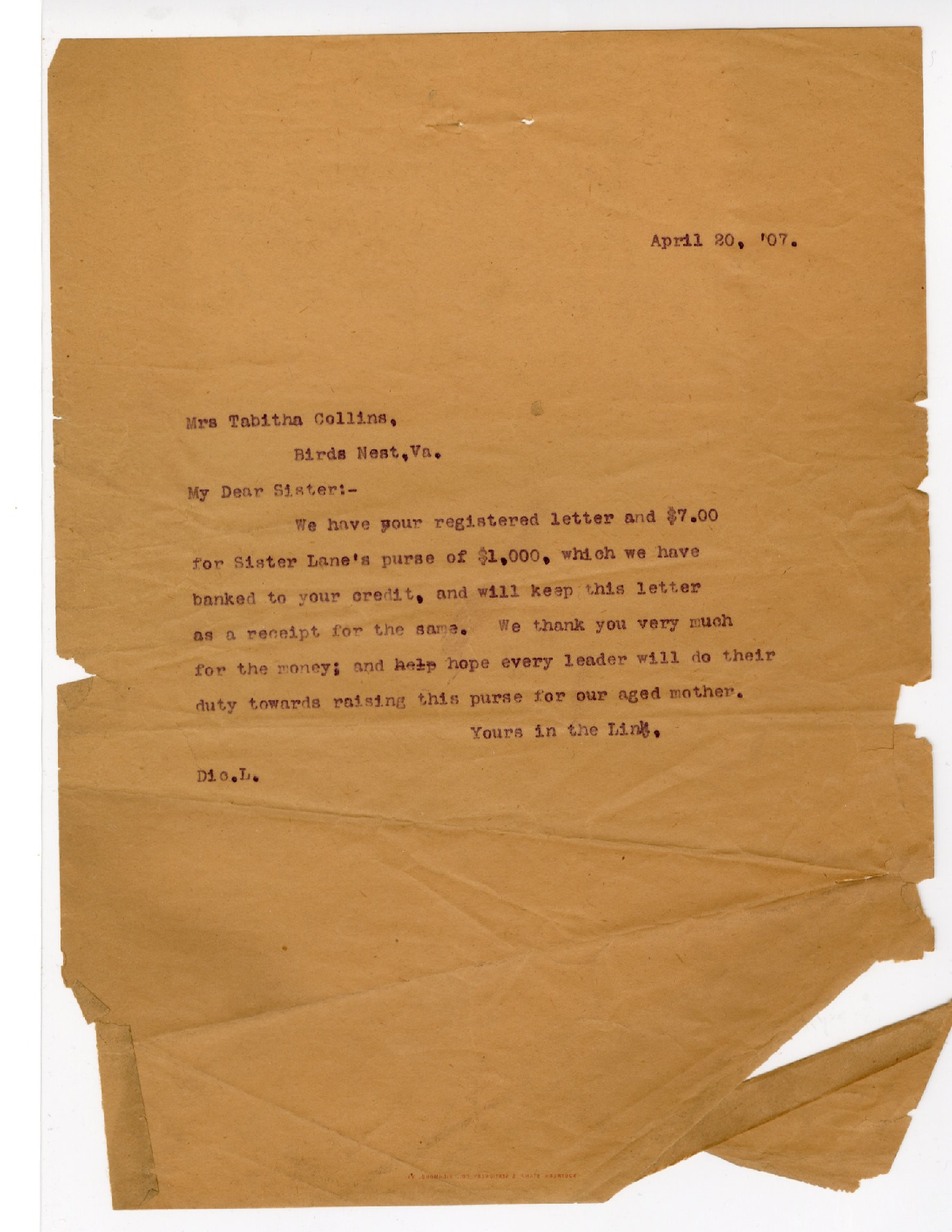
Letter acknowledging a $7 donation toward a fundraising goal; NPS MAWA_99-0811.25.
Complete original PDF · NPS catalogFull file: Open full-size page 1 · Open complete supplied PDF
Letter acknowledging a $7 donation toward a fundraising goal; NPS MAWA_99-0811.25.
Complete original PDF · NPS catalogEvidence classification: Primary correspondence; acknowledgment of $7 toward a fundraising goal, not audited bank finances.
Rights note: NPS asset record identifies the item as public domain.
Woman at the Sepulchre, 1909
Readable text — Selected transcription
The on-page image is the title leaf. This opening paragraph comes from PDF page 2, the first page of the speech text:
The most hallowed scenes of Christian Life cluster around Easter Day. Calvary’s tragedy, the sleep in the sepulchre, and Easter Morning’s Resurrection, are the ROCKS upon which your salvation and mine are built.
The opening uses Easter and renewal imagery. The following page turns toward the women who followed Jesus.
Opening paragraph only, visually checked against PDF page 2; line breaks and spacing normalized. The remainder of the thirteen-page file is not transcribed here. The full PDF below includes the title leaf and speech. Checked against the source images by BEHI, October 28, 2026.
Preview: Supplied document image; see citation for coverage.
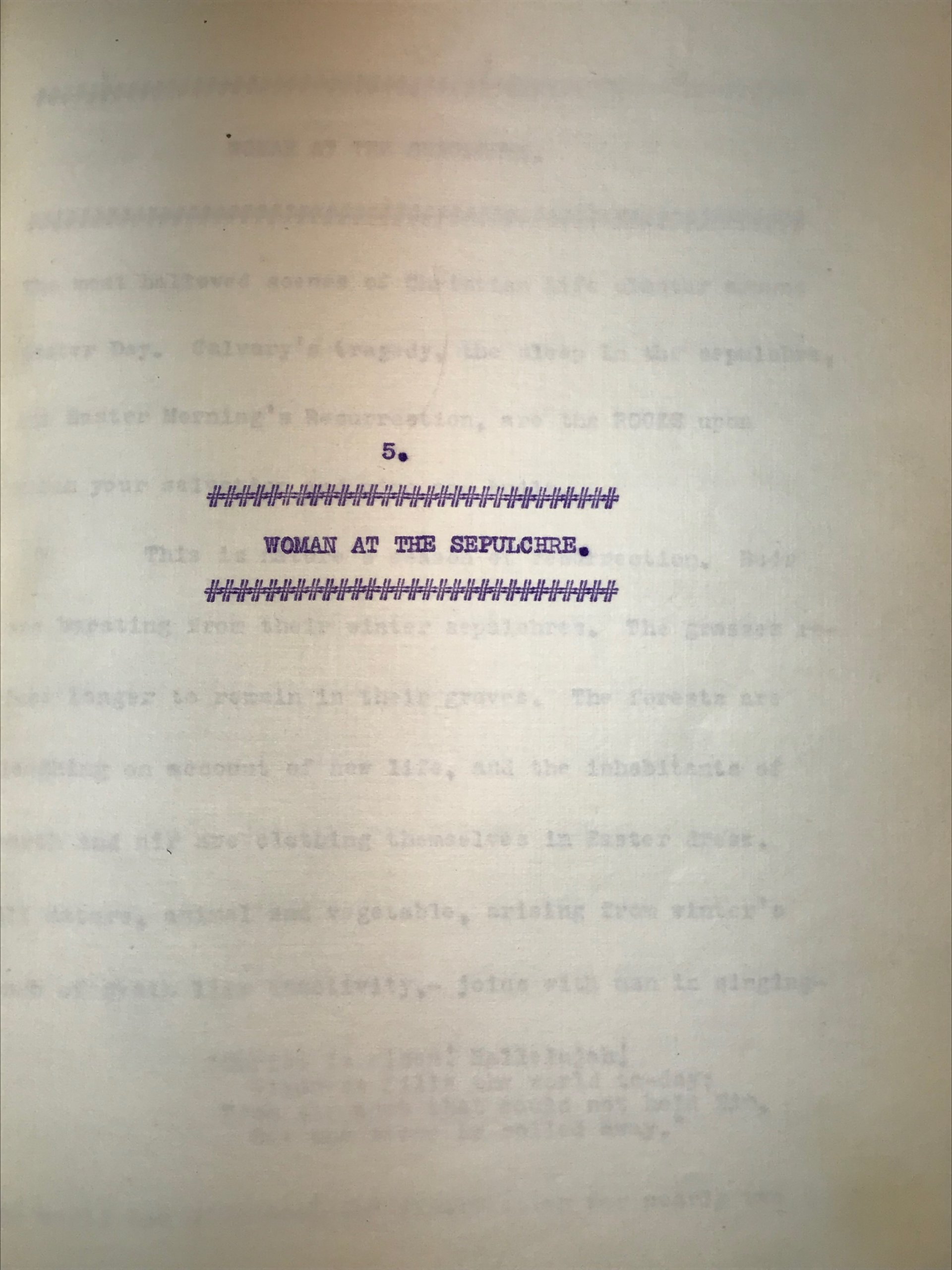
First page of a 13-page speech associated with Walker and St. Luke enterprises; NPS MAWA_99-3222.05.
Complete original PDF · NPS catalogFull file: Open full-size page 1 · Open complete supplied PDF
First page of a 13-page speech associated with Walker and St. Luke enterprises; NPS MAWA_99-3222.05.
Complete original PDF · NPS catalogEvidence classification: Primary speech attributed to Maggie L. Walker; statements and advocacy, not independent financial verification.
Rights note: NPS asset record identifies the item as public domain.
Rights: NPS asset records indicate public domain. Evidence boundary: original correspondence and speech establish documentary statements, not independently audited bank finances or ownership.
Original Maggie Lena Walker documents — National Park Service
1907 correspondence: Letter from Maggie L. Walker to Tabitha Collins, April 20, 1907, acknowledging a $7 donation toward a stated $1,000 fundraising goal. NPS archival record MAWA_99-0811.25.pdf, Maggie L. Walker Papers. View original document at NPS.
1909 speech: Woman at the Sepulchre, attributed to Maggie L. Walker, discussing women’s resolve and the early St. Luke enterprises. NPS archival record MAWA_99-3222.05.pdf, 13 pages. View original document at NPS.
Reproduction status: Both NPS asset records identify the items as public domain. First-page previews and complete PDFs of both documents are now available above in Key Documents. The 1909 speech preview is page 1 of a 13-page document; use the complete PDF for the remaining pages.
Portrait: Maggie Lena Walker, studio photograph, Washington, D.C., circa 1905. NPS catalog MAWA_99-0261 identifies the sitter and marks the image public domain. Portrait source and rights.
Read the source, then read the boundary
Institutional history
Use NPS and Library of Virginia accounts for attributed chronology and interpretation. Identify which underlying document would establish a particular transaction or legal event.
Finding aid
Use a repository’s description to locate a folder or item. A listed financial statement does not verify its figures before the original is inspected.
Appeal versus receipt
A fundraising broadside records a request. Collected funds and their use need acknowledgments, deposits, accounts, or other transaction evidence.
Image provenance
The portrait’s NPS catalog identifies the sitter, approximate date, and rights status. Image metadata answers a different question from financial or corporate evidence.
Evidence-reading map for the linked sources and research gaps below. Preserve the institution, date, unit, document form, locator, and inspection scope for each claim. A new source may resolve one question while others remain open.
SOURCE REGISTER & EVIDENCE LIMITS
| SOURCE | DESCRIPTION | DATE | EVIDENCE CLASSIFICATION | NOTES |
|---|---|---|---|---|
| NPS · St. Luke Penny Savings Bank | Institutional interpretation | See repository | ATTRIBUTED | Bank chronology and segregation context; underlying charter, minutes and statements remain to be inspected. |
| Library of Virginia · Walker biography | Institutional interpretation | See repository | ATTRIBUTED | Biographical, newspaper and retail chronology; financial quantities are not independently verified here. |
| NPS · Maggie L. Walker Papers finding aid | Finding aid | 1922 locator / 2025 finding aid | ATTRIBUTED | IOSL Records, Box 015, Folder 011: financial statement dated July 15, 1922, archival control 0096. Original not yet inspected. |
| Library of Virginia · fundraising broadside | Repository catalog / interpretation | See repository | ATTRIBUTED | Read Every Word Carefully: Act at Once, Richmond, 192-. Broadside 192- .W3 BOX. Appeal does not establish funds received. |
RESEARCH GAPS & OPEN QUESTIONS
ECONOMIC INDICATORS — MISSING EVIDENCE
Bank assets and deposits
Content condition: Not yet established. St. Luke Penny Savings Bank
Reporting period not established
Evidence needed / present limit: 1922 statement locator: IOSL Box 015, Folder 011, control 0096. Amounts require document inspection.
Obtain the 1903 charter, board minutes and ownership register; test the legal sequence and shareholding. Research lead: Virginia corporate records and NPS collection. Status: open.
Inspect the July 15, 1922 original; distinguish assets, deposits, liabilities and paid-in capital. Research lead: NPS IOSL Records, Box 015, Folder 011, control 0096. Status: open.
Seek payroll, sales, expense and subscription records; establish operating results separately. Research lead: Contemporary Herald and Emporium accounts. Status: open.
Reconcile institutional accounts using merger agreements, approvals and opening notices. Research lead: NPS and LVA give differing year labels for stages during 1929–1931. Status: open.
Acquire the broadside and related accounts; separate requested funds from amounts actually received. Research lead: LVA Broadside 192- .W3 BOX. Status: open.
Inspect estate and bank records before assigning a net-worth total. Research lead: Estate inventory and entity-specific statements. Status: open.
Have a document that could help? Contact BEHI with the document, its source and provenance. BEHI reviews submissions through its verification process before inclusion. This profile remains open to new evidence.
RESEARCH UPDATES & RECONCILIATION
PREVIOUS RESEARCH RECONCILED
Evidence status: Catalog entries were checked; the underlying documents were not inspected.
Read full note: Previous research reconciled — NPS archival targets
The current NPS finding aid confirms these targeted leads. The catalog entries were checked; underlying documents were not inspected.
| RECORD TARGET | LOCATOR | BOUNDARY |
|---|---|---|
| 1922 financial statement | IOSL Records, Box 015, Folder 011; control 0096 | July 15, 1922; obtain original statement. |
| School savings clipping | IOSL Records, Box 015, Folder 011; control 0408 | Undated; does not establish account totals. |
| Draft articles | IOSL Records, Box 015, Folder 010; control 1734 | Undated draft; not an approved charter. |
| Checks to Emporium and other payees | Walker Papers, Box 002, Folder 020; control 0587 | March–April 1908; amounts and purpose pending. |
The 1901 address, Golden Jubilee report, payroll, annual statements, retail accounts, and succession papers remain priority acquisitions. Earlier research leads are carried forward without implying that missing scans have been recovered.
Source: NPS finding aid, collection inventory and control-number index.
MLW — Bank founding distinction
Audited Historical Assertion
Maggie Lena Walker was the first Black woman to charter and preside over a U.S. bank.
BEHI Academic Analysis & Research Clarification
NPS attributes this distinction to Walker. Preserve the qualification; do not broaden it to first woman of any race.
Supporting Archival Receipts & Primary Sources
HOW TO READ THE RECEIPTS & ARCHIVAL CITATIONS
Evidence linked on this page may include primary archival records, contemporary sources, repository citations, authoritative secondary scholarship, and Institute analysis. Where a physical archival holding has been identified, BEHI provides repository and locator information when available.
Cite This Profile
The Black Economic History Institute (BEHI) Digital Archive