Profile №1 BEHI-P001-MCJW
Madam C.J. Walker
1867–1919
Entrepreneur, manufacturer, philanthropist, institution builder
“I am not merely satisfied in making money for myself, for I am endeavoring to provide employment for hundreds of women of my race.”
Overview
TAKEAWAY: Walker linked hair-care products, manufacturing, training, and an agent network centered on Black women. The scale of each achievement must be read with its source and evidence limits.
WHY SHE IS IN THE RECORD
Madam C.J. Walker built one of the most visible Black-owned enterprises of the early twentieth century by combining manufacturing, advertising, standardized training, direct distribution, and an agent network centered on Black women.
Her company generated substantial, documented receipts, created thousands of income opportunities, and invested in education and institution-building during the early twentieth-century Black economy.
The economic system behind the Walker name
Products & production
Branded preparations gave the enterprise goods to manufacture, advertise, and distribute. The Indianapolis operation connected production with salon and training functions.
Training & local business
Instruction helped agents combine product sales with beauty services. The agent network created commercial opportunities; cumulative training is a different measure from payroll employment.
Communication & customers
Advertising, demonstrations, and mail order linked the company to customers beyond a single salon. Agents supplied a local route for product knowledge and service.
Organization & civic activity
Agent clubs and the 1917 national convention joined professional exchange with civic participation. The enterprise’s history includes women organizing as well as products changing hands.
BEHI system map based on Walker biographical history, NPS institutional history, and Bundles’s convention account. Financial amounts retain their existing attribution; the diagram does not quantify profits, typical agent earnings, or the number of active businesses at a particular date.
EXACT ACCOMPLISHMENTS
Founded her independent enterprise in Denver in 1906 after prior Malone/Poro agency; Indiana incorporation followed in 1911.
Established Lelia College in Pittsburgh, Pennsylvania, to train agents in beauty culture, business, and personal development.
Established a manufacturing plant and training headquarters in Indianapolis, Indiana, expanding production capacity and standardized instruction.
Developed a nationwide network of trained agents who sold products, delivered education, and built local businesses.
Company reports indicate more than 20,000 individuals were trained by Walker and her faculty by 1919.
What Would Move This Profile Forward?
These are the next evidence priorities for strengthening this Profile. Each identifies a concrete research step and what it could help establish.
- Inspect the original annual financial records
Recover the 1918–1920 annual reports or tax records underlying the published gross-receipt figures, with expense accounts. These would permit independent transcription and distinguish revenue from profit.
- Reconstruct dated workforce and agent counts
Compare training registers, agent lists, convention records and payrolls for defined periods. These would separate cumulative training, active sellers and employees.
- Reconcile personal estate and company ownership
Obtain dated estate inventories, debts, appraisals and ownership records. These would test personal-wealth descriptions without substituting a hypothetical company-sale value.
- Complete the corporate-volume review
Transcribe the remaining 1911–1947 corporate-volume material and connect stock subscriptions and minutes to payment records. This would extend the selected pages already reviewed into a clearer account of capitalization and control.
Read the Research Gaps & Open Questions for the unresolved issues and evidence limits. New material is reviewed before claims or classifications change.
THE RECEIPTS OR EVIDENCE SUPPORTING THIS PROFILE
Evidence labels apply to individual claims. Read the evidence guide and content-condition definitions.
| SOURCE / LOCATOR | RECORD / CONTEXT | DATE / PERIOD | EVIDENCE STATUS | SUPPORT / LIMITS |
|---|---|---|---|---|
| National Negro Business League | Convention remarks reproduced in institutional histories; exact 1914 source item pending. | 1914 | ATTRIBUTED | Supports public business philosophy within the limits of the identified remarks. |
| Madam C.J. Walker Manufacturing Company Records | Reported gross receipts in Bundles’s published archival analysis; originals pending. | 1918–1919 | ATTRIBUTED | Collection identified; exact financial items and independent transcription pending. |
| NAACP Correspondence | Shillady pledge letter described in published archival analysis; original pending. | 1919 | ATTRIBUTED | Contemporary correspondence corroborates anti-lynching contribution. |
EVIDENCE REVIEW
Portrait: Temporarily withheld while the exact image source and usage rights are verified.
The reported 1918 and 1919 gross receipts come from Bundles’s published archival analysis. BEHI has not yet preserved the exact annual reports or tax records for independent transcription. These are gross receipts, not profit or personal wealth.
Sources and evidence limits: A’Lelia Bundles, financial analysis · IHS, Walker Papers finding aid. Institutional and scholarly interpretation is distinguished from original records; a finding aid identifies a collection or item, not an inspected financial statement.
Background
TAKEAWAY: Walker’s route from laundry work to business ownership drew on family responsibilities, education, church networks, and experience in the beauty trade.
EARLY LIFE & ORIGINS
Sarah Breedlove was born on December 23, 1867, on a cotton plantation in Delta, Louisiana, where her parents, Owen and Minerva Breedlove, and older siblings had been enslaved before emancipation. Orphaned at age seven, she survived through childhood field labor and domestic work.
Married at fourteen to Moses McWilliams to escape abuse, she was widowed before age twenty with a young daughter, Lelia. Moving to St. Louis in the late 1880s, Sarah labored as a laundress for more than a decade, earning reported low wages while seeking education for her daughter.
Through St. Paul African Methodist Episcopal Church, mutual aid networks, and exposure to early Black beauty pioneers like Annie Turnbo Malone, Sarah gained the skills, confidence, and determination that launched her journey toward business ownership.
Work, community, and the transition to ownership
A household economy
Sarah Breedlove’s laundry and domestic work supported family responsibilities. Her working experience belongs in the economic story alongside the later corporation.
A beauty-business precedent
Annie Turnbo Malone’s products and Poro agency preceded Walker’s independent enterprise. This relationship places Walker within an existing field of Black beauty entrepreneurship.
Community connections
Church and women’s networks supplied social relationships and opportunities for participation. BEHI analysis treats those connections as context, rather than an unmeasured substitute for financial capital.
A changing business geography
St. Louis, Denver, Pittsburgh, and Indianapolis represent different stages: early work, independent enterprise, training, and manufacturing. New York adds A’Lelia’s later salon and cultural role.
Sources: Walker biographical history, Smithsonian, Walker and Malone, and NPS institutional history. This pathway preserves the existing evidence classifications. Exact early wages, household accounts, and the capital accumulated before the company require their own records.
HISTORICAL & ECONOMIC CONTEXT
Following emancipation, Black families in the South faced sharecropping, debt peonage, and racial terror. Land ownership and political power were systematically denied, limiting economic independence and mobility.
Black women were central to household survival and community economy—working as washers, cooks, caregivers, and seamstresses. Their labor was undervalued, yet it sustained families and built social capital.
Despite barriers to capital, credit, and markets, Black entrepreneurs built businesses in beauty, barbering, boarding houses, transportation, and retail—creating jobs and ownership within our communities.
FORMATIVE EXPERIENCES
Born into Reconstruction-era sharecropping on a Louisiana plantation.
Orphaned by age seven; experienced poverty, dislocation, and physical labor.
Early marriage at 14, birth of daughter A'Lelia, and early widowhood before age 20.
Worked for over a decade as a laundress; joined AME church networks and women's clubs.
Encountered Annie Turnbo Malone's products, worked as a commission agent, and developed formulas.
of Jim Crow and racial exclusion in labor and capital.
faced by Black women whose work sustained families and communities without recognition.
opportunities she created by turning barriers into systems of ownership.
Her background is not just history—it is the foundation of her legacy.
PLACES, PEOPLE & INFLUENCES
| CATEGORY | NAME / PLACE | ROLE IN BACKGROUND | NOTES |
|---|---|---|---|
| Place | Delta, Louisiana | Birthplace in the Reconstruction South | Rural Black communities shaped by freedom, hardship, and resilience. |
| Place | St. Louis, Missouri | Early migration and labor opportunities | Industrial growth created demand for household and service labor. |
| Mentor / Influence | Annie Turnbo Malone | Pioneer entrepreneur in beauty culture | Opened the path in the beauty industry and inspired a new generation of leaders. |
| Community / Institution | Black church networks | Spiritual, social, and economic support | Churches provided community, trust, and early forms of mutual aid. |
| Labor Economy | Washerwomen / Domestic Labor | Primary work that built skills and networks | Central to Black women’s economic contribution in the 19th century. |
Sources and evidence limits: Official Walker biographical history · Smithsonian, Walker and Malone · NPS, Two American Entrepreneurs. Institutional and scholarly interpretation is distinguished from original records; a finding aid identifies a collection or item, not an inspected financial statement.
The Problem
TAKEAWAY: Walker addressed both unmet hair-care needs and restricted economic opportunities for Black women under Jim Crow.
THE PROBLEM SHE CONFRONTED
Black women at the turn of the twentieth century faced acute hair and scalp afflictions under living conditions that differed sharply from modern life. Many households lacked indoor plumbing, central heating, and reliable access to hot water. Harsh lye soaps, limited product options, illness, diet, and demanding domestic or farm labor aggravated dandruff, scalp disease, and hair loss.
The dominant white commercial market rarely designed, advertised, or distributed products tailored to Black women’s needs. At the same time, Black women were heavily confined by Jim Crow labor markets to agricultural work and domestic service, with virtually no structured commercial pathways to ownership or financial independence.
Madam C.J. Walker identified that this problem was physical, social, and economic all at once: hair health affected dignity and public standing, while the absence of Black-centered enterprise left immense consumer demand unserved.
Customer needs and business opportunities
Source framework: Smithsonian, Walker and Malone, Walker biographical history, and NPS institutional history. The diagram describes economic relationships without converting broad labor-market claims or promotional product language into unsupported statistics.
DIMENSIONS OF THE PROBLEM
Scalp trouble, dryness, breakage, and hair loss were common struggles. Few products were formulated for Black women’s unique hair and scalp needs.
Mainstream manufacturers and retailers rarely centered Black women as customers, leaving them on the margins of the beauty industry.
Black women had limited access to capital, formal business systems, and professional training—despite strong demand and entrepreneurial potential.
HOW THE PROBLEM SHOWED UP
Lack of running water, harsh soaps, and environmental stress caused severe scalp irritation and hair loss.
Commercial stores offered few, if any, safe or effective products tailored to textured hair.
Long hours as laundresses, cooks, and field hands exposed women to steam, heat, and lye.
Grooming and personal presentation directly influenced social dignity and employment opportunities.
Hair-care treatments were unstandardized home remedies without formal commercial distribution.
real hair and scalp needs requiring effective formulas and hygienic methods.
questions of dignity, self-presentation, and community standing in Jim Crow America.
an opening for ownership, training, and independent income creation for women.
She did not merely sell a product—she built a system around an unmet need.
PROBLEM CONTEXT, SOURCES & INTERPRETATION
| DIMENSION | HISTORICAL CONTEXT | DOCUMENTATION & SOURCES | INSTITUTE INTERPRETATION |
|---|---|---|---|
| Scalp Hygiene | Infrequent washing and harsh laundry lye soaps led to widespread scalp infections and hair loss. | Contemporary medical articles, advertisements, and oral histories. | Hygiene-based products fulfilled a basic health necessity rather than mere cosmetics. |
| Labor Market | Over 80% of employed Black women were confined to domestic service or agriculture. | U.S. Census Bureau occupational records (1900, 1910). | Beauty culture provided an unprecedented ladder to commercial entrepreneurship. |
| Mainstream Neglect | Major pharmaceutical and department store companies ignored Black consumer purchasing power. | Trade publications and commercial directories of the period. | Created space for Black-owned companies to build independent distribution channels. |
Sources and evidence limits: Smithsonian, Walker and Malone · NPS, Two American Entrepreneurs. Institutional and scholarly interpretation is distinguished from original records; a finding aid identifies a collection or item, not an inspected financial statement.
What She Built
TAKEAWAY: Walker built a connected system of products, manufacturing, advertising, training, and direct sales. Reported training totals do not establish every agent’s earnings.
THE ENTERPRISE SHE BUILT
Madam C.J. Walker built an integrated commercial system that linked product development, factory manufacturing, national Black-press advertising, standardized vocational training, and a nationwide direct-sales network centered on Black women.
Her original preparations—including Madam Walker’s Wonderful Hair Grower, Temple Salve, Tetter Salve, Vegetable Shampoo, and Glossine—were formulated specifically for Black hair and scalp care. She established a factory and laboratory headquarters in Indianapolis in 1910, incorporating the business in Indiana in 1911.
Through Lelia College and local agent clubs, Walker systematized training in beauty culture, professional hygiene, and salesmanship. By her death in 1919, company records reported more than 20,000 individuals trained by Walker and her teaching faculty.
How the company connected the factory to the customer
1 · Manufacture & package
The production base supplied branded preparations. Factory accounts and orders would establish output, costs, and inventory at specific dates.
2 · Teach the method
Schools and instruction linked products with service knowledge. Training records would establish attendance, completion, and the cumulative count.
3 · Advertise & distribute
Black-press advertising, demonstrations, and mail order built routes to customers. A printed advertisement establishes a sales offer, not orders actually placed.
4 · Sell & provide services
Agents could combine selling preparations with beauty work. Agent accounts are needed to distinguish gross sales, product costs, service income, and net earnings.
Company
Manufacturing, brand administration, and distribution belong to the corporate business history.
Agent or salon
A local operator’s sales and expenses require their own account; they are not automatically company payroll wages.
Customer
Purchasing a product or service is a transaction. Repeat buying and customer satisfaction need evidence beyond the advertisement.
BEHI operating diagram, based on Walker biographical history and NPS institutional history. It is not a reconstructed contract or a verified commission schedule. The model keeps company receipts, agent income, and customer expenditure separate.
THE SYSTEM SHE CREATED
Created and refined proprietary hair-care preparations designed specifically for Black women's scalp and hair health.
Produced goods at scale through an organized Indianapolis plant, research laboratory, and packaging facility.
Standardized curricula through Lelia College, awarding diplomas and training agents in beauty culture and business ethics.
Built a national network of thousands of trained agents who sold direct, delivered education, and supported local clubs.
HOW THE BUSINESS WAS STRUCTURED
Recognized widespread hair and scalp conditions caused by harsh soaps, poor water access, and neglect.
Formulated proprietary treatments (Wonderful Hair Grower, Temple Salve, Glossine) centered on scalp health.
Standardized vocational training through Lelia College to certify agents in the Walker System.
Deployed direct-selling agents, local salons, mail order, and local outlets across the nation.
Utilized aggressive advertising in Black newspapers, lecture tours, and conventions to cement market leadership.
Black control over product formulas, manufacturing, property, and capital reinvestment.
Elevated beauty culture from informal domestic chores into a certified, dignified career path.
Demonstrated that a Black-owned enterprise could operate Indianapolis manufacturing and a national distribution network.
She converted unmet need into infrastructure.
CORE ELEMENTS OF THE WALKER ENTERPRISE
| ELEMENT | WHAT IT INCLUDED | FUNCTION | NOTES |
|---|---|---|---|
| Products | Wonderful Hair Grower, Temple Salve, Tetter Salve, Vegetable Shampoo, Glossine. | Solves consumer hair and scalp hygiene needs. | Promoted scalp health, cleanliness, and growth; not hair straightening. |
| Training | Lelia College curriculum, written manuals, diplomas, hygiene standards. | Prepares agents to demonstrate and sell products professionally. | Established in Pittsburgh (1908) and expanded to Indianapolis and New York. |
| Agent Network | Trained sales agents, beauty culturists, local Walker agent clubs. | Carries products directly to consumers and communities. | Over 20,000 agents reported trained by 1919 across US and Caribbean. |
| Manufacturing Base | Indianapolis factory, chemical laboratory, shipping department, salon. | Produces goods at scale under company quality control. | Multi-story industrial facility established in 1910–1911. |
| Brand Identity | Madam Walker’s image, Black-press advertisements, convention programs. | Builds trust, visibility, and commercial authority. | Centered Black female dignity and economic achievement in public media. |
ADVERTISING AS A BUSINESS RECORD
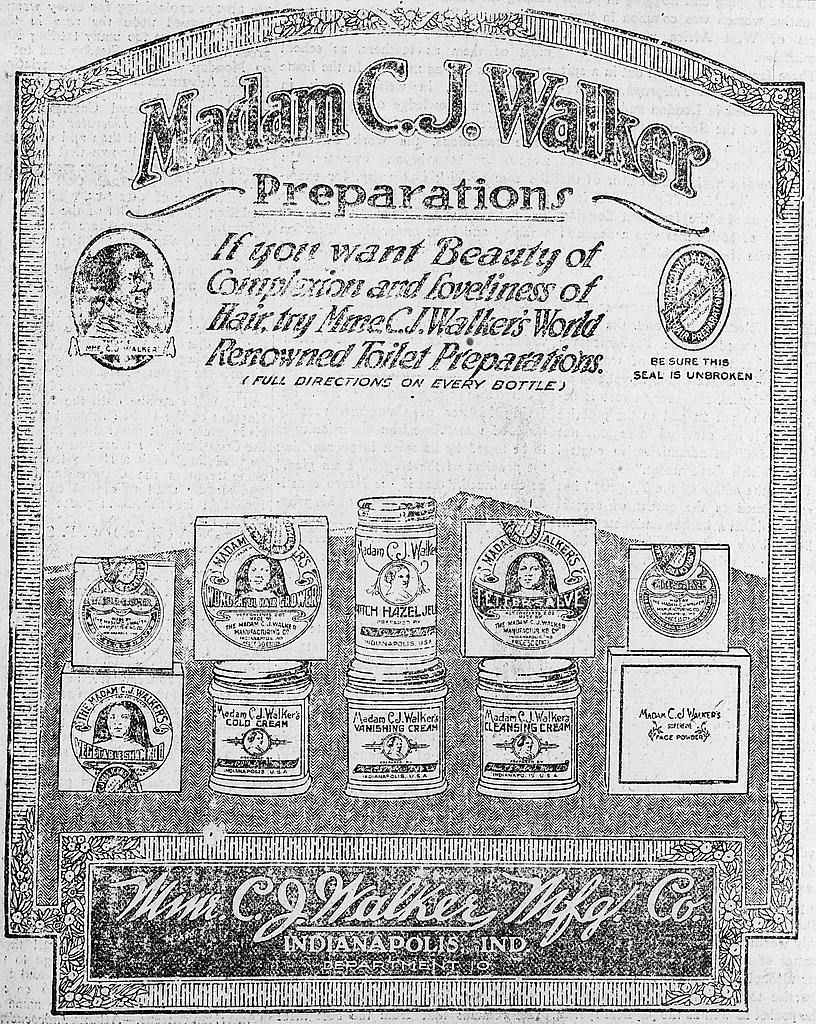
The Library of Congress catalogs a Walker-company advertisement published in The New York Age on January 17, 1920 (LCCN 2002716791; LC-DIG-ppmsca-02902). It supports product marketing and brand continuity after Walker’s death. It does not establish purchases, profits or Walker’s personal action in 1920.
A manufacturing-building photograph identified in the NPS lesson supports the physical Indianapolis enterprise. Its original image and reproduction terms still need reconciliation before BEHI displays it as archival evidence.
Sources and evidence limits: LOC, New York Age advertisement, January 17, 1920 · NPS, Two American Entrepreneurs · IHS, Walker Papers finding aid. Institutional and scholarly interpretation is distinguished from original records; a finding aid identifies a collection or item, not an inspected financial statement.
Accomplishments
TAKEAWAY: Walker’s achievements span enterprise formation, manufacturing, training, and civic support. Corroborated dates, reported quantities, and uninspected archival targets retain separate evidence classifications.
DOCUMENTED ACCOMPLISHMENTS
Madam C.J. Walker’s career represents one of the most thoroughly documented records of Black enterprise in early twentieth-century America. Her achievements span enterprise formation, manufacturing scale, workforce training, national marketing, and civic institution-building.
The Institute distinguishes corroborated chronology from source-derived descriptions and archival targets whose original files remain pending.
From a product to an enterprise
Training
Lelia College opened in Pittsburgh in 1908, giving aspiring hair culturists a place to learn the Walker method.
Production
Her Indianapolis base brought a factory, salon, and training school together by 1910—linking products with instruction and services.
Organization
Local and state agent clubs culminated in a national convention in 1917, connecting business achievement with civic participation.
These milestones show how training, production, and agent organization reinforced one another. Source: A’Lelia Bundles, Madam Walker biography.
ACCOMPLISHMENT LEDGER
Established her enterprise in Denver, Colorado, after prior work as an agent for Annie Turnbo Malone.
Formulated and marketed an original 5-product line centered on scalp care and hair maintenance.
Opened training school in Pittsburgh to prepare Walker hair culturists and agents.
Built manufacturing plant, laboratory, and headquarters; incorporated company in Indiana.
Organized first national convention of agents at Union Baptist Church, Philadelphia, with 200+ attendees.
Reported more than 20,000 individuals trained by Walker and faculty (cumulative network claim).
Established independent corporate ownership and financial control for Black enterprise.
Trained thousands of women to earn incomes beyond domestic servitude.
Operated manufacturing, marketing, and distribution across the United States and parts of the Caribbean.
She did not merely build success for herself—she built a structure other Black women could enter.
ACCOMPLISHMENT CATEGORIES
Transitioned from commission sales agent to independent manufacturer, corporate founder, and business owner.
Established formal educational institutions and curricula to certify beauty culturists and business operators.
Built and operated an industrial manufacturing plant and laboratory in Indianapolis.
Created a nationally recognized brand through Black-press advertising, public appearances, and an agent network.
EVIDENCE SUPPORTING THESE ACCOMPLISHMENTS
| ACCOMPLISHMENT | PRIMARY EVIDENCE | DATE / REPOSITORY | CLASSIFICATION | NOTES |
|---|---|---|---|---|
| Company Incorporation | Articles of Incorporation, Madam C.J. Walker Mfg. Co. | 1911 · Indiana Historical Society, M1250_BV5248 | VERIFIED | Inspected IHS reproductions distinguish execution on September 2, acknowledgment on September 6 and filing on September 19, 1911, and state $10,000 authorized capital. Authorized stock is not paid-in capital or revenue. |
| First National Convention | Official Proceedings & Photographs, Union Baptist Church | August 1917 · Philadelphia, PA | VERIFIED | One of the earliest national gatherings of Black businesswomen. |
| NAACP Anti-Lynching Gift | NAACP Executive Secretary Letter & Minutes | May 10, 1919 · Library of Congress | ATTRIBUTED | $5,000 pledge—largest individual gift to NAACP at that date. |
Sources and evidence limits: Official Walker biographical history · Bundles, 1917 agents’ convention · IHS, Walker Papers finding aid. Institutional and scholarly interpretation is distinguished from original records; a finding aid identifies a collection or item, not an inspected financial statement.
Economic Impact
TAKEAWAY: Company receipts, agents’ income, property, and philanthropy measure different effects. Gross receipts are not profit or Walker’s personal net worth.
ECONOMIC IMPACT
Madam C.J. Walker’s enterprise generated significant, documented economic effects at multiple levels: corporate revenue, household income for Black women, commercial real-estate ownership, and philanthropic capital for civic institutions.
Her company achieved documented gross receipts exceeding $275,000 in 1918 and $486,000 in 1919. More importantly, she established an economic pathway that widened income-producing opportunities through sales and beauty services; individual outcomes varied.
The reported annual total rose by about 76% between these two years. The 1919 total includes business conducted after Walker’s death in May.
Attributed · nominal dollars. Gross receipts measure company sales, not profit, personal wealth, or agent earnings. Figures reported by A’Lelia Bundles from company reports and tax records; the Institute has not inspected those original records. Percentage calculated from the two reported totals.
Company receipts
The chart compares reported annual gross receipts in nominal dollars. These are attributed to Bundles’s archival analysis; BEHI’s independent transcription of the originals remains pending.
Agent earnings
A local agent’s income would require sales, service charges, costs, and commission terms. It cannot be estimated simply by dividing company receipts by the cumulative training figure.
Personal estate
Homes, investments, debts, and company interests require a dated estate reconstruction. The chart’s company sales totals do not establish Walker’s personal net worth.
KEY ECONOMIC INDICATORS
Each measure identifies its entity, period, source and evidence limits. Dollar amounts are nominal historical U.S. dollars. Assets, revenue, profit, transaction amounts and employment measures are distinct. “Not yet established” identifies a research gap, not zero or “not applicable.”
| MEASURE / VALUE | ENTITY / PERIOD | SOURCE / LOCATOR | CONTENT CONDITION / EVIDENCE CLASSIFICATION | INTERPRETATION / LIMITS |
|---|---|---|---|---|
| Gross receipts $275,937.88 | Walker company 1918 | Bundles financial analysis; original company accounts pending. | Documented ATTRIBUTED | Nominal receipts, not profit or personal income. |
| Gross receipts $486,762 | Walker company 1919 | Bundles financial analysis; original company accounts pending. | Documented ATTRIBUTED | Includes operations after Walker’s May 1919 death; not her personal earnings. |
| People trained More than 20,000 | Walker training network Cumulative through 1919 | Company-reported training figure discussed in the profile evidence. | Documented ATTRIBUTED | Cumulative trainees, not simultaneous employees or independently verified jobs. |
| Operating profit Not yet established | Walker company Reporting period not established | Research gap; see Evidence & Context and Receipts. | Not yet established Evidence classification: not assigned to an unresolved answer. | Requires expenses and reconciled accounts; gross receipts cannot establish profit. Research Gap: Operating profit |
For evidence-label definitions, see the Receipts evidence guide.
HOW THE ENTERPRISE GENERATED IMPACT
Targeted overlooked demand for quality scalp and hair products among Black consumers.
Sold branded preparations through direct sales, local agents, and mail order.
Trained thousands of agents through standardized beauty-culture instruction.
Built a multi-city agent and distribution network across multiple states.
Enabled women to earn retail markups, sales commissions, and salon fees.
Established diplomas, uniforms, national conventions, and operating standards.
Reinvested business profits into homeownership, education, and Black civil rights.
Created thousands of opportunities for Black women to earn, support families, and build independent livelihoods.
Established standards for training, business conduct, and customer service that built a respected profession.
Operated in multiple cities and across the nation—demonstrating that Black enterprises could scale.
Walker converted unmet demand into structured economic opportunity—strengthening families, communities, and institutions.
CHANNELS OF ECONOMIC IMPACT
Manufactured and sold hair-care products that generated substantial company revenue documented in 1918 and 1919 records.
Agents earned income through product sales and commissions, creating pathways to economic independence nationwide.
Built manufacturing capacity, managed distribution, and employed factory, laboratory, and clerical staff.
Profits, wages, and purchases were reinvested in homes, churches, schools, and Black-owned institutions.
EVIDENCE SUPPORTING THIS ECONOMIC IMPACT
| INDICATOR | NOMINAL AMOUNT | PERIOD | CLASSIFICATION | HISTORICAL INTERPRETATION |
|---|---|---|---|---|
| Cumulative business receipts | $63,049 | 1912 | ATTRIBUTED | Walker’s convention statement; not an independently audited annual figure. |
| Company gross receipts | $275,937.88 | 1918 | ATTRIBUTED | Nominal historical gross receipts; not net profit. A modern purchasing-power comparison is withheld pending documented calculation inputs. |
| Company gross receipts | $486,762 | 1919 | ATTRIBUTED | Nominal historical gross receipts for the year of the founder’s death; includes posthumous company operations. A modern purchasing-power comparison is withheld pending documented calculation inputs. |
| NAACP anti-lynching pledge | $5,000 | 1919 | ATTRIBUTED | Reported as the largest individual pledge at that date; the original letter and payment evidence remain pending. |
| Reported trained agents | 20,000+ | by 1919 | ATTRIBUTED | Cumulative company claim regarding vocational instruction, not simultaneous payroll. |
EXPANDED ECONOMIC EVIDENCE LEDGER
| YEAR | MEASURE | NOMINAL AMOUNT | CLASSIFICATION | LIMIT |
|---|---|---|---|---|
| 1912 | Cumulative business receipts reported by Walker | $63,049 | ATTRIBUTED | Self-report discussed by NPS; not independently audited annual revenue. |
| 1918 | Company gross receipts | $275,937.88 | ATTRIBUTED | Published by Bundles from archival records; exact original pending. |
| 1919 | Company gross receipts | $486,762 | ATTRIBUTED | Year of founder’s death; gross receipts are not profit. |
| 1920 | Posthumous company gross receipts | $595,353 | ATTRIBUTED | Company performance after Walker’s death; original pending. |
| 1919 | Personal-assets estimate | $600,000–$700,000 | ESTIMATED | Bundles’s biographical estimate; not a preserved estate inventory or audited net worth. |
| 1919 | Hypothetical company sale value | $1–$2 million | ESTIMATED | Later business-historian estimate relayed by Bundles; no actual sale or preserved valuation methodology. |
| 1919 | NAACP anti-lynching pledge | $5,000 | ATTRIBUTED | Original Shillady letter and payment evidence remain distinct research targets. |
Personal assets, company value, revenue, profit, pledges and cash payments are different measures. They must not be added together without reconciling ownership and double counting.
AGENT TESTIMONY & ECONOMIC OPPORTUNITY
The NPS lesson reproduces a 1913 agent’s comparison of Walker work with other available employment and discusses uses of earnings for homes, education and community support. This is attributed testimony, not a uniform wage schedule or guaranteed result for every agent.
Purchasing-power note: This section presents nominal historical dollars. Earlier rounded modern equivalents have been withheld pending documentation of the price index, base years and calculation. Purchasing-power comparisons would not measure present company value.
Sources and evidence limits: A’Lelia Bundles, financial analysis · NPS, Two American Entrepreneurs. Institutional and scholarly interpretation is distinguished from original records; a finding aid identifies a collection or item, not an inspected financial statement.
Timeline
TAKEAWAY: The chronology connects Walker’s early work with enterprise formation and expansion. Each milestone should be read with the source supporting its date and significance.
TIMELINE OF ENTERPRISE & IMPACT
This timeline traces Madam C.J. Walker's journey from early life and labor to the formation of a Black-owned enterprise that scaled nationally and left a documented economic legacy.
Each milestone reflects verifiable steps in her personal and professional life, including enterprise formation, infrastructure development, and measurable financial results.
The record below is built from primary sources, contemporaneous documents, and scholarly analysis—organized to show growth, resilience, and economic impact over time.
The enterprise takes shape
- 1906Independent business
Walker establishes her own hair-care enterprise.
- 1908Pittsburgh
Lelia College adds a dedicated training base.
- 1910Indianapolis
Factory, salon, and school support expansion.
- 1913Harlem
A’Lelia develops the New York salon presence.
- 1917Philadelphia
Agents gather for a national convention.
- 1919Continuity
Walker dies May 25; the company continues.
Chronological overview drawn from A’Lelia Bundles, Madam Walker biography. Detailed records and evidence classifications follow below.
Moved from plantation sharecropping to industrial manufacturing owner.
Created permanent schools, factories, and national distribution channels.
The record includes inspected corporate filings; exact annual-receipt records and individual property instruments remain separate research targets.
The timeline shows that Walker's legacy was built step by step—turning lived experience into scalable enterprise.
PHASES OF DEVELOPMENT
1867–1880s: Emancipation, childhood labor, and family roots in Louisiana.
1880s–1905: Laundress labor in St. Louis, church networks, and Poro agency.
1905–1911: Denver launch, Lelia College Pittsburgh, and Indianapolis incorporation.
1912–1919: National agent conventions, Villa Lewaro, and NAACP leadership.
EVIDENCE SUPPORTING THIS TIMELINE
| PERIOD | MILESTONE EVENT | PRIMARY RECORD & REPOSITORY | CLASSIFICATION | NOTES |
|---|---|---|---|---|
| 1867 | Birth in Delta, Louisiana | U.S. Federal Census & Family Records | VERIFIED | First child in family born after emancipation. |
| 1911 | Incorporation in Indiana | Articles of Incorporation · Indiana Historical Society, M1250_BV5248 | VERIFIED | 1911 incorporation is supported by inspected reproductions from IHS volume M1250_BV5248; selected articles and filing endorsements appear in Receipts. |
| 1917 | First National Agent Convention | Convention Minutes · Union Baptist Church, Philadelphia | VERIFIED | Gathering of 200+ agents passing anti-lynching resolution. |
| 1918 | Completion of Villa Lewaro | HABS NY-5618 · National Park Service | VERIFIED | Designed by Vertner Tandy, NY’s 1st licensed Black architect. |
ADDITIONAL CHRONOLOGICAL CONTEXT
1912: NPS discusses Walker’s NNBL intervention and reported business receipts. 1913: The controlling research records expansion travel to Cuba, Panama, Jamaica, Costa Rica and Haiti; travel does not establish a foreign-sales total. 1920: The company’s advertisement and reported gross receipts belong to posthumous operations. 1927: The Walker Building opened after the founder’s death.
Sources and evidence limits: NPS, Two American Entrepreneurs · Official Walker biographical history · A’Lelia Bundles, financial analysis · LOC, New York Age advertisement, January 17, 1920. Institutional and scholarly interpretation is distinguished from original records; a finding aid identifies a collection or item, not an inspected financial statement.
No verified records are currently published in this category.
Myths & Disputes
TAKEAWAY: Walker’s contribution was organizing and expanding a commercial system; direct selling existed before her. Broader priority and wealth claims require their own evidence.
MYTHS & DISPUTES
Madam C.J. Walker's importance is real, documented, and undeniable. Yet parts of her public story have been simplified, overstated, or repeated without proper evidence.
At BEHI, we distinguish verified facts, attributed claims, disputed claims, estimated claims, and institute analysis so her legacy stands on accuracy—not exaggeration.
Clarifying the record does not diminish Walker. It reveals the true scale, strategy, and impact of what she actually built.
A claim-check map for Walker’s achievement
Sources: Smithsonian, Walker and Malone, Walker biographical history, Bundles’s financial analysis, and NPS institutional history. This chart preserves the profile’s corrections and research gaps rather than replacing the existing classifications with a blanket certainty label.
We commit to facts over folklore. Honoring primary sources protects Walker’s legacy and the integrity of history.
Even without overstatements, Walker built a nationwide brand, trained thousands, created wealth, and opened doors for generations.
Correcting myths strengthens public trust and ensures BEHI remains a credible, accountable steward of Black economic history.
Correcting the record does not diminish Walker — it clarifies the scale of what she truly built.
COMMON SOURCES OF CONFUSION
Complex histories get reduced to simple, catchy phrases that spread across popular media without primary source context.
Dramatic quotes and statistics are repeated across internet outlets without returning to the original business ledgers.
Cumulative network training figures (20,000+) are often mistaken for simultaneous full-time corporate payroll employees.
Creating commercial systems and scaling existing models is misread as "inventing" the hair products or direct selling.
QUALIFIED CLAIMS & SOURCE CONTROLS
Walker did not invent Black hair care, the hot comb, chemical permanents or direct selling. Her contribution was developing and scaling an enterprise within an existing business ecosystem.
She is widely recognized as America’s first self-made woman millionaire. That formulation requires valuation context: the personal-assets estimate and later hypothetical company value are separate estimates, not an independently reconciled net-worth total.
Any dream-origin account should be attributed to Walker, rather than treated as independently verifiable product-development evidence. Netflix’s Self Made is dramatization and must not serve as historical proof.
Sources and evidence limits: Smithsonian, Walker and Malone · Hagley, early Avon history · A’Lelia Bundles, financial analysis · Official Walker history and myth corrections. Institutional and scholarly interpretation is distinguished from original records; a finding aid identifies a collection or item, not an inspected financial statement.
Claim Review & Corrections
| CLAIM / ASSERTION | HISTORICAL CLARIFICATION & CORRECTION | CLAIM STATUS | RECEIPT |
|---|---|---|---|
|
◆
Sarah Breedlove Birth and Family Background
“Sarah Breedlove was born December 23, 1867, in Delta, Louisiana, and was the first Breedlove child born after emancipation.”
|
Bounded research claim from identified institutional or scholarly sources. Original-image custody and reproduction rights are separate. |
Verified | Analysis Note |
|
◆
Annie Turnbo Malone / Poro Ecosystem Predecessor
“Sarah used Annie Turnbo Malone’s products, received instruction connected to Poro, and worked as a Poro sales agent before establishing her own line.”
|
Bounded research claim from identified institutional or scholarly sources. Original-image custody and reproduction rights are separate. |
Verified | Analysis Note |
|
◆
Independent Hair-Care Enterprise Founded in Denver (1906)
“Walker founded an independent hair-care enterprise in Denver in 1906 after prior work as an Annie Turnbo Malone/Poro agent.”
|
Bounded research claim from identified institutional or scholarly sources. Original-image custody and reproduction rights are separate. |
Verified | Analysis Note |
|
◆
Original Five-Product Line Developed and Marketed
“Walker developed and marketed an original five-product line centered on scalp care, cleansing, and hair maintenance.”
|
Bounded research claim from identified institutional or scholarly sources. Original-image custody and reproduction rights are separate. |
Verified | Analysis Note |
|
◆
Lelia College Opened in Pittsburgh (1908)
“Walker opened Lelia College in Pittsburgh in 1908 to train Walker hair culturists and agents.”
|
Bounded research claim from identified institutional or scholarly sources. Original-image custody and reproduction rights are separate. |
Verified | Analysis Note |
|
◆
Indianapolis Headquarters Established & 1911 Incorporation
“Walker established Indianapolis operations in 1910 with manufacturing, laboratory, salon, and training functions; the company was incorporated in Indiana in 1911.”
|
Bounded research claim from identified institutional or scholarly sources. Original-image custody and reproduction rights are separate. IHS, Walker Papers finding aid Receipts → Documents: Walker corporate volume — selected archival pages — preview, full file, citation, evidence classification and rights. Read the document’s limits before applying it to this claim. |
Verified | |
|
◆
National Agent and Distribution Network Scaled
“Walker built a national agent and customer network supported by Black-press advertising, demonstrations, mail order, and professional training.”
|
Bounded research claim from identified institutional or scholarly sources. Original-image custody and reproduction rights are separate. NPS, Two American Entrepreneurs Receipts → Documents: Walker-company advertisement, 1920 — preview, full file, citation, evidence classification and rights. Read the document’s limits before applying it to this claim. |
Verified | |
|
◆
Caribbean and Central American Business Expansion (1913)
“Walker expanded business activity into parts of Central America and the Caribbean by 1913, including Cuba, Panama, Jamaica, Costa Rica, and Haiti.”
|
Bounded research claim from identified institutional or scholarly sources. Original-image custody and reproduction rights are separate. |
Verified | Analysis Note |
|
◆
First National Convention of Walker Agents (Philadelphia, 1917)
“Walker hosted the first national convention of Walker agents and beauty culturists at Union Baptist Church in Philadelphia on August 30–31, 1917, with more than 200 attendees.”
|
Bounded research claim from identified institutional or scholarly sources. Original-image custody and reproduction rights are separate. |
Verified | Analysis Note |
|
◆
20,000+ Agents Trained Cumulative Claim
“By 1919, Walker claimed that she and her teaching faculty had trained more than 20,000 Walker agents.”
|
Cumulative company-reported training claim, not simultaneous employees; original 1919 statement pending. |
Attributed | Analysis Note |
|
◆
1918 Documented Company Gross Receipts — $275,937.88
“Company gross receipts for 1918 were $275,937.88.”
|
Reported by Bundles from annual reports/tax records. Exact underlying original, item locator and independent transcription remain pending; gross receipts are not profit. |
Attributed | |
|
◆
1919 Documented Company Gross Receipts — $486,762
“Company gross receipts for 1919 were $486,762.”
|
Reported by Bundles from annual reports/tax records. Exact underlying original, item locator and independent transcription remain pending; gross receipts are not profit. |
Attributed | |
|
◆
1920 Posthumous Company Gross Receipts — $595,353
“Company gross receipts for 1920 were $595,353 under posthumous management.”
|
Reported by Bundles from annual reports/tax records. Exact underlying original, item locator and independent transcription remain pending; gross receipts are not profit. |
Attributed | |
|
◆
Estimated Personal Assets at Death ($600,000–$700,000)
“Walker’s personal assets at death were estimated at $600,000–$700,000.”
|
This is Bundles’s biographical personal-assets estimate, not a total transcribed from a preserved estate inventory. Estate assets, debts and ownership still require reconciliation. |
Estimated | Analysis Note |
|
◆
Estimated Company Potential Sale Value ($1–$2 Million)
“Later business analysis placed the company’s potential sale value around Walker’s death between $1 million and $2 million.”
|
Retrospective hypothetical company-sale estimate relayed by Bundles. It is not an actual sale price, and the underlying valuation methodology remains pending. |
Estimated | Analysis Note |
|
◆
$5,000 NAACP Anti-Lynching Campaign Pledge (1919)
“Walker pledged $5,000 to the NAACP anti-lynching campaign in 1919, the largest individual gift the association had received to that date.”
|
Institutional and scholarly accounts support the pledge. Original Shillady letter and evidence of payment are separate acquisition targets. |
Attributed | Analysis Note |
|
◆
Will Provision Directing Two-Thirds Net Profits to Charity
“Walker’s will directed two-thirds of future net profits to charitable causes.”
|
Institutional accounts corroborate a future-profits charitable provision. Original will and exact legal scope remain pending. |
Attributed | Analysis Note |
|
◆
Villa Lewaro Commissioned and Completed (1918)
“Villa Lewaro was completed in 1918 and designed by Vertner Woodson Tandy, New York’s first licensed Black architect; it later became a National Historic Landmark.”
|
Bounded research claim from identified institutional or scholarly sources. Original-image custody and reproduction rights are separate. |
Verified | Analysis Note |
|
◆
Myth Correction: Did Walker Invent Direct Selling? (No)
“Walker did not invent direct selling; the California Perfume Company used a national primarily female direct-sales network beginning in 1886.”
|
Bounded research claim from identified institutional or scholarly sources. Original-image custody and reproduction rights are separate. |
Verified | Analysis Note |
|
◆
Myth Correction: Hot Comb / Hair Straightening (No)
“Walker did not invent Black hair care, the hot comb, chemical permanent, or the broader practice of hair straightening.”
|
Bounded research claim from identified institutional or scholarly sources. Original-image custody and reproduction rights are separate. |
Verified | Analysis Note |
|
◆
Millionaire Designation: Qualified Historical Formulation
“Walker is widely recognized as America’s first self-made woman millionaire, but BEHI does not use the unqualified phrase “the first Black female millionaire.””
|
Bounded research claim from identified institutional or scholarly sources. Original-image custody and reproduction rights are separate. |
Disputed | Analysis Note |
|
◆
Walker Clubs Functioned as Civic Infrastructure
“Walker clubs and conventions functioned as civic infrastructure by connecting commercial organization with philanthropy, political education, and anti-lynching advocacy.”
|
BEHI Institute Analysis. Economic opportunity does not imply guaranteed earnings or universal outcomes. |
Institute Analysis | Analysis Note |
|
◆
Widened Income Opportunities for Black Women
“The Walker network widened income-producing opportunities for Black women through commissioned sales, beauty services, and small-business ownership.”
|
BEHI Institute Analysis. Economic opportunity does not imply guaranteed earnings or universal outcomes. |
Institute Analysis | Analysis Note |
|
◆
Netflix Series “Self Made” (2020) Is Popular Culture
“The 2020 Netflix limited series Self Made is a dramatization and should not be used as historical evidence.”
|
Bounded research claim from identified institutional or scholarly sources. Original-image custody and reproduction rights are separate. |
Verified | Analysis Note |
Legacy
TAKEAWAY: Walker’s legacy combines business ownership, professional training, and civic investment. Its significance can be assessed without relying on a personal-wealth ranking.
LEGACY
Madam C.J. Walker’s legacy extends far beyond the hair-care products she created. She built an enterprise model that proved Black women could own, operate, and scale successful commercial corporations in the face of severe Jim Crow barriers. She created professional livelihoods for thousands, invested in education and community institutions, shaped beauty culture as a recognized profession, and used her wealth for civic good.
Her legacy lives in the enterprises she inspired, the pathways she opened, and the institutions and communities that continue to carry forward her example.
Four records of a legacy that continued after 1919
Professional enterprise
The combination of instruction, products, and services created a model for local commercial work. Its significance can be assessed separately from a personal-wealth ranking.
Organized civic participation
The 1917 convention belongs to the history of agents acting collectively. Their professional and civic roles deserve attention alongside the founder’s contributions.
Buildings & later stewardship
Villa Lewaro and the 1927 Walker Building preserve different histories. The latter belongs to posthumous company and institutional leadership, rather than an action Walker personally completed.
An archive that enables scrutiny
Correspondence and company records allow later researchers to test the story. Preservation supports both recognition and correction as more original documents are examined.
Sources: Bundles’s convention account, NPS institutional history, and IHS Walker Papers finding aid. BEHI interpretation: a lasting institution includes successor generations. Reported charitable provisions retain their attribution until the original will and exact legal scope are inspected.
“I had to make my own living and my own opportunity—but I made it! Don’t sit down and wait for the opportunities to come.”
— Madam C.J. Walker
ENDURING LEGACY
Proved that Black women could lead corporate manufacturing and national sales.
Trained thousands of women to earn incomes beyond domestic servitude.
Established beauty services as a respected, credentialed commercial discipline.
Scaled operations multi-city and multi-state with documented revenue exceeding $486,000.
Institutional accounts report a future-profits charitable provision; the original will and exact legal scope remain pending.
Provided the enduring blueprint for Black consumer enterprise and institutional patronage.
Proved that Black women could own, control, and profit from their own enterprises at a time when such opportunities were denied.
Created thousands of economic pathways through training, sales opportunities, and leadership development.
Her investment in schools, clubs, and organizations strengthened Black communities and built permanent infrastructure.
Set a precedent for Black economic self-determination and demonstrated what was possible for generations to come.
Her legacy is not only what she built—it is what she made possible.
CHANNELS OF LEGACY
Developed a replicable model of Black entrepreneurship that demonstrated scalability, branding, distribution, and customer loyalty.
Built a professional sales and training system that created careers, not just individual sales transactions.
Helped reshape beauty standards and elevated Black beauty culture as professional, modern, and aspirational.
Reinvested in communities through philanthropy, education, and active support for social and civic institutions.
EVIDENCE SUPPORTING THIS LEGACY
| LEGACY ELEMENT | ARCHIVAL EVIDENCE | DATE / REPOSITORY | CLASSIFICATION | NOTES |
|---|---|---|---|---|
| Villa Lewaro Estate | Historic American Buildings Survey (HABS NY-5618) | 1918 · National Park Service / LOC | ATTRIBUTED | National Historic Landmark (1976); designed by Vertner Tandy. |
| Walker Building Headquarters | Architectural drawings and corporate dedications | 1927 · Indiana Historical Society | ATTRIBUTED | Posthumous center in Indianapolis containing theater and offices. |
| Philanthropic Bequests | Last Will and Testament of Madam C.J. Walker | May 1919 · New York County Surrogate Court | ATTRIBUTED | Institutional accounts report a two-thirds future-profits provision; inspect the original will before stating its exact legal scope. |
CAPITAL, GIVING & CONTINUITY
The earlier research includes a reported $1,000 contribution toward the Indianapolis Black YMCA. Its institutional account should be distinguished from an inspected payment instrument. The future-profits charitable provision is corroborated in institutional histories, but the original will and its exact legal scope remain to be acquired.
Posthumous company management and the 1927 Walker Building are part of the institution’s later history. They should not be treated as actions personally performed by Walker after 1919.
Sources and evidence limits: LOC, From Rags to Riches · NPS, Two American Entrepreneurs · LOC, Villa Lewaro HABS NY-5618. Institutional and scholarly interpretation is distinguished from original records; a finding aid identifies a collection or item, not an inspected financial statement.
Company Records
TAKEAWAY: The record inventory separates inspected material, reported financial findings, and archival targets. A collection citation does not establish custody or inspection of its underlying originals.
COMPANY RECORDS
This catalog distinguishes located archival targets, institutional descriptions and reported financial figures. Original-file custody is recorded separately.
A collection citation or source-derived catalog description does not establish that BEHI holds the underlying original. Pending scans are not offered as authentic document downloads.
Walker–Ransom letter: property, printing, and product packaging
Reports & Correspondence — primary-source scans inspected. The heading appears to read Springfield, Massachusetts, June 18, 1916; repository confirmation of the date and preferred citation remains outstanding.
- Property strategy: Walker discusses a proposed exchange of Indianapolis property for New York houses and favors retaining the lot because she expects its business-zone location to increase its value.
- Printing and publishing: She expresses interest in the Colored American Review and considers a printing establishment that could produce the magazine, undertake outside job printing, and print her company's literature.
- Operating expenditures: She describes her own literature as amounting to several thousand dollars per year. This is her contemporaneous statement, not an audited expenditure total.
- Product packaging: The postscript proposes paper wrappers to discourage agents from refilling boxes; it documents a proposed control, not verified implementation.
Evidence limit: The letter documents deliberation and proposed actions. It does not establish that the property exchange, printing establishment, magazine investment, or packaging change was completed.
Completeness: The supplied PDF contains five images bearing handwritten page numbers 1–4 and 7. Pages 5–6 appear absent, and page 4 ends mid-sentence. Whether additional pages survive remains unresolved.
Source: Indiana Historical Society, Walker–Ransom letter; image identifier M0399_BOX1_FOLDER4_009, supplied images 001–005. View repository record. Reviewed October 26, 2026.
Selected original corporate exhibits
Four representative documents from the digitized bound volume. The Receipts tab contains all nine image receipts and the complete page-level verification register.
Verified original company-record pages — M1250
BEHI visually examined a 98-page low-resolution scan of the Indiana Historical Society digitized bound volume M1250_BV5248.pdf. The page numbers below refer to the PDF scan index, confirmed against each image's printed archival footer. Images have been cleared for low-resolution use on this website; the complete nine-image set is displayed only in Receipts → Documents; this tab links to that document home. The original repository holds the archival volume; BEHI preserves a digital research copy.
| Archival page | Record | Finding and limit |
|---|---|---|
| M1250_BV5248_007 | 1911 Articles of Incorporation, opening page | Company purposes; $10,000 authorized stock (1,000 shares at $10); authorization is not revenue or paid-in capital. |
| M1250_BV5248_008 | 1911 Articles of Incorporation, continuation | Original directors and September 2 execution; execution and filing dates differ. |
| M1250_BV5248_017 | Typewritten copy of 1911 Articles | Marked filed September 19, 1911; typed copy supports comparison with handwritten instrument. |
| M1250_BV5248_018 | August 20, 1912 Walker agreement | Documents agreed business-interest and noninterference terms and a proposed $500 payment; performance or payment not verified. |
| M1250_BV5248_019 | August 20, 1912 C. J. Walker letter | Signed tender of resignation as company secretary; date of formal acceptance separately unverified. |
| M1250_BV5248_020 | January 1913 first directors' minutes | Early directors and officer appointments; not proof of share ownership or compensation amounts. |
| M1250_BV5248_094 | 1961 Secretary of State certification | State certification of copies of the 1911 articles and later amendment; certification issued decades afterward. |
| M1250_BV5248_095 | Certified-copy 1911 Articles | Reproduces the corporate articles and signatures; not a separate original 1911 filing. |
| M1250_BV5248_096 | Acknowledgments and filing endorsement | Distinguishes execution (Sept. 2), acknowledgment (Sept. 6), and filing (Sept. 19, 1911). |
Required image credit: Madam C.J. Walker Supplemental Collection, Indiana Historical Society. View the digital volume at Indiana Historical Society. Permission for website use does not itself verify the accuracy of every claim, nor does it grant a general right to reuse images in documentaries or curriculum.
Eight categories, connected evidence questions
Formation & ownership
Incorporation and Legal & Regulatory records should identify the company, amendments, ownership, and obligations. A collection description is a locator; the original instrument supplies legal terms.
Receipts & expenses
Financial and Ledgers & Accounts records should reconcile annual totals with transactions, taxes, costs, and bank records. Reported gross receipts alone cannot establish net profit.
Production & distribution
Operational and Contracts & Transactions material can connect manufacturing, agent orders, training, premises, and service. Output, payroll, and commissions require date-specific records.
Rights & correspondence
IP and Reports & Correspondence material can distinguish brand rights, promotional claims, and internal decisions. Advertisements show offers; letters and accounts can establish execution.
BEHI evidence map using the permanent eight-category framework. Primary route: IHS Walker Papers finding aid; reported finances: Bundles’s financial analysis. The catalog below retains its custody notes and excludes placeholder downloads. Collection dates extending beyond 1919 include later management and preservation history.
1911 corporate records — digitized source and website-image clearance
Indiana Historical Society's Madam C.J. Walker Supplemental Collection identifies the digitized bound volume Articles of Incorporation, Capital Stock, and Minutes for the Madam C.J. Walker Manufacturing Company, 1911–1947 (M1250; M1250_BV5248.pdf). Examine the repository record. These documents are source material for the Incorporation, Financial, and Reports & Correspondence categories; selected page-level findings are documented in the Receipts verification register. Pages not included in that review remain uninspected; the volume is not a verified annual financial series.
Use status: October 14, 2026 written authorization confirms selected low-resolution pages may appear on BEHI's website with the exact credit Madam C.J. Walker Supplemental Collection, Indiana Historical Society and a link back to the collection. High-resolution scans may require a separate contract and use fee. Four selected verified images are now embedded in Company Records; all nine page images are available in Receipts.
| RECORD | DATE | SOURCE PATH | CUSTODY | LIMIT |
|---|---|---|---|---|
| 1914 National Negro Business League Remarks | 1914 | NPS, Two American Entrepreneurs | Original scan pending; placeholder excluded | Source interpretation or locator; precise original language requires inspection. |
| Madam C.J. Walker Papers, 1910–1980 | 1910–1980 | IHS, Walker Papers finding aid | Finding aid; collection-level description | Source interpretation or locator; precise original language requires inspection. |
| First National Convention Press Releases and Resolutions (1917) | August 30–31, 1917 | IHS, Walker Papers finding aid | Original scan pending; placeholder excluded | Source interpretation or locator; precise original language requires inspection. |
| Villa Lewaro HABS Architectural Documentation | 1918 / 1976 | LOC, Villa Lewaro HABS NY-5618 | Original scan pending; placeholder excluded | Later survey of 1918 property, not a contemporaneous deed. |
| John R. Shillady Letter Confirming $5,000 NAACP Pledge (May 10, 1919) | May 10, 1919 | A’Lelia Bundles, financial analysis | Original scan pending; placeholder excluded | Source interpretation or locator; precise original language requires inspection. |
| 1918 Annual Report / Tax Record — $275,937.88 Gross Receipts | 1918 | A’Lelia Bundles, financial analysis | Original scan pending; placeholder excluded | Gross receipts reported by Bundles; not independent transcription. |
| 1919 Annual Report / Tax Record — $486,762 Gross Receipts | 1919 | A’Lelia Bundles, financial analysis | Original scan pending; placeholder excluded | Gross receipts reported by Bundles; not independent transcription. |
| 1920 Annual Report / Tax Record — $595,353 Posthumous Receipts | 1920 | A’Lelia Bundles, financial analysis | Original scan pending; placeholder excluded | Gross receipts reported by Bundles; not independent transcription. |
| Madam C.J. Walker Last Will & Testament (1919) | 1919 | NPS, Two American Entrepreneurs | Original scan pending; placeholder excluded | Source interpretation or locator; precise original language requires inspection. |
| Madam C.J. Walker Manufacturing Company Incorporation Record (1911) | 1911 | IHS corporate-volume evidence; collection finding aid | Selected reproduced pages inspected; see Receipts | Verified for the selected incorporation pages and filing endorsements; complete volume transcription and financial claims remain separate. |
| New York Age Walker advertisement | January 17, 1920 | LOC, New York Age advertisement, January 17, 1920 | LOC catalog identified; original master pending ingestion | Posthumous marketing, not verified purchases or profits. |
ARCHIVAL CERTIFICATION & PUBLIC RECORD INTEGRITY
All company records presented in this repository have been cataloged according to the BEHI Company Records Classification System. Documents marked as Primary Sources are drawn from certified state and county archives, corporate filings, and recognized institutional repositories. Where physical scans are currently in the acquisition pipeline, verified archival metadata, source citations, and holding locators are provided to facilitate scholarly research.
| Document & ID | Evidence Type | Date | Description & Location | Source Repository | Action |
|---|---|---|---|---|---|
|
1914 National Negro Business League Remarks
BEHI-P001-MCJW-REC001-REVIEW
Madam C.J. Walker
|
Repository Authority
Publications & Press Releases · Reports & Correspondence
|
1914 |
Institutional/source-derived description of an archival target; original scan pending.
|
Library of Congress, Rare Book and Special Collections Division / HABS
NNBL 1914 Convention Proceedings / LOC Educational Archive
|
|
|
Madam C.J. Walker Papers, 1910–1980
BEHI-P001-MCJW-REC002-REVIEW
Madam C.J. Walker Manufacturing Company
|
Finding Aid
Business Reports · Reports & Correspondence
|
1910–1980 |
Institutional/source-derived description of an archival target; original scan pending.
|
Indiana Historical Society
M 0399; OMB 0022; BV 2667–2678; addition M 1250
|
|
|
First National Convention Press Releases and Resolutions (1917)
BEHI-P001-MCJW-REC003-REVIEW
Madam C.J. Walker / National Walker Agents
|
Repository Authority
Business Operations · Operational
|
August 30–31, 1917 |
Institutional/source-derived description of an archival target; original scan pending.
|
Indiana Historical Society
M 0399, Box 12, Folder 1
|
|
|
Villa Lewaro HABS Architectural Documentation
BEHI-P001-MCJW-REC004-REVIEW
Villa Lewaro
|
Repository Authority
Ownership & Property · Property Records
|
1918 / 1976 |
Official later historic-property documentation; selected original file pending.
|
Library of Congress, Rare Book and Special Collections Division / HABS
HABS NY-5618
|
|
|
John R. Shillady Letter Confirming $5,000 NAACP Pledge (May 10, 1919)
BEHI-P001-MCJW-REC005-REVIEW
NAACP / Madam C.J. Walker
|
Repository Authority
Correspondence · Reports & Correspondence
|
May 10, 1919 |
Institutional/source-derived description of an archival target; original scan pending.
|
National Association for the Advancement of Colored People Records, Library of Congress
NAACP Papers — correspondence / pledge materials
|
|
|
1918 Annual Report / Tax Record — $275,937.88 Gross Receipts
BEHI-P001-MCJW-REC006-REVIEW
Madam C.J. Walker Manufacturing Company
|
Repository Authority
Financial · Financial Statements
|
1918 |
Reported gross receipts from published archival analysis; exact underlying original and transcription pending.
|
Indiana Historical Society
Walker Manufacturing Company records (financial / tax)
|
|
|
1919 Annual Report / Tax Record — $486,762 Gross Receipts
BEHI-P001-MCJW-REC007-REVIEW
Madam C.J. Walker Manufacturing Company
|
Repository Authority
Financial · Financial Statements
|
1919 |
Reported gross receipts from published archival analysis; exact underlying original and transcription pending.
|
Indiana Historical Society
Walker Manufacturing Company records (financial / tax)
|
|
|
1920 Annual Report / Tax Record — $595,353 Posthumous Receipts
BEHI-P001-MCJW-REC008-REVIEW
Madam C.J. Walker Manufacturing Company
|
Repository Authority
Financial · Financial Statements
|
1920 |
Reported gross receipts from published archival analysis; exact underlying original and transcription pending.
|
Indiana Historical Society
Walker Manufacturing Company records (posthumous revenue)
|
|
|
Madam C.J. Walker Last Will & Testament (1919)
BEHI-P001-MCJW-REC009-REVIEW
Estate of Madam C.J. Walker
|
Repository Authority
Estate & Testamentary · Ownership & Property
|
1919 |
Institutional/source-derived description of an archival target; original scan pending.
|
U.S. National Park Service, Historic Preservation and Landmark Documentation
Estate records / testamentary trust documentation
|
|
|
Madam C.J. Walker Manufacturing Company Incorporation Record (1911)
BEHI-P001-MCJW-REC010-REVIEW
Madam C.J. Walker Manufacturing Company
|
Repository Authority
Formation & Governance · Incorporation
|
1911 |
Selected incorporation pages in the Indiana Historical Society’s digitized corporate volume M1250_BV5248 have been inspected and are disp...
|
Indiana Secretary of State / Corporate Filings Archives
Corporate filing / articles of incorporation 1911
|
|
|
Walker-company advertisement — The New York Age, January 17, 1920
BEHI-P001-MCJW-AD1920-REVIEW
Madam C.J. Walker Manufacturing Company
|
Repository Authority
Advertising · Operational
|
January 17, 1920 |
LCCN 2002716791; LC-DIG-ppmsca-02902
|
No verified records are currently published in this category.
Receipts
TAKEAWAY: Follow Walker’s claims through the documents and source register, then consult the gaps and updates. Evidence classifications apply to specific findings, not the entire profile.
RECEIPTS & EVIDENCE
HOW TO READ THE EVIDENCE
Follow the claim to its source, then read the evidence status and limits. A source may support one narrow fact while leaving a larger conclusion unresolved.
Content condition describes whether the question can currently be answered. Evidence classification describes the support for a documented finding.
- Documented: A finding is presented with its source, evidence classification and limits. Documented does not automatically mean Verified.
- Not yet established: The answer remains unresolved. The entry identifies missing evidence and connects to Research Gaps.
- Not applicable: The measure does not fit the person or enterprise being examined; an explanation must state why. Missing evidence alone never makes a question not applicable.
Shared section headings remain visible. Relevance that is uncertain is treated as Not yet established until resolved.
Evidence labels and source access
- Verified
- The specific fact or record described has been checked against the cited material. Read the limit: an inspected reproduction, index or catalog entry does not mean every underlying document or broader claim has been verified.
- Attributed
- The statement is credited to the named source. Independent confirmation or the underlying original may still be outstanding.
- Disputed
- Sources or interpretations conflict. Read the competing evidence and the unresolved question.
- Estimated
- The figure is an approximation or qualified valuation, not an exact measured total. Read its basis, date and uncertainty.
- Institute Analysis
- BEHI’s interpretation or calculation from identified evidence. It is separate from what the historical source directly states.
Source access: A link may lead to an original scan, a published transcription, a finding aid, or a repository page. Use the source ID, collection, box, folder and page locator where supplied. A catalog listing or repository confirmation is not inspection of the item itself.
Images and permissions: Historical support and reproduction permission are separate questions. Read each image credit and rights note; a source link does not itself grant permission to republish.
Open questions: See Research Gaps & Open Questions below for missing records and unresolved claims.
The Receipts Layer is BEHI's evidence-verification system. Historical claims are connected to the strongest available evidence, including primary archival records, contemporary sources, authoritative repositories, secondary scholarship, and Institute analysis. Each claim is classified according to the strength and type of evidence currently available.
Select any claim below to inspect supporting receipts, evidence type, repository locators, citations, and claim status.
DOCUMENTS
Walker-company advertisement — January 17, 1920
Walker-company advertisement, 1920
Readable text — Selected transcription and image description
Madam C. J. Walker Preparations
The advertisement pictures labeled hair and skin-care products and identifies the company in Indianapolis, Indiana. The product display includes hair grower, shampoo, salve, creams and face powder.
Heading transcribed; product display summarized. Small-print instructions and promotional claims are omitted. This is a 1920 company advertisement published after Walker’s death, not independent verification of product efficacy or sales. Checked against the source images by BEHI, October 28, 2026.
Preview: Supplied document image; see citation for coverage.
Full file: Open full-size file
Evidence classification: Contemporary advertisement; posthumous company operations, not revenue or product effectiveness.
Rights note: Library of Congress: no known restrictions on publication.
Evidence classification: Contemporary primary-source advertisement; posthumous company operations. The scan shows product packaging and marketing after Walker’s death in 1919. It does not establish sales, revenue, profit, product effectiveness, or personal advertising activity by Walker in 1920.
Walker–Ransom letter — five supplied scans
Publication hold — reviewed October 28, 2026. The October 26, 2026 Indiana Historical Society reply identifies the M0399 letter but does not establish website reproduction terms. The October 14 low-resolution website clearance applies to separate M1250 corporate records and is not being extended to this letter.
Release condition: Confirm website reproduction terms for M0399_BOX1_FOLDER4_009, images 001–005, and the required credit.
Evidence limit: The supplied sequence shows handwritten pages 1–4 and 7; pages 5–6 appear missing. The heading appears to read June 18, 1916, but date confirmation remains open. These pages describe proposals, not proven completed transactions. This publication hold does not change the claim-specific evidence classifications.
Preview: Withheld while the publication hold is unresolved; the description above identifies the supplied material.
Full file: Not publicly released. No download is offered while this hold remains.
Citation: Indiana Historical Society, M0399_BOX1_FOLDER4_009, supplied images 001–005; handwritten pages 1–4 and 7. Apparent date June 18, 1916, pending confirmation.
Evidence classification: Primary correspondence with apparent missing pages and an unconfirmed date.
Rights note: Unresolved reproduction terms; release conditions above remain in force.
Five scans supplied through Indiana Historical Society correspondence were inspected October 26, 2026. The heading appears to read Springfield, Massachusetts, June 18, 1916 (date confirmation pending). The letter supports Walker's consideration of a property exchange, a printing establishment serving a magazine and her company, and wrappers intended to discourage refilling of product boxes. Her estimate of several thousand dollars annually for company literature is a self-reported amount, not an audited figure. No completed transaction or implementation is established by these pages.
Locator: M0399_BOX1_FOLDER4_009, images 001–005. Indiana Historical Society digital record.
Research gap — incomplete supplied sequence: The PDF shows handwritten pages 1–4 and 7; pages 5–6 appear absent. Confirm whether those pages survive, verify the date and full archival citation, and seek corroborating records before asserting that any proposed venture or transaction occurred.
Original corporate record located — low-resolution website use cleared
Articles of Incorporation, Capital Stock, and Minutes for the Madam C.J. Walker Manufacturing Company, 1911–1947. Indiana Historical Society, Madam C.J. Walker papers addition (M1250), digitized bound volume M1250_BV5248.pdf. The volume includes corporate organization, capital-stock and governance records spanning 1911–1947. View the digitized record at Indiana Historical Society.
Website reproduction authorization (October 14, 2026): Indiana Historical Society confirmed in writing that no separate reproduction license is needed to display selected low-resolution page images on BEHI’s website, provided the required credit and a link to the collection appear with their use. The permission concerns image display, not independent authentication of particular historical claims. Required credit: Madam C.J. Walker Supplemental Collection, Indiana Historical Society. Source collection.
Custody and publication boundary: BEHI has obtained and visually inspected a 98-page digital research copy of the repository volume, and matched nine selected page images to their printed M1250_BV5248 archival identifiers. The institutional original remains in the Indiana Historical Society collection. Website use of these selected low-resolution pages is confirmed; the nine images have been uploaded and embedded in the Receipts tab. High-resolution scans may require a use contract and fee. Curriculum and video reuse remain outside the confirmed website-specific permission.
Original corporate documents — visual receipts
Low-resolution page images from Indiana Historical Society, accession M1250, volume M1250_BV5248. Select an image to inspect a larger view. Each page is captioned with its unique archival identifier and a bounded evidence interpretation.
Walker corporate volume — selected archival pages
Readable text — Page-by-page reading guide
BEHI summary of the nine displayed archival pages; archival image suffixes identify the images below.
- 007–008: handwritten articles name the Indiana company, state capital of $10,000 divided into 1,000 shares of $10, a fifty-year term, three directors, and Indianapolis as the principal place of business. The execution date is September 2, 1911.
- 017: typed articles repeat the corporate provisions and show a September 19, 1911 filing date.
- 018: an August 20, 1912 agreement between Charles J. Walker and Sarah Walker addresses release of company-related claims and a stated $500 obligation in two installments. The agreement does not establish that those installments were paid.
- 019: C. J. Walker submits his resignation as company secretary, asking that it take effect upon receipt and consideration.
- 020: January 1, 1913 directors’ minutes record officers including Madam C. J. Walker, Lelia Walker Robinson and Annetta Breedlove. The salary table is blank.
- 094: a September 29, 1961 state certification describes copies of articles filed in 1911 and amendments filed April 2, 1948. This certification is later than Walker’s lifetime.
- 095–096: reproduced articles, signatures, acknowledgments and the 1911 filing notation.
Selected-page summary, not a transcription of the complete corporate volume. Legal language, signatures and marginal details are not fully transcribed. Stated capital is not proof of paid-in cash, company valuation or personal wealth. Checked against the source images by BEHI, October 28, 2026.
Preview: 9 selected page images; see citation for coverage.
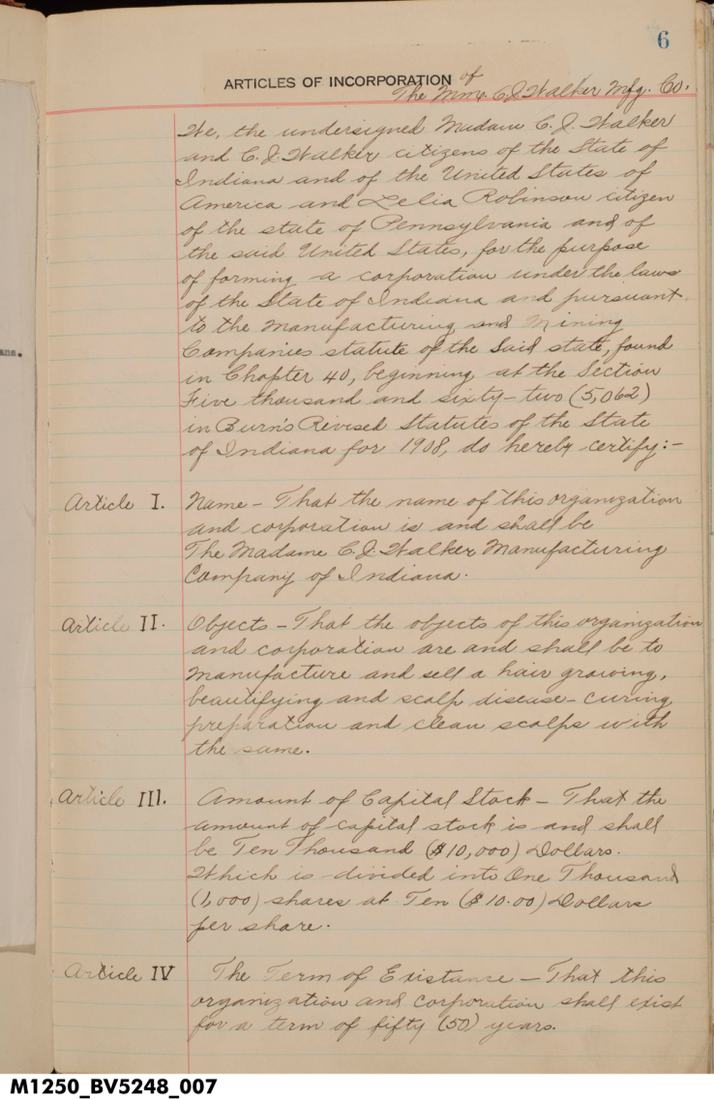
M1250_BV5248_007Handwritten articles: corporate purposes and authorized capital ($10,000, not gross receipts).
Image credit: Madam C.J. Walker Supplemental Collection, Indiana Historical Society.
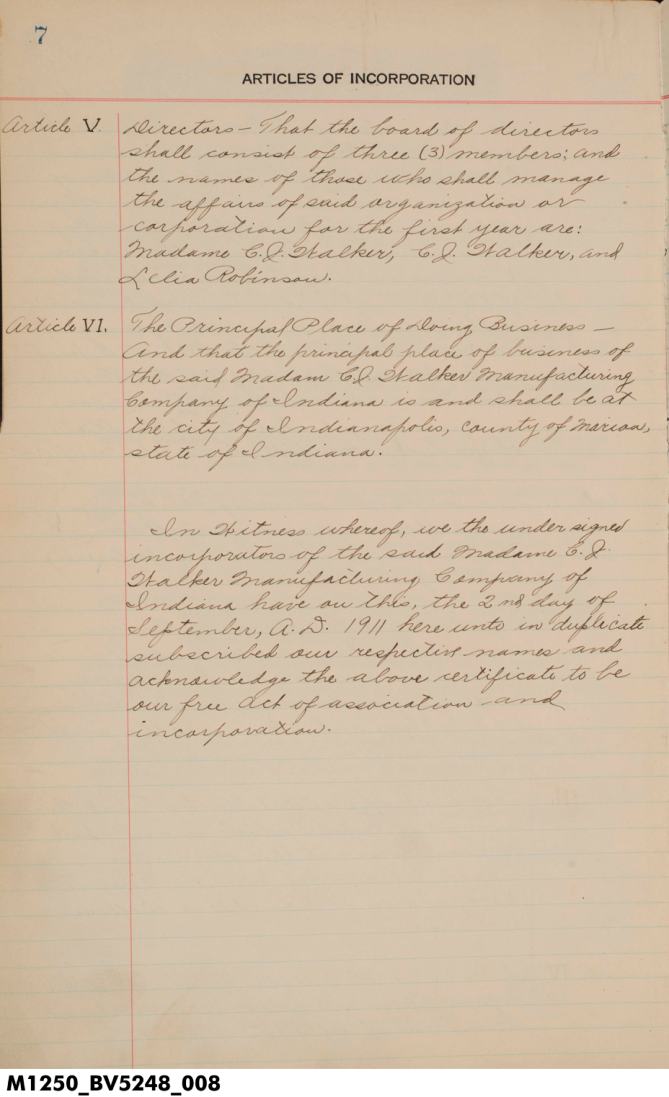
M1250_BV5248_008Continuation of the 1911 articles with the board and corporate provisions.
Image credit: Madam C.J. Walker Supplemental Collection, Indiana Historical Society.
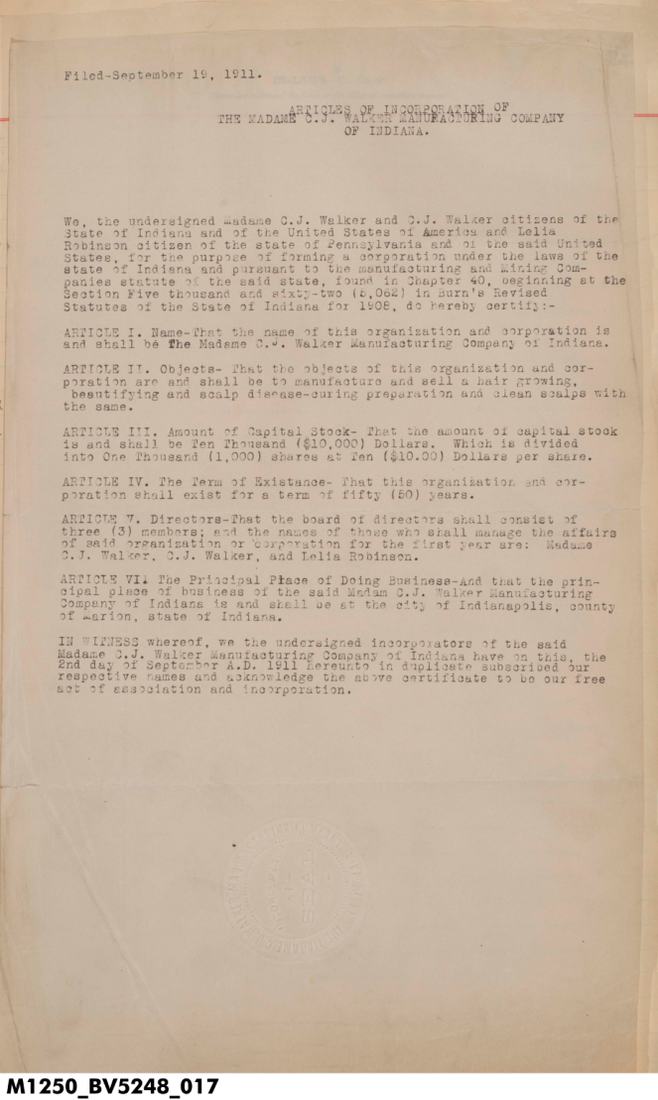
M1250_BV5248_017Typewritten articles identified as filed September 19, 1911.
Image credit: Madam C.J. Walker Supplemental Collection, Indiana Historical Society.
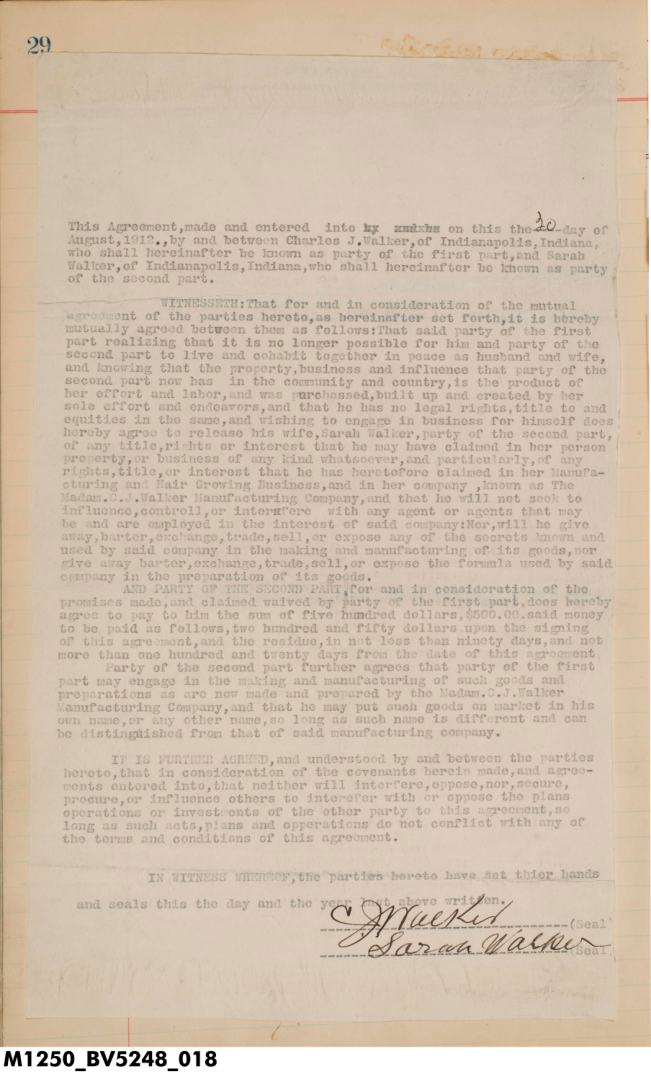
M1250_BV5248_018Written agreement involving Sarah Walker and C. J. Walker; terms do not independently prove payments occurred.
Image credit: Madam C.J. Walker Supplemental Collection, Indiana Historical Society.
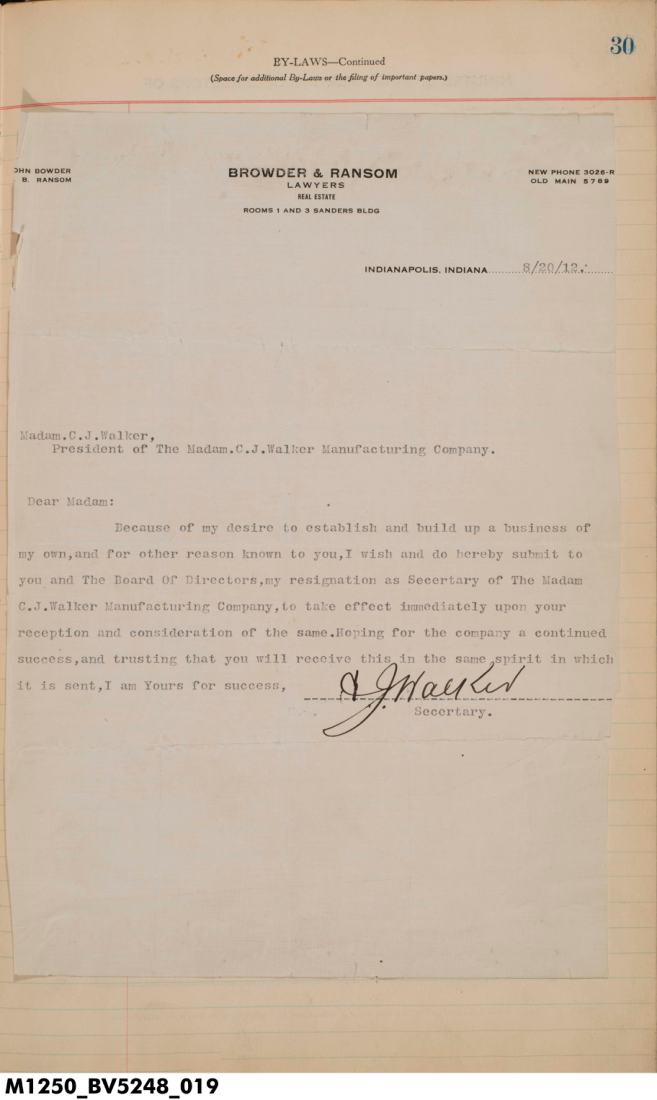
M1250_BV5248_019Signed August 1912 letter tendering resignation as company secretary.
Image credit: Madam C.J. Walker Supplemental Collection, Indiana Historical Society.
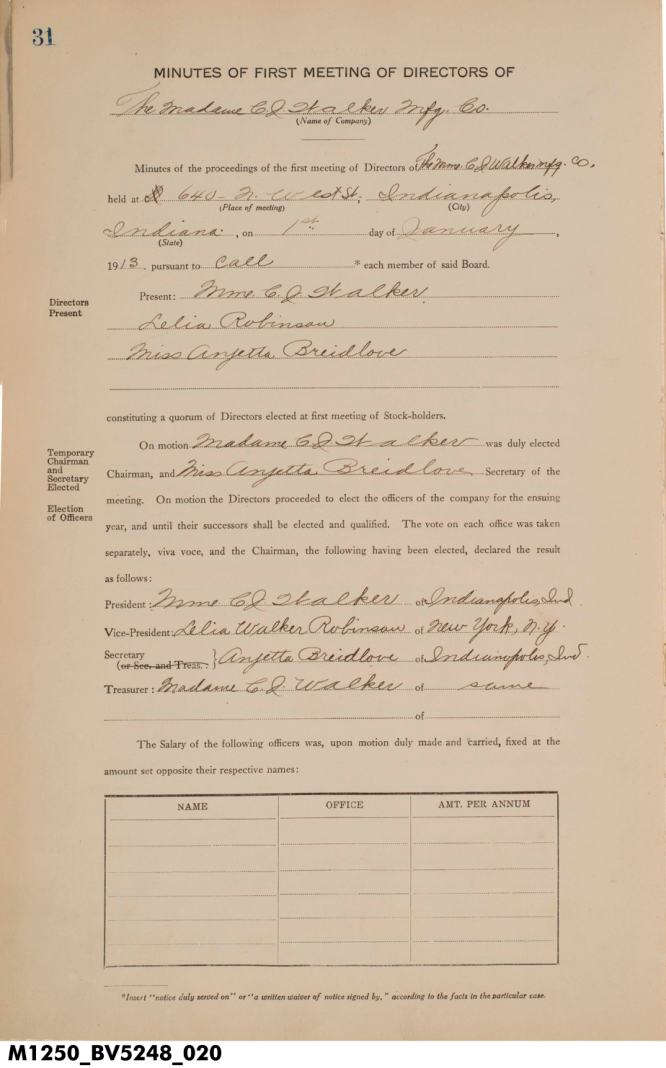
M1250_BV5248_020First board meeting minutes recording early corporate officers and governance.
Image credit: Madam C.J. Walker Supplemental Collection, Indiana Historical Society.
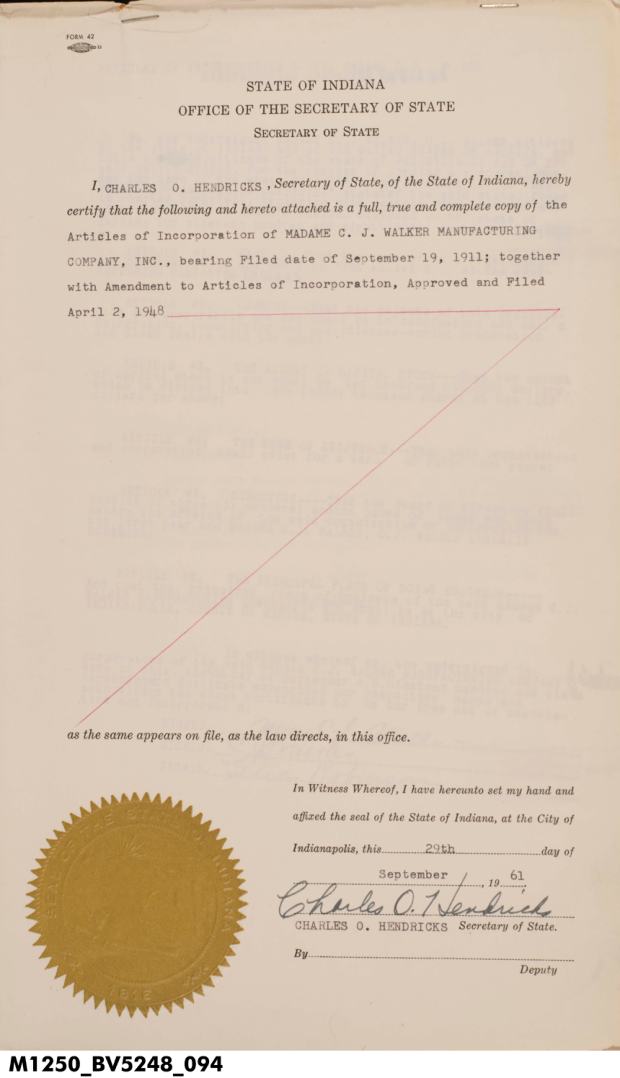
M1250_BV5248_0941961 certification of accompanying Walker incorporation records.
Image credit: Madam C.J. Walker Supplemental Collection, Indiana Historical Society.
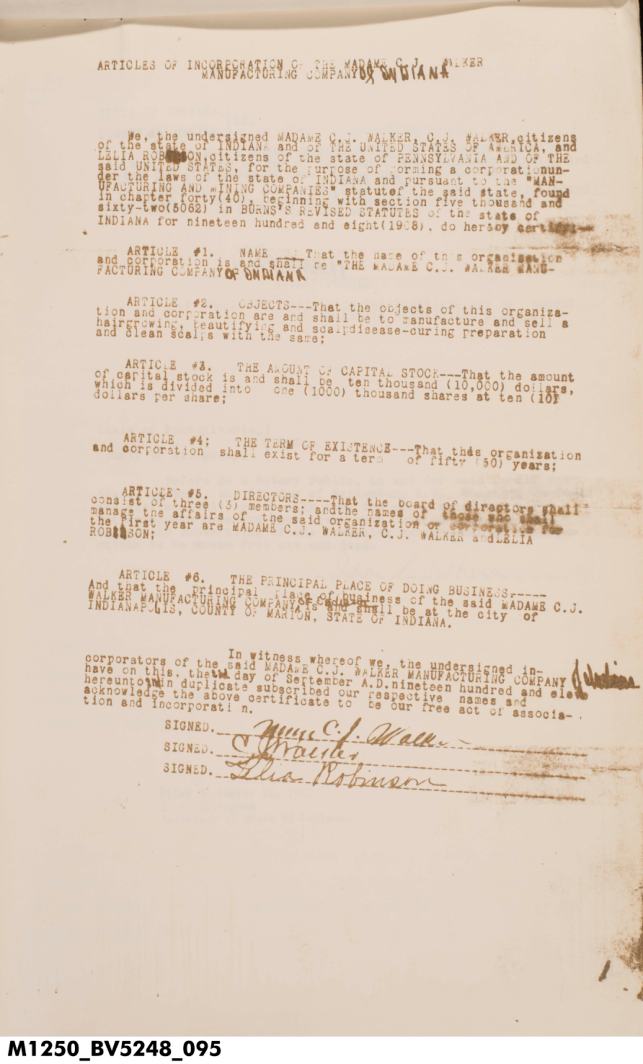
M1250_BV5248_095Copy of the 1911 articles accompanying Indiana certification.
Image credit: Madam C.J. Walker Supplemental Collection, Indiana Historical Society.
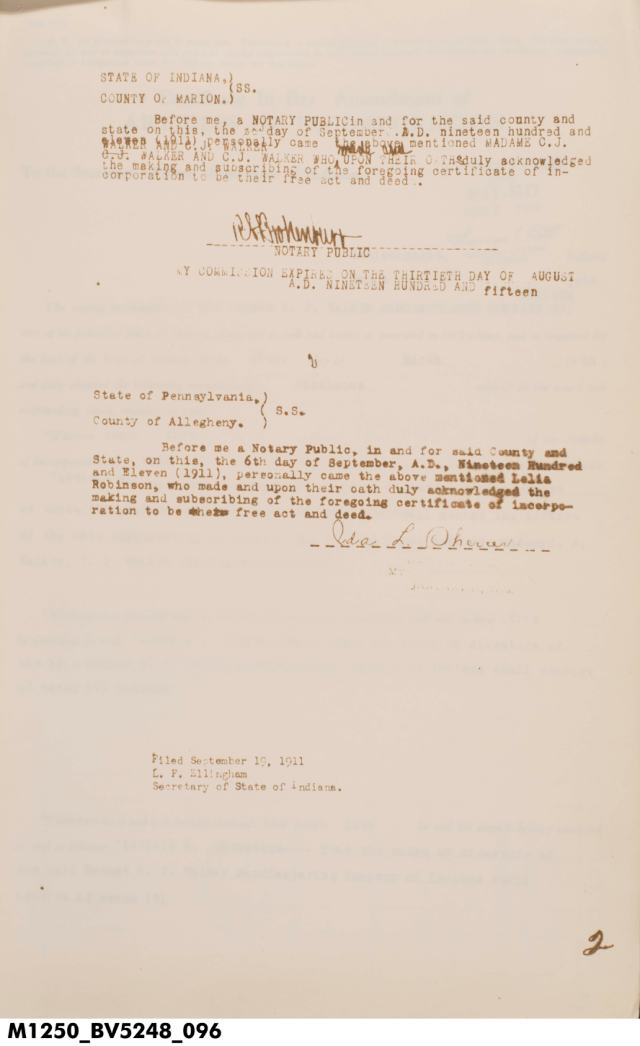
M1250_BV5248_096Acknowledgments and September 19, 1911 filing endorsement.
Image credit: Madam C.J. Walker Supplemental Collection, Indiana Historical Society.
Full file: Open full-size page 1 · Open full-size page 2 · Open full-size page 3 · Open full-size page 4 · Open full-size page 5 · Open full-size page 6 · Open full-size page 7 · Open full-size page 8 · Open full-size page 9
Evidence classification: Inspected primary corporate records; articles, agreements, and minutes have distinct evidentiary limits.
Rights note: IHS written clearance, October 14, 2026: selected low-resolution website images only. Credit: Madam C.J. Walker Supplemental Collection, Indiana Historical Society. High-resolution, curriculum, and video reuse are outside this clearance.
Collection: Indiana Historical Society digitized bound volume (M1250). BEHI holds a digital research copy; the original archival material remains with the repository. These images establish the displayed text and records, not unexamined business revenue or payment events.
SOURCE REGISTER & EVIDENCE LIMITS
Verified original company-record pages — M1250
BEHI visually examined a 98-page low-resolution scan of the Indiana Historical Society digitized bound volume M1250_BV5248.pdf. The page numbers below refer to the PDF scan index, confirmed against each image's printed archival footer. Images have been cleared for low-resolution use on this website; the nine selected low-resolution page images are now displayed with identifiers, citations, and credit. The original repository holds the archival volume; BEHI preserves a digital research copy.
| Archival page | Record | Finding and limit |
|---|---|---|
| M1250_BV5248_007 | 1911 Articles of Incorporation, opening page | Company purposes; $10,000 authorized stock (1,000 shares at $10); authorization is not revenue or paid-in capital. |
| M1250_BV5248_008 | 1911 Articles of Incorporation, continuation | Original directors and September 2 execution; execution and filing dates differ. |
| M1250_BV5248_017 | Typewritten copy of 1911 Articles | Marked filed September 19, 1911; typed copy supports comparison with handwritten instrument. |
| M1250_BV5248_018 | August 20, 1912 Walker agreement | Documents agreed business-interest and noninterference terms and a proposed $500 payment; performance or payment not verified. |
| M1250_BV5248_019 | August 20, 1912 C. J. Walker letter | Signed tender of resignation as company secretary; date of formal acceptance separately unverified. |
| M1250_BV5248_020 | January 1913 first directors' minutes | Early directors and officer appointments; not proof of share ownership or compensation amounts. |
| M1250_BV5248_094 | 1961 Secretary of State certification | State certification of copies of the 1911 articles and later amendment; certification issued decades afterward. |
| M1250_BV5248_095 | Certified-copy 1911 Articles | Reproduces the corporate articles and signatures; not a separate original 1911 filing. |
| M1250_BV5248_096 | Acknowledgments and filing endorsement | Distinguishes execution (Sept. 2), acknowledgment (Sept. 6), and filing (Sept. 19, 1911). |
Required image credit: Madam C.J. Walker Supplemental Collection, Indiana Historical Society. View the digital volume at Indiana Historical Society. Permission for website use does not itself verify the accuracy of every claim, nor does it grant a general right to reuse images in documentaries or curriculum.
Trace a claim without crossing its evidence boundary
Reader route: use the controlled claims and research gaps below to identify the question, then follow its source and limit. IHS Walker Papers finding aid locates the collection; the exact report, register, correspondence, or will must answer the particular claim.
A new source should carry complete page coverage, date, repository, collection or instrument identifier, provenance, and any known rights restrictions. New evidence can strengthen one claim while other questions remain open.
CONTROLLED CLAIMS & EVIDENCE LIMITS
| CLAIM | CLASSIFICATION | SOURCE | EVIDENCE LIMIT |
|---|---|---|---|
| Sarah Breedlove was born December 23, 1867, in Delta, Louisiana, and was the first Breedlove child born after emancipation. | VERIFIED | Official Walker biographical history | Bounded research claim from identified institutional or scholarly sources. Original-image custody and reproduction rights are separate. |
| Sarah used Annie Turnbo Malone’s products, received instruction connected to Poro, and worked as a Poro sales agent before establishing her own line. | VERIFIED | Smithsonian, Walker and Malone | Bounded research claim from identified institutional or scholarly sources. Original-image custody and reproduction rights are separate. |
| Walker founded an independent hair-care enterprise in Denver in 1906 after prior work as an Annie Turnbo Malone/Poro agent. | VERIFIED | Official Walker biographical history | Bounded research claim from identified institutional or scholarly sources. Original-image custody and reproduction rights are separate. |
| Walker developed and marketed an original five-product line centered on scalp care, cleansing, and hair maintenance. | VERIFIED | Official Walker biographical history | Bounded research claim from identified institutional or scholarly sources. Original-image custody and reproduction rights are separate. |
| Walker opened Lelia College in Pittsburgh in 1908 to train Walker hair culturists and agents. | VERIFIED | Official Walker biographical history | Bounded research claim from identified institutional or scholarly sources. Original-image custody and reproduction rights are separate. |
| Walker established Indianapolis operations in 1910 with manufacturing, laboratory, salon, and training functions; the company was incorporated in Indiana in 1911. | VERIFIED | IHS, Walker Papers finding aid | Bounded research claim from identified institutional or scholarly sources. Original-image custody and reproduction rights are separate. |
| Walker built a national agent and customer network supported by Black-press advertising, demonstrations, mail order, and professional training. | VERIFIED | NPS, Two American Entrepreneurs | Bounded research claim from identified institutional or scholarly sources. Original-image custody and reproduction rights are separate. |
| Walker expanded business activity into parts of Central America and the Caribbean by 1913, including Cuba, Panama, Jamaica, Costa Rica, and Haiti. | VERIFIED | Official Walker biographical history | Bounded research claim from identified institutional or scholarly sources. Original-image custody and reproduction rights are separate. |
| Walker hosted the first national convention of Walker agents and beauty culturists at Union Baptist Church in Philadelphia on August 30–31, 1917, with more than 200 attendees. | VERIFIED | Bundles, 1917 agents’ convention | Bounded research claim from identified institutional or scholarly sources. Original-image custody and reproduction rights are separate. |
| By 1919, Walker claimed that she and her teaching faculty had trained more than 20,000 Walker agents. | ATTRIBUTED | Official Walker biographical history | Cumulative company-reported training claim, not simultaneous employees; original 1919 statement pending. |
| Company gross receipts for 1918 were $275,937.88. | ATTRIBUTED | A’Lelia Bundles, financial analysis | Reported by Bundles from annual reports/tax records. Exact underlying original, item locator and independent transcription remain pending; gross receipts are not profit. |
| Company gross receipts for 1919 were $486,762. | ATTRIBUTED | A’Lelia Bundles, financial analysis | Reported by Bundles from annual reports/tax records. Exact underlying original, item locator and independent transcription remain pending; gross receipts are not profit. |
| Company gross receipts for 1920 were $595,353 under posthumous management. | ATTRIBUTED | A’Lelia Bundles, financial analysis | Reported by Bundles from annual reports/tax records. Exact underlying original, item locator and independent transcription remain pending; gross receipts are not profit. |
| Walker’s personal assets at death were estimated at $600,000–$700,000. | ESTIMATED | A’Lelia Bundles, financial analysis | This is Bundles’s biographical personal-assets estimate, not a total transcribed from a preserved estate inventory. Estate assets, debts and ownership still require reconciliation. |
| Later business analysis placed the company’s potential sale value around Walker’s death between $1 million and $2 million. | ESTIMATED | A’Lelia Bundles, financial analysis | Retrospective hypothetical company-sale estimate relayed by Bundles. It is not an actual sale price, and the underlying valuation methodology remains pending. |
| Walker pledged $5,000 to the NAACP anti-lynching campaign in 1919, the largest individual gift the association had received to that date. | ATTRIBUTED | A’Lelia Bundles, financial analysis | Institutional and scholarly accounts support the pledge. Original Shillady letter and evidence of payment are separate acquisition targets. |
| Walker’s will directed two-thirds of future net profits to charitable causes. | ATTRIBUTED | NPS, Two American Entrepreneurs | Institutional accounts corroborate a future-profits charitable provision. Original will and exact legal scope remain pending. |
| Villa Lewaro was completed in 1918 and designed by Vertner Woodson Tandy, New York’s first licensed Black architect; it later became a National Historic Landmark. | ATTRIBUTED | LOC, Villa Lewaro HABS NY-5618 | Bounded research claim from identified institutional or scholarly sources. Original-image custody and reproduction rights are separate. |
| Walker did not invent direct selling; the California Perfume Company used a national primarily female direct-sales network beginning in 1886. | VERIFIED | Hagley, early Avon history | Bounded research claim from identified institutional or scholarly sources. Original-image custody and reproduction rights are separate. |
| Walker did not invent Black hair care, the hot comb, chemical permanent, or the broader practice of hair straightening. | VERIFIED | Smithsonian, Walker and Malone | Bounded research claim from identified institutional or scholarly sources. Original-image custody and reproduction rights are separate. |
| Walker is widely recognized as America’s first self-made woman millionaire, but BEHI does not use the unqualified phrase “the first Black female millionaire.” | QUALIFIED | A’Lelia Bundles, financial analysis | Bounded research claim from identified institutional or scholarly sources. Original-image custody and reproduction rights are separate. |
| Walker clubs and conventions functioned as civic infrastructure by connecting commercial organization with philanthropy, political education, and anti-lynching advocacy. | INSTITUTE ANALYSIS | Bundles, 1917 agents’ convention | BEHI Institute Analysis. Economic opportunity does not imply guaranteed earnings or universal outcomes. |
| The Walker network widened income-producing opportunities for Black women through commissioned sales, beauty services, and small-business ownership. | INSTITUTE ANALYSIS | NPS, Two American Entrepreneurs | BEHI Institute Analysis. Economic opportunity does not imply guaranteed earnings or universal outcomes. |
| The 2020 Netflix limited series Self Made is a dramatization and should not be used as historical evidence. | VERIFIED | Official Walker biographical history | Bounded research claim from identified institutional or scholarly sources. Original-image custody and reproduction rights are separate. |
RESEARCH GAPS & OPEN QUESTIONS
ECONOMIC INDICATORS — MISSING EVIDENCE
Operating profit
Content condition: Not yet established. Walker company
Reporting period not established
Evidence needed / present limit: Requires expenses and reconciled accounts; gross receipts cannot establish profit.
The record remains open. This Profile presents the evidence currently assembled; further documents may expand, clarify, or correct it.
These questions distinguish evidence still to be located from evidence that needs further review. An open question does not establish or disprove a claim.
Wealth and the millionaire description
What valuation date, assets, debts, and ownership interests support descriptions of Walker’s personal wealth?
Evidence needed: Dated estate inventories, appraisals, financial statements, and ownership records that distinguish personal assets from company value.
Status: Published personal-assets and hypothetical company-sale estimates are already researched. Estate inventories, debts, ownership evidence and valuation methodology are still sought.
Training, agents, and payroll
How many people were trained, selling as agents, or employed on payroll at particular dates? The reported 20,000 training figure should not be treated as a simultaneous employee count.
Evidence needed: Dated training registers, agent lists, convention records, and payroll records, with duplicate names and date ranges reconciled.
Status: The cumulative 20,000 training report is already researched and attributed. Its underlying 1919 statement and date-specific payroll/agent records remain to be reconciled.
Company finances and commercial scale
What do surviving accounts establish about revenue, expenses, profits, and agent earnings in specific years?
Evidence needed: Dated company ledgers, audited accounts, tax records, commission schedules, and agent-level business records.
Status: The 1918–1920 gross-receipt figures are already reported in Bundles’s archival analysis. Exact original annual reports/tax records and independent transcriptions remain pending; expense, profit and agent-earnings evidence is still sought.
HELP EXPAND THE RECORD
Have a document or source that could expand or clarify this Profile? Share the source, its provenance, and your explanation with BEHI for review. Contributions undergo BEHI’s verification process before any decision to include them.
Contact BEHI about a source. Include the Profile name, where the document came from, and any known ownership or reproduction restrictions.
RESEARCH UPDATES & RECONCILIATION
DOCUMENT CUSTODY & OPEN QUESTIONS
Evidence status: Finding aids and institutional accounts do not establish inspection of original records. Portrait provenance and usage rights remain unresolved.
Read full note: Document custody and open questions
BEHI has located the Indiana Historical Society's digitized 1911–1947 corporate-volume source (M1250_BV5248.pdf), including incorporation, stock, and minutes material; selected incorporation, agreement, resignation and minutes pages have since been reviewed and displayed in Receipts. Review of the remaining volume and a complete transcription are still pending. BEHI continues to seek the 1919 will, Shillady pledge letter, convention documents, and 1918–1920 annual report/tax records with exact item locators. Institutional corroboration of chronology and permission to display selected low-resolution pages do not establish BEHI custody of original documents.
No archival placeholder is represented as an original in this review. The portrait is temporarily withheld while its exact image source and usage rights are reconciled. Smithsonian catalog records identify public-domain Walker portraits, but they do not establish the provenance of the previously uploaded file.
Sources and evidence limits: IHS, Walker Papers finding aid · A’Lelia Bundles, financial analysis · LOC, Villa Lewaro HABS NY-5618 · Bundles, 1917 agents’ convention · LOC, New York Age advertisement, January 17, 1920. Institutional and scholarly interpretation is distinguished from original records; a finding aid identifies a collection or item, not an inspected financial statement.
Sarah Breedlove Birth and Family Background
Audited Historical Assertion
Sarah Breedlove was born December 23, 1867, in Delta, Louisiana, and was the first Breedlove child born after emancipation.
BEHI Academic Analysis & Research Clarification
Bounded research claim from identified institutional or scholarly sources. Original-image custody and reproduction rights are separate.
Secondary literature, biographical registries, or contextual analysis supports this entry. Primary archival scans are pending acquisition or cataloging.
HOW TO READ THE RECEIPTS & ARCHIVAL CITATIONS
Evidence linked on this page may include primary archival records, contemporary sources, repository citations, authoritative secondary scholarship, and Institute analysis. Where a physical archival holding has been identified, BEHI provides repository and locator information when available.
Cite This Profile
The Black Economic History Institute (BEHI) Digital Archive