Profile №7 BEHI-P007-TLJ
Thomas L. Jennings
c. 1791–1859
Inventor, Tailor, Clothier, Abolitionist
Overview
TAKEAWAY: Jennings’s tailoring and garment-care enterprise connects invention with Black civic activity. A federal patent list anchors the 1821 patent date; broader financial claims remain unresolved.
BEHI PROFILE — RESEARCH IN PROGRESS — UPDATED OCTOBER 28, 2026. EVIDENCE IS CLASSIFIED CLAIM BY CLAIM; ATTRIBUTED ACCOUNTS AND UNRESOLVED RESEARCH QUESTIONS ARE IDENTIFIED THROUGHOUT.
OVERVIEW
Thomas L. Jennings was a New York tailor, clothier and inventor whose dry-scouring patent is dated March 3, 1821 in the scanned federal patent list. His contemporary obituary connects his business career with abolitionist and civil-rights activity. This profile distinguishes documented publication facts from retrospective accounts and economic claims still awaiting originals.
A career at the intersection of trade, invention, and rights
Skilled enterprise
Tailoring, garment renovation, and clothing sales place Jennings within New York’s commercial economy.
Recorded invention
A federal patent list preserves his name, city, dry-scouring subject, and March 3, 1821 grant date.
Collective action
His contemporary obituary describes involvement in Black civic organization and abolitionist publishing.
Career map. The 1822 federal patent list, printed p. 6, establishes the patent-list facts. The advertisement and obituary provide different evidence for business and public activity; retrospective career descriptions remain attributed. BEHI analysis connects these strands without assuming that patent income financed every civic action.
A garment-renovation method linked to an established tailoring trade.
Advertising, directories and court reporting must be read separately from financial accounts.
The obituary attributes organizational work and support for abolitionist publishing.
EXACT ACCOMPLISHMENTS
The scanned federal patent list records Thomas L. Jennings of New York and a March 3, 1821 grant for dry scouring.
Contemporary obituary accounts connect Jennings’s business career with tailoring and garment renovation; complete business accounts remain unrecovered.
His contemporary obituary describes organizational work and support for abolitionist publishing. The scale of his financial contributions remains unresolved.
THE RECORD & ITS LIMITS
The scanned federal report, printed page 6, directly confirms Jennings’s dry-scouring patent date of March 3, 1821. Patent number 3306X is supplied by institutional histories; the specification remains unrecovered.
The inspected March 1859 obituary reports February 11 death. The older 1856 death year is rejected.
No audited revenue, profit, royalty, net-worth or emancipation payment is presented as verified.
A garment-renovation method linked to an established tailoring trade.
Advertising, directories and court reporting must be read separately from financial accounts.
The obituary attributes organizational work and support for abolitionist publishing.
Jennings’s enterprise and public activity can be studied through distinct records. Recognition of an invention does not establish the income it generated. No authenticated portrait has been approved for this profile.
What Would Move This Profile Forward?
These are the next evidence priorities for strengthening this Profile. Each identifies a concrete research step and what it could help establish.
- Recover surviving patent and commercial-rights records
Seek any surviving specification, related correspondence, assignments and licensing or payment records. These would add technical and commercial detail to the confirmed patent date without assuming royalty income.
- Inspect complete newspaper and court sources
Obtain the full issue containing the recovered advertisement and the December 6, 1821 court report with its underlying case record. These would confirm publication context and the legal nature of the reported damages.
- Resolve the Church Street property instruments
Recover the 157/167 Church Street deeds, mortgages and related Scott–Smith and Jinnings–Scott instruments. These would distinguish addresses, tenancy, ownership and namesakes.
- Document business earnings and family freedom transactions
Locate dated operating accounts, manumission and payment records, and probate documents. These would test financial claims without treating an obituary, patent or later family business as proof of Jennings’s earnings.
Read the Research Gaps & Open Questions for the unresolved issues and evidence limits. New material is reviewed before claims or classifications change.
THE RECEIPTS OR EVIDENCE SUPPORTING THIS PROFILE
Evidence labels apply to individual claims. Read the evidence guide and content-condition definitions.
| SOURCE / LOCATOR | RECORD / CONTEXT | DATE / PERIOD | EVIDENCE STATUS | SUPPORT / LIMITS |
|---|---|---|---|---|
| 1822 State Department patent list | Primary government report | January 8, 1822 | VERIFIED | Scanned government table, printed p. 6 (PDF page 6), directly confirms dry scouring, Thomas L. Jennings, March 3, 1821, and New York residence. The list does not reproduce the specification or document earnings. |
| Douglass’ Monthly · Thomas L. Jennings obituary | Inspected contemporary newspaper scan | March 1859 · p. 36 | VERIFIED | Printed masthead is March 1859, despite the supplied filename saying 1869. Reports death in New York on February 11. Retrospective business and civic accounts remain attributed. |
| National Inventors Hall of Fame | Institutional interpretation | Modern institutional biography | ATTRIBUTED | Identifies patent number 3306X, 2015 induction and February 11, 1859 death. March 3, 1821 is independently confirmed by the federal report. Not a patent specification. |
Background
TAKEAWAY: Jennings’s obituary describes craft training and independent business. His original birth record and a reconciled family chronology remain research priorities.
BACKGROUND
Institutional histories place Jennings’s birth around 1791 in New York. The obituary calls him a New York native and describes a tailoring apprenticeship followed by business on his own account. An original birth record and a reconciled family chronology remain acquisition priorities.
From learning a trade to working on his own account
Apprenticeship
The obituary recalls training with a prominent New York tailor: a route into specialized craft work.
Independent practice
It then describes business on his own account, placing ownership and customer service alongside technical skill.
Family & community
Later family and organizational records widen the story, but shared names and addresses require separate identity checks.
Biographical sequence from Douglass’ Monthly, March 1859, p. 36. This is a retrospective obituary account, not an apprenticeship contract. The chart shows stages in that account, not measured income or dated business growth. Thomas the dentist and the elder Jennings must remain distinct.
HISTORICAL & ECONOMIC CONTEXT
The obituary describes apprenticeship with a prominent New York tailor.
Named children and later family enterprises require independent identity checks.
Birth and manumission records are needed before treating freedom status as independently verified.
THE RECORD & ITS LIMITS
The obituary provides a retrospective account, rather than a surviving apprenticeship agreement.
Exact birth date and obituary age require reconciliation. A modern January 1 birth date is not promoted to a verified date.
Thomas the dentist and the deceased founder must not be merged. Lucy and Elizabeth also require careful source comparison.
The obituary describes apprenticeship with a prominent New York tailor.
Named children and later family enterprises require independent identity checks.
Birth and manumission records are needed before treating freedom status as independently verified.
Match names, occupation, household and address before attaching property, hotel operations or family records to Jennings.
EVIDENCE & CONTEXT
| SOURCE | DESCRIPTION | DATE | EVIDENCE CLASSIFICATION | NOTES |
|---|---|---|---|---|
| Douglass’ Monthly · Thomas L. Jennings obituary | Inspected contemporary newspaper scan | March 1859 · p. 36 | VERIFIED | Printed masthead is March 1859, despite the supplied filename saying 1869. Reports death in New York on February 11. Retrospective business and civic accounts remain attributed. |
| National Inventors Hall of Fame | Institutional interpretation | Modern institutional biography | ATTRIBUTED | Identifies patent number 3306X, 2015 induction and February 11, 1859 death. March 3, 1821 is independently confirmed by the federal report. Not a patent specification. |
| MIT Lemelson | Institutional interpretation | Modern institutional biography | ATTRIBUTED | Recognition and biographical context. Priority, family emancipation and proceeds claims require distinct documentary support. |
The Problem
TAKEAWAY: Jennings addressed garment care through his trade and unequal treatment through civic work. The record does not establish a single motive connecting every activity.
THE PROBLEM
Jennings worked in a society structured by slavery and racial exclusion. His trade addressed the practical care of garments; his civic work addressed unequal treatment and access. The profile treats these related activities without inventing a documented business motive.
Two problems, two kinds of evidence
Garment care
Customers needed clothing cleaned and restored. The 1821 advertisement offers direct evidence of the services Jennings promoted.
Unequal treatment
The obituary and later biographies place Jennings and his family within struggles against racial exclusion.
Different routes to a response
Commercial services addressed garment needs; civic organizations and legal action addressed rights and access.
Sources: Gotham Center advertisement reproduction and the March 1859 obituary. BEHI analysis: the diagram separates commercial and civic activity. Advertising establishes an offer, not proven cleaning performance, customer volume, or a documented explanation of why Jennings invented the process.
DIMENSIONS OF THE PROBLEM
Advertisements offer evidence of services being marketed, not measured demand.
Civil-rights accounts describe discrimination in public transportation.
The earlier Cox report concerns signs and trespass; legal characterization matters.
HOW THE PROBLEM SHOWED UP
A claim that stains could be removed is a seller’s representation until tested by other evidence.
Sources do not yet establish that a specific episode caused Jennings to invent the process.
Recover court records for the daughter’s case and distinguish her action from her father’s organizational support.
Advertisements offer evidence of services being marketed, not measured demand.
Civil-rights accounts describe discrimination in public transportation.
The earlier Cox report concerns signs and trespass; legal characterization matters.
Historical barriers help explain the setting. They do not by themselves establish sales, costs, success rates or profits.
EVIDENCE & CONTEXT
| SOURCE | DESCRIPTION | DATE | EVIDENCE CLASSIFICATION | NOTES |
|---|---|---|---|---|
| New-York Gazette & General Advertiser | Advertisement / published reproduction | March 13, 1821 · p. 4 | ATTRIBUTED | Inspected advertisement clipping reproduced by the Gotham Center and identified as March 13, 1821, p. 4. It names Jennings at 61 Nassau Street, offers garment cleaning and secondhand clothing sales, and claims federal letters patent. The clipping does not include its masthead; issue date remains attributed to the reproduction citation. No sales totals established. |
| New-York American · Jennings v. Cox | Earlier newspaper transcription | Reported December 6, 1821 | ATTRIBUTED | Prior research describes trespass for destroying signs and $50 damages, with the patent produced in evidence. Recover the supplied scan and reconcile the masthead; do not describe this as patent infringement. |
| Douglass’ Monthly · Thomas L. Jennings obituary | Inspected contemporary newspaper scan | March 1859 · p. 36 | VERIFIED | Printed masthead is March 1859, despite the supplied filename saying 1869. Reports death in New York on February 11. Retrospective business and civic accounts remain attributed. |
What He Built
TAKEAWAY: Jennings’s record includes tailoring, clothing sales, a patented process, and civic organizations. Later hotel advertisements require separate identity and succession checks.
WHAT HE BUILT
The evidence points to a tailoring and clothing business, a patented garment-care process, and participation in civic organizations. Each activity needs its own chronology and records; later hotel advertisements are treated as separate identity and succession questions.
The commercial offering visible in the advertisement
Garment cleaning
An offered service connected Jennings’s work to the care and renovation of clothing.
Secondhand clothing
The same advertisement markets clothing sales, showing an additional commercial activity beside cleaning.
A named business location
The clipping identifies 61 Nassau Street, linking services and merchandise to a specific New York address.
The inspected clipping is reproduced in the Gotham Center advertisement reproduction; its March 13, 1821 issue date remains attributed because the clipping lacks the newspaper masthead. Business-model diagram: boxes show advertised activities, not revenue shares. The advertisement does not reveal the process’s recipe, sales volume, costs, or legal ownership of the premises.
THE ENTERPRISE SYSTEM
The 1822 list names dry scouring clothes.
The obituary describes business in Nassau and Chatham streets.
The obituary names the Wilberforce Society and Legal Rights Association.
THE RECORD & ITS LIMITS
The inspected advertisement clipping names 61 Nassau Street. Its March 13, 1821 issue date is attributed to the Gotham Center reproduction citation; other addresses still need directory and deed reconciliation.
A patent is an intellectual-property record; it does not document a licensing contract or royalty payment.
Union House and post-1859 hotels require identity confirmation and succession evidence before being assigned to the founder.
The 1822 list names dry scouring clothes.
The obituary describes business in Nassau and Chatham streets.
The obituary names the Wilberforce Society and Legal Rights Association.
Separate the founder’s lifetime enterprise from later widow, daughter and successor operations.
EVIDENCE & CONTEXT
| SOURCE | DESCRIPTION | DATE | EVIDENCE CLASSIFICATION | NOTES |
|---|---|---|---|---|
| 1822 State Department patent list | Primary government report | January 8, 1822 | VERIFIED | Scanned government table, printed p. 6 (PDF page 6), directly confirms dry scouring, Thomas L. Jennings, March 3, 1821, and New York residence. The list does not reproduce the specification or document earnings. |
| New-York Gazette & General Advertiser | Advertisement / published reproduction | March 13, 1821 · p. 4 | ATTRIBUTED | Inspected advertisement clipping reproduced by the Gotham Center and identified as March 13, 1821, p. 4. It names Jennings at 61 Nassau Street, offers garment cleaning and secondhand clothing sales, and claims federal letters patent. The clipping does not include its masthead; issue date remains attributed to the reproduction citation. No sales totals established. |
| Frederick Douglass’ Paper · Union House | Earlier advertisement transcription | June 8, 1855 · p. 4 | ATTRIBUTED | 167 Church Street; issue and ad-run details require original reinspection and father/son identity confirmation. |
| Weekly Anglo-African · family hotel advertisements | Earlier research lead | 1860–1864 | ATTRIBUTED | Empire State Hotel / Union House at 541 Broome Street concerns later family enterprise after Jennings’s death. Originals and identities remain to be checked. |
| Douglass’ Monthly · Thomas L. Jennings obituary | Inspected contemporary newspaper scan | March 1859 · p. 36 | VERIFIED | Printed masthead is March 1859, despite the supplied filename saying 1869. Reports death in New York on February 11. Retrospective business and civic accounts remain attributed. |
Accomplishments
TAKEAWAY: The federal patent list and contemporary publications anchor Jennings’s achievements. They do not establish royalties, personal wealth, or every later priority claim.
ACCOMPLISHMENTS
Jennings is widely recognized as an early Black American patentee. The primary government list and the contemporary obituary provide a firmer documentary basis than unsupported claims about wealth or proceeds.
Achievement and the document that supports it
Sources: 1822 federal patent list; inspected advertisement and obituary; National Inventors Hall of Fame. “Documented” identifies the limited publication fact in the named source. NIHF’s priority claim is institutional attribution; these records do not establish royalties, a fortune, or every legal claim repeated in later accounts.
ACCOMPLISHMENT LEDGER
Dates and evidence classifications apply to the specific findings below. Economic significance is BEHI analysis; evidence limits remain attached to each entry.
| DATE / PERIOD | ACCOMPLISHMENT | ECONOMIC SIGNIFICANCE | SOURCE / LOCATOR | EVIDENCE CLASSIFICATION | EVIDENCE LIMITS |
|---|---|---|---|---|---|
| March 3, 1821 | Dry-scouring patent recorded The federal list names Jennings, New York and the dry-scouring grant. | Documents a technical contribution connected to garment care. | 1822 State Department patent list Printed p. 6 of the January 8, 1822 report. | VERIFIED | The list does not reproduce the specification or establish earnings. |
| Career before 1859 | Independent clothing and garment-care enterprise The contemporary obituary describes Jennings’s work as a clothier and garment renovator. | Connects skilled work with independent commercial activity. | Douglass’ Monthly · Thomas L. Jennings obituary March 1859, p. 36. | ATTRIBUTED | The retrospective career account is not a complete operating or financial ledger. |
| Career before 1859 | Civic organizational leadership The obituary reports Legal Rights Association leadership and public activity. | Connects the business career with collective action for access and rights. | Douglass’ Monthly · Thomas L. Jennings obituary March 1859, p. 36. | ATTRIBUTED | Organizational work does not establish the amount or source of financial contributions. |
ACCOMPLISHMENT CATEGORIES
Modern institutions identify patent 3306X for dry scouring.
The obituary describes his work as a clothier and garment renovator.
Legal Rights Association leadership is reported in the obituary.
THE RECORD & ITS LIMITS
Institutional recognition of Jennings as the first Black U.S. patent recipient is attributed; racial identification and completeness of earlier records require care.
An earlier newspaper transcription reports a $50 trespass award. It is not evidence of patent-infringement damages or royalty income.
H.Res. 514 was introduced in 2014. It is not described here as an adopted resolution.
Modern institutions identify patent 3306X for dry scouring.
The obituary describes his work as a clothier and garment renovator.
Legal Rights Association leadership is reported in the obituary.
A meaningful technical and civic career does not require an invented fortune, unsupported transaction or exaggerated legal victory.
EVIDENCE & CONTEXT
| SOURCE | DESCRIPTION | DATE | EVIDENCE CLASSIFICATION | NOTES |
|---|---|---|---|---|
| 1822 State Department patent list | Primary government report | January 8, 1822 | VERIFIED | Scanned government table, printed p. 6 (PDF page 6), directly confirms dry scouring, Thomas L. Jennings, March 3, 1821, and New York residence. The list does not reproduce the specification or document earnings. |
| Douglass’ Monthly · Thomas L. Jennings obituary | Inspected contemporary newspaper scan | March 1859 · p. 36 | VERIFIED | Printed masthead is March 1859, despite the supplied filename saying 1869. Reports death in New York on February 11. Retrospective business and civic accounts remain attributed. |
| National Inventors Hall of Fame | Institutional interpretation | Modern institutional biography | ATTRIBUTED | Identifies patent number 3306X, 2015 induction and February 11, 1859 death. March 3, 1821 is independently confirmed by the federal report. Not a patent specification. |
| H.Res. 514 · introduced text | Inspected congressional document | March 12, 2014 | VERIFIED | Introduced and referred to committee. This is a proposal for recognition, not proof that a resolution passed; historical recitals remain attributed. |
Economic Impact
TAKEAWAY: Jennings illustrates the connection between skill, intellectual property, and enterprise. Sales, profit, employment, licensing income, and estate value remain unquantified.
ECONOMIC IMPACT
Jennings’s work illustrates the relationship between skilled labor, intellectual property and independent enterprise. The surviving sources used here do not quantify his sales, operating profit, employment, licensing income or estate.
How the enterprise could create economic value
Services
Cleaning and tailoring offered work tied to customers’ existing garments.
Goods
Clothing sales added merchandise to the commercial offering.
Intellectual property
The patent supplied a distinct legal record of the invention. Commercial returns need separate evidence.
Sales receipts − operating expenses = operating profit. Royalty receipts, debt, property equity, and personal assets require their own records.
Qualitative economic diagram · BEHI analysis. Based on the advertised business activities and federal patent entry. This is a framework for examining value, not a numerical reconstruction of Jennings’s accounts. No surviving source inspected for this profile establishes a reliable revenue, profit, royalty, or wealth total.
KEY ECONOMIC INDICATORS
Each measure identifies its entity, period, source and evidence limits. Dollar amounts are nominal historical U.S. dollars. Assets, revenue, profit, transaction amounts and employment measures are distinct. “Not yet established” identifies a research gap, not zero or “not applicable.”
| MEASURE / VALUE | ENTITY / PERIOD | SOURCE / LOCATOR | CONTENT CONDITION / EVIDENCE CLASSIFICATION | INTERPRETATION / LIMITS |
|---|---|---|---|---|
| Annual revenue and profit Not yet established | Jennings tailoring and cleaning enterprise Reporting period not established | Research gap; see Evidence & Context and Receipts. | Not yet established Evidence classification: not assigned to an unresolved answer. | Requires sales and expense accounts; a patent or obituary cannot establish earnings. Research Gap: Annual revenue and profit |
| Patent royalties Not yet established | Thomas L. Jennings Reporting period not established | Research gap; see Evidence & Context and Receipts. | Not yet established Evidence classification: not assigned to an unresolved answer. | Requires licensing agreements and payment records. Trespass damages are not patent royalties. Research Gap: Patent royalties |
| Personal net worth Not yet established | Thomas L. Jennings Reporting period not established | Research gap; see Evidence & Context and Receipts. | Not yet established Evidence classification: not assigned to an unresolved answer. | Requires dated assets, debts and probate records; property leads remain unresolved. Research Gap: Personal net worth |
For evidence-label definitions, see the Receipts evidence guide.
CHANNELS OF ECONOMIC IMPACT
Tailoring and garment care offered a route to business ownership.
A patent could protect an invention; actual commercial returns require accounts.
The obituary describes subscriptions to abolitionist publishing without amounts.
THE RECORD & ITS LIMITS
The reported $50 Cox award is a litigation item, not annual revenue or a patent royalty.
Popular accounts connect patent proceeds with family freedom; payment and manumission records remain unresolved.
Addresses, mortgages and hotel advertising do not establish ownership or equity without the instruments and account context.
Tailoring and garment care offered a route to business ownership.
A patent could protect an invention; actual commercial returns require accounts.
The obituary describes subscriptions to abolitionist publishing without amounts.
Revenue, profit, assets, debt, damages and requested payments are different quantities. No present-day dollar conversion is supplied for an unverified amount.
EVIDENCE & CONTEXT
| SOURCE | DESCRIPTION | DATE | EVIDENCE CLASSIFICATION | NOTES |
|---|---|---|---|---|
| Douglass’ Monthly · Thomas L. Jennings obituary | Inspected contemporary newspaper scan | March 1859 · p. 36 | VERIFIED | Printed masthead is March 1859, despite the supplied filename saying 1869. Reports death in New York on February 11. Retrospective business and civic accounts remain attributed. |
| New-York American · Jennings v. Cox | Earlier newspaper transcription | Reported December 6, 1821 | ATTRIBUTED | Prior research describes trespass for destroying signs and $50 damages, with the patent produced in evidence. Recover the supplied scan and reconcile the masthead; do not describe this as patent infringement. |
| Property / mortgage instruments | Unresolved acquisition | 1841–1849 leads | ATTRIBUTED | 157/167 Church Street and Scott–Smith / Jinnings–Scott leads require deeds, legal descriptions and mortgage recitals. No consideration or debt amount verified. |
Timeline
TAKEAWAY: The chronology combines inspected publication evidence with attributed dates. Listing an open lead in date order does not make it a verified event.
TIMELINE
This chronology includes both directly inspected publication evidence and attributed historical dates. Each entry retains its source boundary; open leads do not become verified events merely by appearing in order.
Dates with different documentary meanings
- March 3, 1821Patent grant
Date confirmed in the federal table.
- March 13, 1821Advertisement citation
Clipping recovered; issue date attributed to its reproduction.
- January 8, 1822Federal report
The government list records the earlier grant.
- 1855Legal Rights Association
Institutional accounts date the organization to this year.
- February 11, 1859Death report
Date reported in the contemporary obituary.
- March 1859Obituary publication
Printed masthead corrects the supplied filename’s 1869 label.
Sources: 1822 federal patent list, Gotham Center advertisement reproduction, National Inventors Hall of Fame, and Douglass’ Monthly, March 1859, p. 36. This visual distinguishes an event from the later document reporting it. Post-1859 family businesses belong to a succession chronology, not the founder’s lifetime operating record.
TIMELINE AT A GLANCE
c. 1791 birth is an institutional account.
March 3, 1821 is confirmed in the scanned federal table.
March issue reports February 11 death.
THE RECORD & ITS LIMITS
New York birth reported in institutional biographies; original birth record pending.
The scanned federal table, printed page 6, confirms dry scouring, Jennings, March 3, 1821 and New York residence.
A recovered advertisement clipping shows Jennings at 61 Nassau Street; its March 13 date is attributed to the reproduction citation. The December 6 trespass report still awaits original reinspection.
The obituary reports emancipation celebrations, publishing support and convention participation retrospectively.
Institutional history dates the Legal Rights Association to 1855; Union House advertisement remains a separate identity question.
Reported in the inspected Douglass’ Monthly, March 1859, p. 36.
Later hotel advertisements do not describe Jennings as a living operator.
c. 1791 birth is an institutional account.
March 3, 1821 is confirmed in the scanned federal table.
March issue reports February 11 death.
1856 is not used as the death year. The obituary filename’s 1869 label is preserved as provenance but corrected to the printed March 1859 date.
EVIDENCE & CONTEXT
| SOURCE | DESCRIPTION | DATE | EVIDENCE CLASSIFICATION | NOTES |
|---|---|---|---|---|
| 1822 State Department patent list | Primary government report | January 8, 1822 | VERIFIED | Scanned government table, printed p. 6 (PDF page 6), directly confirms dry scouring, Thomas L. Jennings, March 3, 1821, and New York residence. The list does not reproduce the specification or document earnings. |
| Douglass’ Monthly · Thomas L. Jennings obituary | Inspected contemporary newspaper scan | March 1859 · p. 36 | VERIFIED | Printed masthead is March 1859, despite the supplied filename saying 1869. Reports death in New York on February 11. Retrospective business and civic accounts remain attributed. |
| Frederick Douglass’ Paper · Union House | Earlier advertisement transcription | June 8, 1855 · p. 4 | ATTRIBUTED | 167 Church Street; issue and ad-run details require original reinspection and father/son identity confirmation. |
| Weekly Anglo-African · family hotel advertisements | Earlier research lead | 1860–1864 | ATTRIBUTED | Empire State Hotel / Union House at 541 Broome Street concerns later family enterprise after Jennings’s death. Originals and identities remain to be checked. |
| National Inventors Hall of Fame | Institutional interpretation | Modern institutional biography | ATTRIBUTED | Identifies patent number 3306X, 2015 induction and February 11, 1859 death. March 3, 1821 is independently confirmed by the federal report. Not a patent specification. |
CHRONOLOGICAL RECORD
-
c. 1791
Jennings №7 — Reported New York birth
Thomas L. Jennings
Institutional histories report a birth around 1791 in New York. Exact date and original birth record remain unresolved. -
March 3, 1821
Jennings №7 — Dry-scouring patent
Thomas L. Jennings
The scanned 1822 federal patent report, printed page 6, directly confirms March 3, 1821 for Jennings’s dry-scouring patent and New York residence. NIHF supplies identifier 3306X; the specification remains unrecovered. -
1827–1834
Jennings №7 — Civic and abolitionist activity
Thomas L. Jennings
The March 1859 obituary retrospectively reports emancipation celebration, publishing support and national convention activity. Amounts are not supplied. -
February 11, 1859
Jennings №7 — Death in New York
Thomas L. Jennings
The inspected Douglass’ Monthly, March 1859, p. 36 reports death at his residence in New York on February 11. Filename date 1869 is incorrect. -
2015
Jennings №7 — National Inventors Hall of Fame recognition
Thomas L. Jennings
NIHF’s institutional page reports induction in 2015. Modern commemoration is separate from nineteenth-century financial evidence.
Myths & Disputes
TAKEAWAY: Jennings’s record contains date conflicts and unsupported extensions of documented facts. An unresolved claim is neither established nor disproved by missing evidence alone.
MYTHS & DISPUTES
This section identifies specific overstatements, date conflicts and unresolved claims. It does not replace a questionable claim with a different unsupported certainty.
A claim-correction chart
Sources: federal report and contemporary obituary; earlier Cox transcription; MIT Lemelson biography. The color labels identify documentary status, not a certainty score. An unresolved claim is neither established nor disproved merely because the needed original has not been acquired.
COMMON SOURCES OF CONFUSION
The contemporary obituary supports February 11, 1859.
Earlier transcription describes destruction of signs, not patent infringement.
Original manumission and payment records remain necessary.
THE RECORD & ITS LIMITS
Disputed: the inspected obituary’s masthead is March 1859 and its death report says February 11.
Disputed: the older research transcription characterizes Jennings v. Cox as trespass involving signs. Recover the original and court file; do not call the award a royalty.
Attributed popular account; not verified by an inspected transaction or legal instrument.
Unresolved: operating an establishment, living at an address and owning real property are separate claims.
The inspected H.Res. 514 text was introduced and referred to committee; passage is not established here.
No portrait is published until sitter identification and rights are verified.
The contemporary obituary supports February 11, 1859.
Earlier transcription describes destruction of signs, not patent infringement.
Original manumission and payment records remain necessary.
New original documents may revise the classification. Preserve citation, image, transcription and interpretation as separate parts of the evidence trail.
EVIDENCE & CONTEXT
| SOURCE | DESCRIPTION | DATE | EVIDENCE CLASSIFICATION | NOTES |
|---|---|---|---|---|
| Douglass’ Monthly · Thomas L. Jennings obituary | Inspected contemporary newspaper scan | March 1859 · p. 36 | VERIFIED | Printed masthead is March 1859, despite the supplied filename saying 1869. Reports death in New York on February 11. Retrospective business and civic accounts remain attributed. |
| New-York American · Jennings v. Cox | Earlier newspaper transcription | Reported December 6, 1821 | ATTRIBUTED | Prior research describes trespass for destroying signs and $50 damages, with the patent produced in evidence. Recover the supplied scan and reconcile the masthead; do not describe this as patent infringement. |
| MIT Lemelson | Institutional interpretation | Modern institutional biography | ATTRIBUTED | Recognition and biographical context. Priority, family emancipation and proceeds claims require distinct documentary support. |
| H.Res. 514 · introduced text | Inspected congressional document | March 12, 2014 | VERIFIED | Introduced and referred to committee. This is a proposal for recognition, not proof that a resolution passed; historical recitals remain attributed. |
| Property / mortgage instruments | Unresolved acquisition | 1841–1849 leads | ATTRIBUTED | 157/167 Church Street and Scott–Smith / Jinnings–Scott leads require deeds, legal descriptions and mortgage recitals. No consideration or debt amount verified. |
Claim Review & Corrections
| CLAIM / ASSERTION | HISTORICAL CLARIFICATION & CORRECTION | CLAIM STATUS | RECEIPT |
|---|---|---|---|
|
◆
Jennings №7 — Death year and obituary date
“The contemporary obituary reports Jennings’s death in New York on February 11, 1859.”
|
The inspected issue is Douglass’ Monthly, March 1859, p. 36. The supplied filename says 1869; that filename is incorrect. The older 1856 death year is not retained. |
Verified | |
|
◆
Jennings №7 — Dry-scouring patent date and identifier
“The scanned federal patent list confirms Jennings’s dry-scouring patent was issued March 3, 1821.”
|
Printed page 6 of the 1822 report visually confirms date, inventor, invention and New York residence. NIHF supplies identifier 3306X. The original specification, royalties and earnings remain unverified. Receipts → Documents: Federal patent list, 1822 — preview, full file, citation, evidence classification and rights. Read the document’s limits before applying it to this claim. |
Attributed | |
|
◆
Jennings №7 — Cox case was not patent-income evidence
“The reported Cox damages establish a patent-infringement victory or royalty income.”
|
Recover the New-York American scan and reconcile its reported December 6, 1821 masthead. Do not characterize the case as patent infringement, or the award as royalties, from this transcription. |
Disputed | |
|
◆
Jennings №7 — Patent proceeds and family emancipation
“Popular histories connect Jennings’s proceeds with family emancipation.”
|
No inspected manumission, payment or royalty record verifies the claimed transaction. Retain as an attributed account and an open research question. |
Attributed | |
|
◆
Jennings №7 — Property, hotel operations and wealth
“Earlier sources associate family members with Church Street and later hotels.”
|
Deeds, mortgages, estate accounts, operating records and identity checks remain necessary. Addresses or advertisements do not establish ownership, profit or net worth; post-1859 business is not a living founder operation. |
Attributed | |
|
◆
Jennings №7 — 2014 congressional proposal
“H.Res. 514 was introduced on March 12, 2014 and referred to the Judiciary Committee.”
|
The inspected introduced text establishes the proposal, not passage. Its historical recitals are attributed and not independent verification of 1821 finances. |
Verified | |
|
◆
Jennings №7 — Research-chain claim: Thompson estate special master’s sale, 1899
“A March 1, 1899 newspaper advertisement documents a New Jersey Chancery-ordered special master’s sale of Joseph I. Thompson estate real estate, including a farm near Atlantic Highlands described as about 180 acres with contiguous salt meadow, with David S. Crater acting as Special Master.”
|
The advertisement does not identify the complainant or case caption, the successful purchaser, final price, resulting deed, or any direct connection to Thomas L. Jennings. It is contextual research-chain evidence, not proof of a Jennings ownership interest. |
Verified |
Legacy
TAKEAWAY: Jennings’s legacy joins technical invention, independent enterprise, and civic organization. Primary records determine the precise scope of his accomplishments.
LEGACY
Jennings’s legacy joins technical invention, independent business and Black civic organization. Modern recognition helps locate the story, while primary records determine what can be stated precisely about his life and enterprise.
Technical, civic, and family legacies
Invention history
The federal entry anchors Jennings’s place in the history of garment-care innovation. Modern induction brings that record to new audiences.
Organized civil rights
NIHF describes his 1831 convention role and involvement in the Legal Rights Association in 1855, supporting organized challenges to discrimination.
Family agency
Elizabeth Jennings’s transportation case and later family activity deserve their own records and credit, alongside her father’s career.
Sources: 1822 federal patent list, the March 1859 obituary, and National Inventors Hall of Fame. BEHI analysis: legacy is broader than a single patent or a personal wealth claim. The diagram connects related fields of activity without making the daughter’s achievement her father’s act or attributing later family operations to him.
CHANNELS OF LEGACY
His dry-scouring patent remains a point of recognition in invention history.
The obituary places his family and organizations in struggles against exclusion.
Unrecovered records can refine the business and family chronology.
THE RECORD & ITS LIMITS
NIHF’s 2015 induction is modern recognition, not a nineteenth-century financial record.
Elizabeth Jennings’s transportation case deserves its own evidence; the daughter’s action is not absorbed into a founder achievement.
Recover the patent image, census household, property instruments and court file before assigning financial quantities.
His dry-scouring patent remains a point of recognition in invention history.
The obituary places his family and organizations in struggles against exclusion.
Unrecovered records can refine the business and family chronology.
BEHI’s interpretation connects skill, invention and collective action. It does not claim that a patent automatically created wealth.
EVIDENCE & CONTEXT
| SOURCE | DESCRIPTION | DATE | EVIDENCE CLASSIFICATION | NOTES |
|---|---|---|---|---|
| Douglass’ Monthly · Thomas L. Jennings obituary | Inspected contemporary newspaper scan | March 1859 · p. 36 | VERIFIED | Printed masthead is March 1859, despite the supplied filename saying 1869. Reports death in New York on February 11. Retrospective business and civic accounts remain attributed. |
| National Inventors Hall of Fame | Institutional interpretation | Modern institutional biography | ATTRIBUTED | Identifies patent number 3306X, 2015 induction and February 11, 1859 death. March 3, 1821 is independently confirmed by the federal report. Not a patent specification. |
| MIT Lemelson | Institutional interpretation | Modern institutional biography | ATTRIBUTED | Recognition and biographical context. Priority, family emancipation and proceeds claims require distinct documentary support. |
| H.Res. 514 · introduced text | Inspected congressional document | March 12, 2014 | VERIFIED | Introduced and referred to committee. This is a proposal for recognition, not proof that a resolution passed; historical recitals remain attributed. |
Company Records
TAKEAWAY: The register distinguishes inspected sources, interpretations, earlier transcriptions, and acquisition leads. Category coverage does not imply that missing accounts or ledgers are available.
COMPANY RECORDS
About the counts: “Show All” counts unique records. Individual records may appear in more than one category, so category counts may add up to more than the “Show All” total.
These records distinguish inspected evidence, published interpretation, earlier transcriptions and acquisition leads. Category coverage describes the research work; it does not imply that missing ledgers or financial statements are available.
Business-record coverage at a glance
Coverage matrix, not a completion percentage. Categories describe the evidence currently available and what is still needed. A tailor’s independent business should not be assigned a corporate charter or modern company structure without documentation. Category-specific sources and the eight-part record inventory follow below.
Government list and institutional patent identifiers.
Advertisements, addresses and obituary account.
Cox report, court-file request and property leads.
THE RECORD & ITS LIMITS
No corporate charter asserted; establish the legal form of the tailoring business.
No audited financial statement or estate total recovered.
Reinspect advertisements and directories; identify services and dates.
Licenses, emancipation payments and property consideration remain open.
New Jersey creditor-litigation file J35-819 recovered and reviewed (1899 decree); this is contextual Thompson property evidence, not a Jennings lawsuit. Separate partition deeds and the Jennings-related Cox case remain acquisition targets.
1822 patent-list image inspected: March 3, 1821 confirmed. Patent specification remains unrecovered.
Sales, payroll, expenses and royalty books not recovered.
Obituary inspected; Schomburg Hewitt papers remain an acquisition lead.
Government list and institutional patent identifiers.
Advertisements, addresses and obituary account.
Cox report, court-file request and property leads.
A catalog locator or previous request does not establish the contents of a document. No placeholder is offered as a downloadable original.
LEGAL & REGULATORY — RELATED THOMPSON PROPERTY CASE (1899)
New Jersey State Archives Chancery case First National Bank of Freehold v. John I. Thompson et al., J35-819, is a recovered 103-page primary case file. Its original complaint addresses questioned deeds of Monmouth County lands (PDF pp. 1–8); the December 18, 1899 decree invalidated specified conveyances to Caroline M. Flander and Horatio N. Terrett against the creditor bank’s judgment and execution (pp. 47–49). Witness testimony provides further land-transaction leads (pp. 61–75).
Scope: This was not litigation involving Thomas L. Jennings. It is retained as contextual research into the later Thompson property chain. It does not establish Jennings ownership, business receipts, or a verified family title connection. The separate 1898–1899 estate partition and special master’s report remain research targets.
Archival citation: New Jersey State Archives, Court of Chancery, J35-819, BEHI-held PDF pp. 1–8, 47–49, 61–75. Archival scan reproduction rights to be confirmed.
EVIDENCE & CONTEXT
| SOURCE | DESCRIPTION | DATE | EVIDENCE CLASSIFICATION | NOTES |
|---|---|---|---|---|
| 1822 State Department patent list | Primary government report | January 8, 1822 | VERIFIED | Scanned government table, printed p. 6 (PDF page 6), directly confirms dry scouring, Thomas L. Jennings, March 3, 1821, and New York residence. The list does not reproduce the specification or document earnings. |
| Douglass’ Monthly · Thomas L. Jennings obituary | Inspected contemporary newspaper scan | March 1859 · p. 36 | VERIFIED | Printed masthead is March 1859, despite the supplied filename saying 1869. Reports death in New York on February 11. Retrospective business and civic accounts remain attributed. |
| New-York Gazette & General Advertiser | Advertisement / published reproduction | March 13, 1821 · p. 4 | ATTRIBUTED | Inspected advertisement clipping reproduced by the Gotham Center and identified as March 13, 1821, p. 4. It names Jennings at 61 Nassau Street, offers garment cleaning and secondhand clothing sales, and claims federal letters patent. The clipping does not include its masthead; issue date remains attributed to the reproduction citation. No sales totals established. |
| New-York American · Jennings v. Cox | Earlier newspaper transcription | Reported December 6, 1821 | ATTRIBUTED | Prior research describes trespass for destroying signs and $50 damages, with the patent produced in evidence. Recover the supplied scan and reconcile the masthead; do not describe this as patent infringement. |
| Frederick Douglass’ Paper · Union House | Earlier advertisement transcription | June 8, 1855 · p. 4 | ATTRIBUTED | 167 Church Street; issue and ad-run details require original reinspection and father/son identity confirmation. |
| Weekly Anglo-African · family hotel advertisements | Earlier research lead | 1860–1864 | ATTRIBUTED | Empire State Hotel / Union House at 541 Broome Street concerns later family enterprise after Jennings’s death. Originals and identities remain to be checked. |
| National Inventors Hall of Fame | Institutional interpretation | Modern institutional biography | ATTRIBUTED | Identifies patent number 3306X, 2015 induction and February 11, 1859 death. March 3, 1821 is independently confirmed by the federal report. Not a patent specification. |
| MIT Lemelson | Institutional interpretation | Modern institutional biography | ATTRIBUTED | Recognition and biographical context. Priority, family emancipation and proceeds claims require distinct documentary support. |
| H.Res. 514 · introduced text | Inspected congressional document | March 12, 2014 | VERIFIED | Introduced and referred to committee. This is a proposal for recognition, not proof that a resolution passed; historical recitals remain attributed. |
| 1850 federal census | Unresolved acquisition | Requested locator: NYC Ward 5, p. 22; M432, roll 537 | ATTRIBUTED | Original household page not recovered for this audit. Do not publish household or valuation figures from an uninspected locator. |
| Property / mortgage instruments | Unresolved acquisition | 1841–1849 leads | ATTRIBUTED | 157/167 Church Street and Scott–Smith / Jinnings–Scott leads require deeds, legal descriptions and mortgage recitals. No consideration or debt amount verified. |
| Schomburg · John H. Hewitt writings | Prior request / archival lead | Sc MG 612 · Box 4, Folder 5 | ATTRIBUTED | Delivery not confirmed. Folders 6–7 remain follow-up leads; a request is not an inspected document. |
ARCHIVAL CERTIFICATION & PUBLIC RECORD INTEGRITY
All company records presented in this repository have been cataloged according to the BEHI Company Records Classification System. Documents marked as Primary Sources are drawn from certified state and county archives, corporate filings, and recognized institutional repositories. Where physical scans are currently in the acquisition pipeline, verified archival metadata, source citations, and holding locators are provided to facilitate scholarly research.
| Document & ID | Evidence Type | Date | Description & Location | Source Repository | Action |
|---|---|---|---|---|---|
|
Jennings №7 — 1822 State Department patent list
BEHI-P007-S1
Thomas L. Jennings
|
Primary Archival
IP · Patents
|
January 8, 1822 |
Scanned federal patent list, printed page 6 (PDF page 6), visually inspected October 2, 2026. The row confirms dry scouring, Thomas L. Je...
|
Serial Set 64, document 18; printed p. 6; PDF page 6
|
|
|
Jennings №7 — Douglass’ Monthly · Thomas L. Jennings obituary
BEHI-P007-S2
Thomas L. Jennings
|
Primary Archival
Reports & Correspondence
|
March 1859 · p. 36 |
Printed masthead is March 1859, despite the supplied filename saying 1869. Reports death in New York on February 11. Retrospective busine...
|
March 1859 · p. 36
|
|
|
Jennings №7 — New-York Gazette & General Advertiser
BEHI-P007-S3
Thomas L. Jennings
|
Primary Archival
Advertising & Marketing · Operational
|
March 13, 1821 · p. 4 |
Inspected advertisement clipping reproduced by the Gotham Center, cited there as New-York Gazette & General Advertiser, March 13, 182...
|
March 13, 1821 · p. 4
|
|
|
Jennings №7 — New-York American · Jennings v. Cox
BEHI-P007-S4
Thomas L. Jennings
|
Primary Archival
Court Filings · Legal & Regulatory
|
Reported December 6, 1821 |
Prior research describes trespass for destroying signs and $50 damages, with the patent produced in evidence. Recover the supplied scan a...
|
Reported December 6, 1821
|
|
|
Jennings №7 — Frederick Douglass’ Paper · Union House
BEHI-P007-S5
Thomas L. Jennings
|
Primary Archival
Advertising & Marketing · Operational
|
June 8, 1855 · p. 4 |
167 Church Street; issue and ad-run details require original reinspection and father/son identity confirmation.
|
June 8, 1855 · p. 4
|
|
|
Jennings №7 — Weekly Anglo-African · family hotel advertisements
BEHI-P007-S6
Thomas L. Jennings
|
Primary Archival
Advertising & Marketing · Operational
|
1860–1864 |
Empire State Hotel / Union House at 541 Broome Street concerns later family enterprise after Jennings’s death. Originals and identities r...
|
1860–1864
|
|
|
Jennings №7 — National Inventors Hall of Fame
BEHI-P007-S7
Thomas L. Jennings
|
Primary Archival
IP · Patents
|
Modern institutional biography |
Attributes dry-scouring patent to March 3, 1821, identifies patent number 3306X and reports February 11, 1859 death. Not an inspected pat...
|
Modern institutional biography
|
|
|
Jennings №7 — MIT Lemelson
BEHI-P007-S8
Thomas L. Jennings
|
Primary Archival
Reports & Correspondence
|
Modern institutional biography |
Recognition and biographical context. Priority, family emancipation and proceeds claims require distinct documentary support.
|
Modern institutional biography
|
|
|
Jennings №7 — H.Res. 514 · introduced text
BEHI-P007-S9
Thomas L. Jennings
|
Primary Archival
Reports & Correspondence
|
March 12, 2014 |
Introduced and referred to committee. This is a proposal for recognition, not proof that a resolution passed; historical recitals remain ...
|
March 12, 2014
|
|
|
Jennings №7 — 1850 federal census
BEHI-P007-S10
Thomas L. Jennings
|
Primary Archival
Reports & Correspondence
|
Requested locator: NYC Ward 5, p. 22; M432, roll 537 |
Original household page not recovered for this audit. Do not publish household or valuation figures from an uninspected locator.
|
Requested locator: NYC Ward 5, p. 22; M432, roll 537
|
|
|
Jennings №7 — Property / mortgage instruments
BEHI-P007-S11
Thomas L. Jennings
|
Primary Archival
Contracts & Transactions · Property Records
|
1841–1849 leads |
157/167 Church Street and Scott–Smith / Jinnings–Scott leads require deeds, legal descriptions and mortgage recitals. No consideration or...
|
1841–1849 leads
|
|
|
Jennings №7 — Schomburg · John H. Hewitt writings
BEHI-P007-S12
Thomas L. Jennings
|
Primary Archival
Reports & Correspondence
|
Sc MG 612 · Box 4, Folder 5 |
Delivery not confirmed. Folders 6–7 remain follow-up leads; a request is not an inspected document.
|
Sc MG 612 · Box 4, Folder 5
|
|
|
Jennings №7 — Red Bank Register · Joseph I. Thompson estate special master’s sale
BEHI-P007-S13
Estate of Joseph I. Thompson · David S. Crater, Special Master
|
Primary Archival
Court Filings · Estate & Testamentary · Property Records · Publications & Press Releases
|
March 1, 1899 · PDF page 15 |
A contemporary sale advertisement for real estate belonging to the estate of Joseph I. Thompson. It is preserved to document the separate...
|
Red Bank Register · March 1, 1899 · PDF page 15
|
No verified records are currently published in this category.
Receipts
TAKEAWAY: Jennings’s patent and publication evidence supports narrow findings. Earlier leads remain visible while original-page recovery, identity reconciliation, and financial evidence are still pending.
RECEIPTS & EVIDENCE
HOW TO READ THE EVIDENCE
Follow the claim to its source, then read the evidence status and limits. A source may support one narrow fact while leaving a larger conclusion unresolved.
Content condition describes whether the question can currently be answered. Evidence classification describes the support for a documented finding.
- Documented: A finding is presented with its source, evidence classification and limits. Documented does not automatically mean Verified.
- Not yet established: The answer remains unresolved. The entry identifies missing evidence and connects to Research Gaps.
- Not applicable: The measure does not fit the person or enterprise being examined; an explanation must state why. Missing evidence alone never makes a question not applicable.
Shared section headings remain visible. Relevance that is uncertain is treated as Not yet established until resolved.
Evidence labels and source access
- Verified
- The specific fact or record described has been checked against the cited material. Read the limit: an inspected reproduction, index or catalog entry does not mean every underlying document or broader claim has been verified.
- Attributed
- The statement is credited to the named source. Independent confirmation or the underlying original may still be outstanding.
- Disputed
- Sources or interpretations conflict. Read the competing evidence and the unresolved question.
- Estimated
- The figure is an approximation or qualified valuation, not an exact measured total. Read its basis, date and uncertainty.
- Institute Analysis
- BEHI’s interpretation or calculation from identified evidence. It is separate from what the historical source directly states.
Source access: A link may lead to an original scan, a published transcription, a finding aid, or a repository page. Use the source ID, collection, box, folder and page locator where supplied. A catalog listing or repository confirmation is not inspection of the item itself.
Images and permissions: Historical support and reproduction permission are separate questions. Read each image credit and rights note; a source link does not itself grant permission to republish.
Open questions: See Research Gaps & Open Questions below for missing records and unresolved claims.
The audit below accounts for each recovered source and carried-forward research lead. The obituary scan was inspected; its filename date conflicts with its printed masthead. Older newspaper transcriptions remain visibly separated from originals recovered for this audit.
Record filename, printed date and repository separately.
Verification applies claim by claim.
Portrait and scan reproduction rights require review.
DOCUMENTS
Read the record — federal patent-list entry
Federal patent list, 1822
Readable text — Selected transcription
| Entry | Recorded value |
|---|---|
| Invention | Dry scouring clothes |
| Issue date | March 3, 1821 |
| Patentee | Thomas L. Jennings |
| Residence | do [New York] |
Selected row only. The year 1821 comes from the table heading; 1822 is the publication year. “do” is the printed ditto entry; [New York] is an editorial expansion from the preceding residence entry. This list is not the patent specification. Checked against the source images by BEHI, October 28, 2026.
Preview: Supplied document image; see citation for coverage.
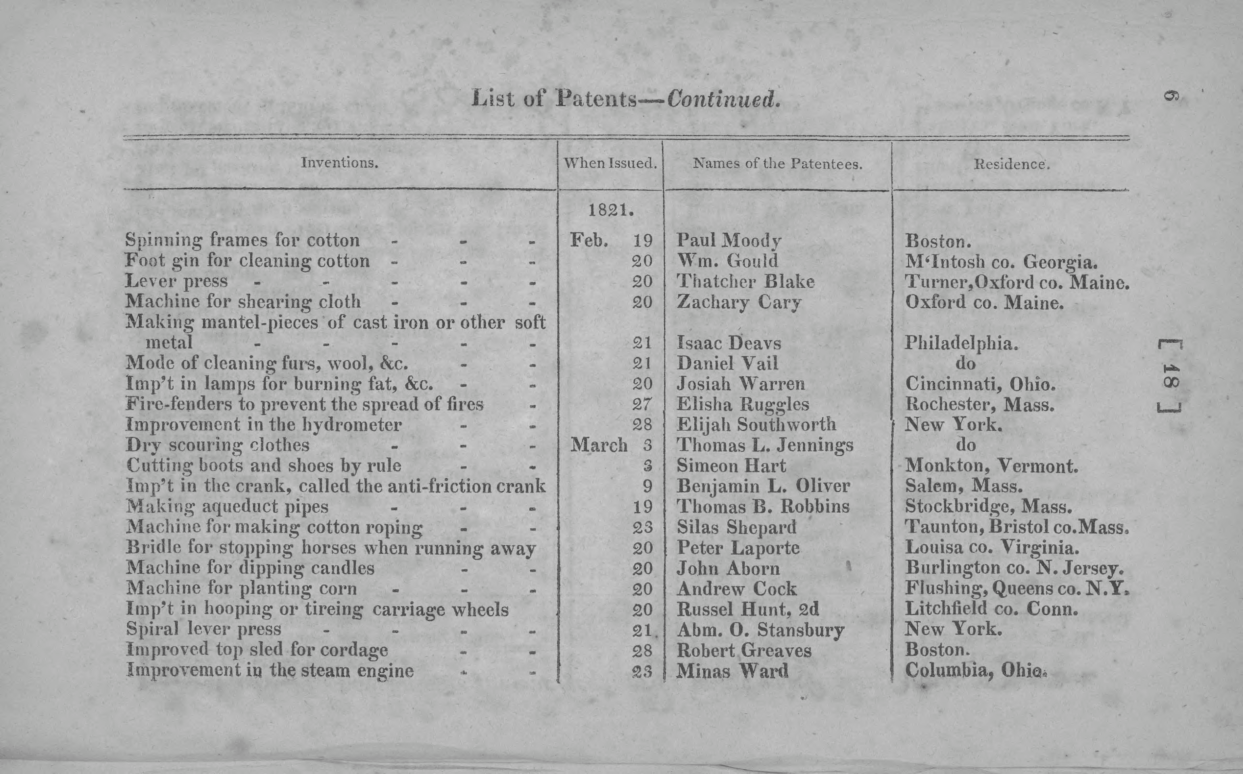
Full file: Open full-size page 1 · Open complete supplied PDF
Evidence classification: Contemporary federal patent-list entry; not the missing patent specification or evidence of income.
Rights note: Public-domain federal publication.
Recovered contextual court record — New Jersey Chancery file J35-819 (October 2026): BEHI has received and examined a 103-page scan of First National Bank of Freehold v. John I. Thompson et al. from the New Jersey State Archives. The complaint addresses contested Monmouth County land conveyances, and the December 18, 1899 decree set aside specified transfers to Caroline M. Flander and Horatio N. Terrett as against the bank's judgment and execution (PDF pp. 1–8, 47–49). Deposition testimony (PDF pp. 61–75) supplies leads concerning a separate 1899 special master's sale. Evidence status: original creditor-litigation case received and reviewed; the separate Thompson estate partition bill, report of sale, purchaser schedule, and deeds remain unverified in this file. Jennings connection: not established; the documents do not prove that Thomas L. Jennings owned these parcels, took part in the case, or received sale proceeds. Full scans are held for internal research; public image reproduction is pending a rights review.
How a source becomes a usable Receipt
Identify the original
Match repository, publication title, printed date, page, and document image.
State the narrow fact
Transcribe the relevant entry or passage and identify exactly which assertion it supports.
Preserve the boundary
Keep publication facts, retrospective accounts, uninspected leads, and BEHI interpretation distinct.
Evidence workflow. The Jennings obituary is a practical example: the supplied filename says 1869, but the printed masthead says March 1859. BEHI retains the filename as provenance and uses the inspected publication date for the citation. Likewise, the patent-list row supports a grant date without supplying the missing specification or earnings.
RECEIPT — NEW JERSEY CHANCERY CASE J35-819
Source: New Jersey State Archives, First National Bank of Freehold v. John I. Thompson et al., Court of Chancery, J35-819. Record: 103-page scanned case file, retained internally by BEHI; separate rescan of image 16 still to be reconciled.
Key original pages: complaint and tract descriptions, PDF pp. 1–8; December 18, 1899 decree, pp. 47–49; witness depositions, pp. 61–75.
What this receipt establishes: The Chancery Court ruled that identified conveyances to Caroline M. Flander and Horatio N. Terrett were void against the bank’s judgment and execution. The testimony also discusses a distinct special master’s sale, requiring separate documentation.
What it does not establish: A Jennings ownership interest, the outcome of the separate estate partition sale, its purchasers or prices, or revenue received by Jennings. Classification: verified court record; unverified Jennings-family link. No original scanned page is displayed pending reproduction-permission review.
SOURCE REGISTER & EVIDENCE LIMITS
EVIDENCE & CONTEXT
| SOURCE | DESCRIPTION | DATE | EVIDENCE CLASSIFICATION | NOTES |
|---|---|---|---|---|
| 1822 State Department patent list | Primary government report | January 8, 1822 | VERIFIED | Scanned government table, printed p. 6 (PDF page 6), directly confirms dry scouring, Thomas L. Jennings, March 3, 1821, and New York residence. The list does not reproduce the specification or document earnings. |
| Douglass’ Monthly · Thomas L. Jennings obituary | Inspected contemporary newspaper scan | March 1859 · p. 36 | VERIFIED | Printed masthead is March 1859, despite the supplied filename saying 1869. Reports death in New York on February 11. Retrospective business and civic accounts remain attributed. |
| New-York Gazette & General Advertiser | Advertisement / published reproduction | March 13, 1821 · p. 4 | ATTRIBUTED | Inspected advertisement clipping reproduced by the Gotham Center and identified as March 13, 1821, p. 4. It names Jennings at 61 Nassau Street, offers garment cleaning and secondhand clothing sales, and claims federal letters patent. The clipping does not include its masthead; issue date remains attributed to the reproduction citation. No sales totals established. |
| New-York American · Jennings v. Cox | Earlier newspaper transcription | Reported December 6, 1821 | ATTRIBUTED | Prior research describes trespass for destroying signs and $50 damages, with the patent produced in evidence. Recover the supplied scan and reconcile the masthead; do not describe this as patent infringement. |
| Frederick Douglass’ Paper · Union House | Earlier advertisement transcription | June 8, 1855 · p. 4 | ATTRIBUTED | 167 Church Street; issue and ad-run details require original reinspection and father/son identity confirmation. |
| Weekly Anglo-African · family hotel advertisements | Earlier research lead | 1860–1864 | ATTRIBUTED | Empire State Hotel / Union House at 541 Broome Street concerns later family enterprise after Jennings’s death. Originals and identities remain to be checked. |
| National Inventors Hall of Fame | Institutional interpretation | Modern institutional biography | ATTRIBUTED | Identifies patent number 3306X, 2015 induction and February 11, 1859 death. March 3, 1821 is independently confirmed by the federal report. Not a patent specification. |
| MIT Lemelson | Institutional interpretation | Modern institutional biography | ATTRIBUTED | Recognition and biographical context. Priority, family emancipation and proceeds claims require distinct documentary support. |
| H.Res. 514 · introduced text | Inspected congressional document | March 12, 2014 | VERIFIED | Introduced and referred to committee. This is a proposal for recognition, not proof that a resolution passed; historical recitals remain attributed. |
| 1850 federal census | Unresolved acquisition | Requested locator: NYC Ward 5, p. 22; M432, roll 537 | ATTRIBUTED | Original household page not recovered for this audit. Do not publish household or valuation figures from an uninspected locator. |
| Property / mortgage instruments | Unresolved acquisition | 1841–1849 leads | ATTRIBUTED | 157/167 Church Street and Scott–Smith / Jinnings–Scott leads require deeds, legal descriptions and mortgage recitals. No consideration or debt amount verified. |
| Schomburg · John H. Hewitt writings | Prior request / archival lead | Sc MG 612 · Box 4, Folder 5 | ATTRIBUTED | Delivery not confirmed. Folders 6–7 remain follow-up leads; a request is not an inspected document. |
| Red Bank Register · Special Master’s Sale | Inspected contemporary newspaper advertisement | March 1, 1899 · PDF p. 15 | VERIFIED CONTEXTUAL | New Jersey Chancery-ordered sale of Joseph I. Thompson estate real estate. David S. Crater is named as Special Master; one parcel is a farm near Atlantic Highlands described as about 180 acres with contiguous salt meadow. This record does not establish Jennings-family ownership or a direct Jennings connection. |
RESEARCH GAPS & OPEN QUESTIONS
ECONOMIC INDICATORS — MISSING EVIDENCE
Annual revenue and profit
Content condition: Not yet established. Jennings tailoring and cleaning enterprise
Reporting period not established
Evidence needed / present limit: Requires sales and expense accounts; a patent or obituary cannot establish earnings.
Patent royalties
Content condition: Not yet established. Thomas L. Jennings
Reporting period not established
Evidence needed / present limit: Requires licensing agreements and payment records. Trespass damages are not patent royalties.
Personal net worth
Content condition: Not yet established. Thomas L. Jennings
Reporting period not established
Evidence needed / present limit: Requires dated assets, debts and probate records; property leads remain unresolved.
The review below distinguishes inspected evidence, corrections and the original records still needed.
THE RECORD & ITS LIMITS
The federal table’s date columns have been visually reconciled: March 3, 1821 confirmed. Seek any surviving patent specification or related correspondence.
March advertisement clipping recovered and inspected; obtain its full issue to confirm the masthead date. Recover the December 6, 1821 court-report scan and check its legal characterization.
Earlier 1850 request: NYC Ward 5, p. 22, M432 roll 537. Household page and 1855 state census remain open.
Obtain 157/167 Church Street instruments, Scott–Smith 1841/42 and 1849 leads (Vol. 525), and Jinnings–Scott instrument.
Seek manumission, payment, probate and business-account records before asserting a financial total.
Carry forward Sc MG 612, Box 4, Folder 5 request and Marine Court case acquisition; delivery not confirmed.
Reinspect 1860–1867 hotel and directory sources. Long Branch atlas and 1870 household material cannot document a living founder who died in 1859.
RESEARCH GAP — THOMPSON PROPERTY CHAIN
New primary-source advancement (October 16, 2026): The complete 103-page J35-819 creditor-litigation scan is now held by BEHI. Its December 18, 1899 decree and related testimony clarify later Thompson-property conveyances. The original estate partition bill, Crater sale report, purchaser identities, prices, and master’s deeds have not been established by this creditor case.
Verified contextual receipt: The March 1, 1899 Red Bank Register documents a Chancery-ordered sale of Joseph I. Thompson estate property conducted by Special Master David S. Crater, including a farm near Atlantic Highlands described as about 180 acres with contiguous salt meadow.
Why BEHI is tracking it: The record confirms the separate Thompson estate partition/sale proceeding now being used to reconstruct the later property chain connected to the broader Jennings-family Long Branch investigation.
Evidence boundary: The advertisement does not identify the complainant, successful purchaser, final sale price, resulting deed, or any direct ownership interest by Thomas L. Jennings or his family.
Open question: Can the 1898–1899 Thompson partition file and resulting master’s deeds establish a documentary connection—or definitively rule out a connection—between the Thompson property chain and the Jennings family’s Long Branch business/property activity?
RESEARCH UPDATES & RECONCILIATION
Evidence status: Earlier leads are retained without claiming that missing scans have been recovered. Verification applies claim by claim.
Read full note: Document-by-document reconciliation of earlier research
DOCUMENT-BY-DOCUMENT RECONCILIATION — ADDITIONAL EARLIER RESEARCH
| DOCUMENT | EARLIER FINDING / LOCATOR | AUDIT DISPOSITION |
|---|---|---|
| Freedom’s Journal, March 30, 1827, p. 4 | Earlier transcription: cash purchases and resale of cast-off clothes; 110 Nassau Street, formerly 64. | Original page not recovered in this audit. Retained as a commercial evidence lead; no sales quantity or income verified. |
| Freedom’s Journal, April 6, 1827, p. 4 | Earlier research identifies another clothing advertisement. | Each issue requires its own original-page check. |
| Freedom’s Journal, April 20, 1827, p. 4 | Earlier research identifies another clothing advertisement. | Repeat advertising is not a financial account. |
| Freedom’s Journal, April 27, 1827, p. 4 | Earlier research identifies another clothing advertisement. | Original-page check pending. |
| 1827–28 New York directory | Earlier transcription: Thomas L. Jinnings, tailor, 110 Nassau. | Name variant retained; original page and identity reconciliation pending. |
| 1850–51 New York directory | Earlier transcription: Jinnings Thomas L., 167 Church; Tailors & Drapers. | Occupation and address lead; no ownership inferred. |
| 1852 directory | Earlier transcription: T. L. Jennings, 167 Church. | Original-page recovery pending. |
| Frederick Douglass’ Paper, May 25 and June 1, 1855 | Earlier research identifies Union House ad insertions. | Original images not recovered; tracked separately from June 8. |
| Frederick Douglass’ Paper, June 8, 1855, p. 4 | Vol. VIII, No. 25, whole No. 389. Earlier transcription names Thomas L. Jennings as proprietor at 167 Church; day/week/month lodging. | Reinspection and father/son identity check pending. Proprietorship does not establish property ownership. |
| 1859–60 directory | Earlier transcription: widow Eliza, boardinghouse, 157 Church. | Post-death household/business lead; distinguish 157 from 167. |
| 1860, 1861 and 1864 hotel advertisements | Earlier transcriptions identify Widow T. L. Jinnings and Empire State Hotel / Union House, 541 Broome. | Separate family succession trail. Each issue’s exact citation and image must be recovered. |
| Zion’s Standard, September 4, 1867 | Earlier research identifies a notice in the later family trail. | Contents and identity unresolved until original recovered. |
| African Society history, 1892 | Earlier transcription describes Thomas L. Jinnings as a dealer in real estate. | Retrospective account; obtain page and corroborating instruments before asserting transactions. |
| Scott–Smith conveyances, 1841/1842 and 1849 | Earlier research alternates transaction and recording years. 1849 New York Conveyances, vol. 525; alleged earlier Jinnings mortgage connection. | No mortgage amount or ownership adopted. Recover instruments and reconcile execution, recording and party identities. |
| 1870 census and Long Branch materials | Later family/Elizabeth Jennings Graham and hotel trail. | Jennings died in 1859. These cannot establish him as a living 1870 business operator; no uninspected valuation published. |
Record filename, printed date and repository separately.
Verification applies claim by claim.
Portrait and scan reproduction rights require review.
These leads are retained without claiming the missing scans have been recovered. Have a document that could help? Contact BEHI with its source and provenance. Submissions are reviewed before inclusion.
PREVIOUS RESEARCH RECONCILED
These leads are retained without claiming the missing scans have been recovered. Have a document that could help? Contact BEHI with its source and provenance. Submissions are reviewed before inclusion.
Jennings №7 — Death year and obituary date
Audited Historical Assertion
The contemporary obituary reports Jennings’s death in New York on February 11, 1859.
BEHI Academic Analysis & Research Clarification
The inspected issue is Douglass’ Monthly, March 1859, p. 36. The supplied filename says 1869; that filename is incorrect. The older 1856 death year is not retained.
Supporting Archival Receipts & Primary Sources
HOW TO READ THE RECEIPTS & ARCHIVAL CITATIONS
Evidence linked on this page may include primary archival records, contemporary sources, repository citations, authoritative secondary scholarship, and Institute analysis. Where a physical archival holding has been identified, BEHI provides repository and locator information when available.
Cite This Profile
The Black Economic History Institute (BEHI) Digital Archive