Profile №8 BEHI-P008-AFH
Alonzo F. Herndon
1857/1858–1927
Entrepreneur, Barber, Insurance Founder, Real Estate Investor
Overview
TAKEAWAY: Herndon developed barbering, property interests, and insurance enterprises. Advertisements and state insurance statements document businesses and company growth, not his personal net worth.
BEHI PROFILE — RESEARCH IN PROGRESS — UPDATED OCTOBER 28, 2026. EVIDENCE IS CLASSIFIED CLAIM BY CLAIM; ATTRIBUTED ACCOUNTS AND UNRESOLVED RESEARCH QUESTIONS ARE IDENTIFIED THROUGHOUT.
OVERVIEW
Alonzo F. Herndon built a career across barbering, real estate and insurance in Atlanta. Contemporary advertisements and Georgia insurance statements document identifiable enterprises and substantial company growth. They do not establish his personal net worth. This profile preserves unresolved identity, property and financial questions.
Three enterprises, three documentary trails
Barbering
The named proprietor, shop address, and advertised staff connect Herndon to an identifiable service business.
Property
Published accounts describe investment, but titles, debt, and appraisals are needed to reconstruct the actual holdings.
Insurance
State statements record company resources and obligations across the Atlanta Mutual–Atlanta Life transition.
Sources: 1927 Georgia Tech advertisement, the March 1921 Crisis profile, and Georgia insurance reports. BEHI analysis: diversification is a useful way to study the career. This map does not establish that a particular shop profit or property sale funded a specific company transaction.
A 1927 advertisement identifies Herndon as proprietor at 66 Peachtree Street.
Annual state statements distinguish Atlanta Mutual and Atlanta Life across their development.
Company assets, insurance in force and personal wealth are separate measures.
EXACT ACCOMPLISHMENTS
The 1927 Georgia Tech advertisement names A. F. Herndon as proprietor at 66 Peachtree Street and advertises 25 barbers. It does not establish year-round payroll.
Georgia statements record admitted company assets of $71,645.91 in 1916 and $1,154,927.79 at year-end 1927. These are company measures.
Contemporary and institutional accounts connect barbering, property investment and insurance. Individual property titles and financing links remain under investigation.
THE RECORD & ITS LIMITS
Admitted company assets rise from $71,645.91 in 1916 to $1,154,927.79 at the end of 1927.
Herndon died July 21, 1927 in institutional accounts. The year-end company statement includes operations after his death.
Representative 1902 barber-ledger photographs have been received; complete ledger coverage and analysis remain pending, alongside title instruments, tax returns, probate inventory and a cleared portrait.
A 1927 advertisement identifies Herndon as proprietor at 66 Peachtree Street.
Annual state statements distinguish Atlanta Mutual and Atlanta Life across their development.
Company assets, insurance in force and personal wealth are separate measures.
Herndon's significance rests on institution building and sustained enterprise. Verification is assigned to individual claims; the overall profile remains under research.
What Would Move This Profile Forward?
These are the next evidence priorities for strengthening this Profile. Each identifies a concrete research step and what it could help establish.
- Complete the 1902 barber-ledger review
Obtain the remaining ledger pages and reconcile receipts, expenses and wage entries. The representative photographs already supplied establish a surviving account book; a fuller review could support operating measures.
- Recover original insurance organization records
Inspect charters, amendments, early accounts and regulatory reports. These would clarify legal transitions and distinguish company finances from Herndon’s personal interests.
- Resolve property ownership and tenancy
Acquire the full 1919 newspaper page and relevant deeds, leases and tax records. These would test the 66 Peachtree transaction and distinguish a tenant’s business from ownership of the building.
- Establish personal estate holdings
Obtain the estate inventory, appraisals, debts and settlement accounts. These would provide a dated basis for assessing personal wealth separately from corporate assets.
Read the Research Gaps & Open Questions for the unresolved issues and evidence limits. New material is reviewed before claims or classifications change.
THE RECEIPTS OR EVIDENCE SUPPORTING THIS PROFILE
Evidence labels apply to individual claims. Read the evidence guide and content-condition definitions.
| SOURCE / LOCATOR | RECORD / CONTEXT | DATE / PERIOD | EVIDENCE STATUS | SUPPORT / LIMITS |
|---|---|---|---|---|
| Georgia insurance report — 1916 | Government statement | 1916 | VERIFIED | PDF pp. 702–704; admitted-assets table printed p. 638. Atlanta Mutual Insurance Company: $25,000 paid capital; November 8 reinsurance item $38,528.86; admitted assets $71,645.91. |
| Georgia insurance report — 1927 | Government statement | 1927 | VERIFIED | PDF p. 108; printed p. 103: admitted assets $1,154,927.79; liabilities $882,630.08; capital $100,000; surplus $172,297.71; insurance $24,940,424.73; premiums $1,738,869.66; total income $1,794,091.63; net policy obligations paid $713,387.46. The scan says 1927, although OCR reads 1937. Year-end figures extend beyond Herndon's July death. |
| Georgia Tech — Herndon's barber-shop advertisement | Contemporary advertisement | 1927 | VERIFIED | The 1927 Tech Terror and Tatler, PDF p. 10, left page: A. F. Herndon, proprietor, 66 Peachtree Street, and advertised 25 barbers. Advertising establishes what was offered; it does not establish year-round payroll or profit. |
| Herndon Home — National Register nomination | Government heritage interpretation | Later historical account | ATTRIBUTED | PDF pp. 20–21 report 1905 policyholders 6,324, insurance $180,962 and income $5,446; September 27, 1916 charter; November 8 operations; September 29, 1922 charter/name transition. This nomination is not the original charter or 1905 operating ledger. |
Background
TAKEAWAY: Institutional histories trace Herndon’s path from enslavement to Atlanta business. Conflicting birth-year evidence remains unresolved.
BACKGROUND
Institutional accounts place Herndon's origins in slavery in Walton County, Georgia, and describe his transition into barbering and Atlanta business. The surviving reproduced passport supplies a conflicting birth year. The profile reports that conflict rather than selecting an exact date without reconciliation.
Trade, family, and preparation for continuity
Post-emancipation enterprise
Heritage histories trace his movement from enslavement into skilled barbering and Atlanta business.
Adrienne’s contribution
The nomination credits Adrienne Herndon with the home’s design and links her work to Atlanta University.
A next generation
The same account describes Norris’s business education and preparation to participate in the insurance enterprise.
Attributed to the Herndon Home National Register nomination, especially PDF pp. 4 and 18. These accounts widen the family and institutional setting; they do not resolve the conflicting birth years or establish share ownership. Original family and business records remain necessary for those questions.
HISTORICAL & ECONOMIC CONTEXT
The 1912 passport application names Alonzo Franklin Herndon.
Later institutional histories describe enslavement, emancipation and trade training.
Family and succession evidence requires distinct records for Alonzo and Norris Herndon.
THE RECORD & ITS LIMITS
The reproduced sworn application gives June 26, 1857; The Crisis and institutional accounts give 1858. No independent birth record resolves this audit.
The Crisis reports arrival at age 28 with $11. This is a contemporary retrospective account, not an inspected cash ledger.
Institutional accounts give July 21, 1927. End-of-year Atlanta Life figures must not be assigned solely to the founder's lifetime.
The 1912 passport application names Alonzo Franklin Herndon.
Later institutional histories describe enslavement, emancipation and trade training.
Family and succession evidence requires distinct records for Alonzo and Norris Herndon.
Match occupation, location, company and generation before attaching transactions or wealth to Herndon.
EVIDENCE & CONTEXT
| SOURCE | DESCRIPTION | DATE | EVIDENCE CLASSIFICATION | NOTES |
|---|---|---|---|---|
| The Crisis — Men of the Month | Contemporary magazine | March 1921 | ATTRIBUTED | PDF pp. 25–26; printed pp. 215–216. Contemporary account reports three shops valued at $30,000, $15,000 and $15,000; estimated real estate of $500,000; $3,000 income tax and a $10,000 nursery gift. These are published claims, not ledgers, appraisals, tax returns or payment instruments. |
| Herndon Home — National Register nomination | Government heritage interpretation | Later historical account | ATTRIBUTED | PDF pp. 20–21 report 1905 policyholders 6,324, insurance $180,962 and income $5,446; September 27, 1916 charter; November 8 operations; September 29, 1922 charter/name transition. This nomination is not the original charter or 1905 operating ledger. |
| Passport application — reproduced image | Reproduced government record | May 24, 1912 | DISPUTED | Application 74574 names Alonzo Franklin Herndon, Walton County, and June 26, 1857 birth. Institutional biographies and The Crisis give 1858. Treat the birth year as unresolved; the application is a self-report. NARA series/roll and full original provenance remain to be reconciled. |
The Problem
TAKEAWAY: Herndon operated under racial exclusion while building service and insurance businesses. Historical context alone does not quantify demand or establish his particular motives.
THE PROBLEM
Herndon's businesses operated amid racial exclusion and unequal access to economic institutions. Barbering offered a market for skilled services; insurance pooled policyholder obligations and required capital and reserves. Historical context does not by itself prove a particular business motive or quantify unmet demand.
How insurance answers a household risk
Premiums collected
Policyholders pay for specified contractual protection.
Resources & obligations
The insurer holds assets while recognizing liabilities for its commitments.
Benefits paid
Claims and policy obligations translate the contract into payments when covered events occur.
Net policy obligations paid in the 1927 company statement.
Explanatory insurance diagram. Figure from 1927 Georgia insurance report, PDF p. 108 / printed p. 103. Payment totals establish a company measure, not individual household outcomes, unmet demand, or Herndon’s income. The report’s precise category is retained rather than relabeling every payment a death benefit.
DIMENSIONS OF THE PROBLEM
Advertisements identify services and staffing claims.
Insurance statements record premiums, obligations, assets and liabilities.
Paid capital and reserves belong to company accounting.
HOW THE PROBLEM SHOWED UP
A shop advertisement is direct evidence of a marketed offering, not a measured customer count.
Policies and insurance in force represent contractual exposure; they are not deposits, assets or profits.
BEHI connects enterprise with economic access as analysis. A causal claim requires stronger records.
Advertisements identify services and staffing claims.
Insurance statements record premiums, obligations, assets and liabilities.
Paid capital and reserves belong to company accounting.
Business records allow concrete study of economic activity without assigning undocumented motives or market shares.
EVIDENCE & CONTEXT
| SOURCE | DESCRIPTION | DATE | EVIDENCE CLASSIFICATION | NOTES |
|---|---|---|---|---|
| Georgia insurance report — 1920 | Government statement | 1920 | VERIFIED | PDF p. 39, Table 9: Georgia-only premiums $817,213.64, losses paid $394,107.85, incurred $392,169.35. PDF pp. 538–539, printed pp. 513–514: company-wide net premiums $1,113,563.99 and admitted assets $201,347.74. The geographic scopes must remain separate. |
| Georgia insurance report — 1927 | Government statement | 1927 | VERIFIED | PDF p. 108; printed p. 103: admitted assets $1,154,927.79; liabilities $882,630.08; capital $100,000; surplus $172,297.71; insurance $24,940,424.73; premiums $1,738,869.66; total income $1,794,091.63; net policy obligations paid $713,387.46. The scan says 1927, although OCR reads 1937. Year-end figures extend beyond Herndon's July death. |
| Georgia Tech — Herndon's barber-shop advertisement | Contemporary advertisement | 1927 | VERIFIED | The 1927 Tech Terror and Tatler, PDF p. 10, left page: A. F. Herndon, proprietor, 66 Peachtree Street, and advertised 25 barbers. Advertising establishes what was offered; it does not establish year-round payroll or profit. |
What He Built
TAKEAWAY: Herndon’s enterprises involved different businesses and legal entities. Atlanta Mutual and Atlanta Life figures must retain their dates and organizational identities.
WHAT WAS BUILT
Herndon's record spans barber shops, reported property investment and an insurance organization that developed from Atlanta Mutual into Atlanta Life. The sources document different legal entities and dates; their finances must not be merged into one personal balance sheet.
The institution changes form
1905 · Association
The state report identifies Atlanta Mutual Insurance Association and A. F. Herndon as president.
1916 · Company
The report identifies Atlanta Mutual Insurance Company and records $25,000 in paid capital.
1922 · Atlanta Life
The state table names Atlanta Life, with $100,000 capital and separately reported assets, liabilities, and surplus.
Sources: 1905 Georgia insurance report, printed p. 405; 1916 Georgia insurance report, printed p. 638 and related statement; 1922 Georgia insurance report, folded table, PDF p. 57. This entity map follows the report names. Original charters and stock records are still needed to determine the exact legal transitions and shareholders.
THE ENTERPRISE SYSTEM
The Georgia Tech advertisement names the proprietor and location.
State annual reports identify companies and financial positions.
Contemporary wealth estimates await deeds and appraisals.
THE RECORD & ITS LIMITS
The NPS nomination describes a 1916 charter and 1922 name/legal-reserve transition. The original charters are acquisition targets.
The 1916 statement records paid capital and a November 8 reinsurance item. This independently supports part of the operating sequence.
Earlier research treats Herndon as tenant in a 1919 sale of 66 Peachtree. Original sale reporting and deeds remain pending.
The Georgia Tech advertisement names the proprietor and location.
State annual reports identify companies and financial positions.
Contemporary wealth estimates await deeds and appraisals.
Occupying a shop does not prove ownership of its building. Company capitalization does not establish the founder's personal assets.
EVIDENCE & CONTEXT
| SOURCE | DESCRIPTION | DATE | EVIDENCE CLASSIFICATION | NOTES |
|---|---|---|---|---|
| Georgia insurance report — 1916 | Government statement | 1916 | VERIFIED | PDF pp. 702–704; admitted-assets table printed p. 638. Atlanta Mutual Insurance Company: $25,000 paid capital; November 8 reinsurance item $38,528.86; admitted assets $71,645.91. |
| Georgia insurance report — 1922 | Government statement | 1922 | VERIFIED | PDF p. 57, folded table: Atlanta Life admitted assets $405,810.09; liabilities $263,841.39; capital $100,000; surplus $41,968.70; insurance $9,745,977.80. |
| The Crisis — Men of the Month | Contemporary magazine | March 1921 | ATTRIBUTED | PDF pp. 25–26; printed pp. 215–216. Contemporary account reports three shops valued at $30,000, $15,000 and $15,000; estimated real estate of $500,000; $3,000 income tax and a $10,000 nursery gift. These are published claims, not ledgers, appraisals, tax returns or payment instruments. |
| Georgia Tech — Herndon's barber-shop advertisement | Contemporary advertisement | 1927 | VERIFIED | The 1927 Tech Terror and Tatler, PDF p. 10, left page: A. F. Herndon, proprietor, 66 Peachtree Street, and advertised 25 barbers. Advertising establishes what was offered; it does not establish year-round payroll or profit. |
| Herndon Home — National Register nomination | Government heritage interpretation | Later historical account | ATTRIBUTED | PDF pp. 20–21 report 1905 policyholders 6,324, insurance $180,962 and income $5,446; September 27, 1916 charter; November 8 operations; September 29, 1922 charter/name transition. This nomination is not the original charter or 1905 operating ledger. |
| Atlanta Georgian — 66 Peachtree sale | Prior transcription | 1919 lead | ATTRIBUTED | Earlier research describes a $165,000 building sale from the R. L. Worthen estate to Lee Hogan, with Herndon as tenant. Exact issue and original page remain unrecovered. No Herndon ownership or purchase price is verified. |
Accomplishments
TAKEAWAY: Inspected sources support a continuing service business and insurance-company growth. Philanthropy accounts remain attributed where payment and recipient records are missing.
ACCOMPLISHMENTS
The inspected evidence supports a long-running service enterprise and the growth of an insurance company. Published philanthropy accounts broaden the picture but remain attributed until payment and recipient records are recovered.
The 1927 company balance sheet
Admitted assets: $1,154,927.79
Liabilities
$882,630.08 · company obligations
Capital
$100,000.00 · separately stated capital
Surplus
$172,297.71 · separately stated surplus
The three components sum to admitted assets. Source: 1927 Georgia insurance report, PDF p. 108 / printed p. 103. Verified statement figures · nominal dollars. Segment widths show each component’s proportion. Surplus is not annual profit; these are company finances, and the year-end statement includes operations after Herndon’s July death.
ACCOMPLISHMENT LEDGER
Dates and evidence classifications apply to the specific findings below. Economic significance is BEHI analysis; evidence limits remain attached to each entry.
| DATE / PERIOD | ACCOMPLISHMENT | ECONOMIC SIGNIFICANCE | SOURCE / LOCATOR | EVIDENCE CLASSIFICATION | EVIDENCE LIMITS |
|---|---|---|---|---|---|
| 1927 | Identifiable barbering operation A contemporary advertisement names A. F. Herndon as proprietor at 66 Peachtree Street and advertises 25 barbers. | Documents a named service enterprise and its advertised capacity. | Georgia Tech — Herndon's barber-shop advertisement Tech Terror and Tatler, PDF p. 10, left page. | VERIFIED | Advertised staffing is not a verified payroll series or annual profit. |
| Year-end 1927 | Insurance institution reached a documented scale Atlanta Life’s state statement reports $1,154,927.79 in admitted assets. | Measures institutional resources and continuity through leadership change. | Georgia insurance report — 1927 PDF p. 108; printed p. 103. | VERIFIED | Company assets are not personal wealth. The statement includes months after Herndon’s July death; this is not solely his lifetime result. |
| Reported 1920; published 1921 | Nursery support Published accounts report $10,000 for nursery purchase, equipment or support. | Describes reported support for community care infrastructure. | The Crisis — Men of the Month The Crisis, March 1921, pp. 215–216; related nursery clipping below. | ATTRIBUTED | The gift has not been reconciled to a deed, payment instrument or recipient ledger. |
ACCOMPLISHMENT CATEGORIES
Annual company statements establish measurable growth.
The 1927 advertisement promotes 25 barbers in attendance.
The Crisis and a reproduced newspaper clipping report nursery support.
THE RECORD & ITS LIMITS
1927 admitted assets, liabilities and surplus are verified from the scanned state table.
An advertisement's staffing claim is not a payroll series or proof of 25 permanent jobs.
Reported $10,000 nursery support is not yet reconciled to a deed, cancelled payment or recipient ledger.
Annual company statements establish measurable growth.
The 1927 advertisement promotes 25 barbers in attendance.
The Crisis and a reproduced newspaper clipping report nursery support.
Publish the precise achievement the record supports, with its entity, date and limitations.
EVIDENCE & CONTEXT
| SOURCE | DESCRIPTION | DATE | EVIDENCE CLASSIFICATION | NOTES |
|---|---|---|---|---|
| Georgia insurance report — 1927 | Government statement | 1927 | VERIFIED | PDF p. 108; printed p. 103: admitted assets $1,154,927.79; liabilities $882,630.08; capital $100,000; surplus $172,297.71; insurance $24,940,424.73; premiums $1,738,869.66; total income $1,794,091.63; net policy obligations paid $713,387.46. The scan says 1927, although OCR reads 1937. Year-end figures extend beyond Herndon's July death. |
| The Crisis — Men of the Month | Contemporary magazine | March 1921 | ATTRIBUTED | PDF pp. 25–26; printed pp. 215–216. Contemporary account reports three shops valued at $30,000, $15,000 and $15,000; estimated real estate of $500,000; $3,000 income tax and a $10,000 nursery gift. These are published claims, not ledgers, appraisals, tax returns or payment instruments. |
| Georgia Tech — Herndon's barber-shop advertisement | Contemporary advertisement | 1927 | VERIFIED | The 1927 Tech Terror and Tatler, PDF p. 10, left page: A. F. Herndon, proprietor, 66 Peachtree Street, and advertised 25 barbers. Advertising establishes what was offered; it does not establish year-round payroll or profit. |
| Atlanta Constitution — nursery clipping | Reproduced newspaper clipping | Reported November 21, 1920 | ATTRIBUTED | Visible clipping reports $10,000 purchase and equipment for a nursery. Date and p. 12A are attributed to the reproduction citation; masthead and full original page were not recovered. |
Economic Impact
TAKEAWAY: State insurance reports measure company resources in historical dollars. They do not establish shop profits, founder equity, or estate net worth.
ECONOMIC IMPACT
Georgia insurance reports supply company-scale measures. Barber-shop revenues, wages, profits, founder equity and estate net worth remain unverified. All figures below are historical nominal dollars; no inflation conversion or modern wealth ranking is asserted.
Admitted assets across selected reporting years
Verified state-report figures · historical nominal dollars. Sources: 1916 Georgia insurance report, 1920 Georgia insurance report, 1922 Georgia insurance report, 1923 Georgia insurance report, 1926 Georgia insurance report, and 1927 Georgia insurance report; precise page locators follow below. Bars share a zero baseline. Selected years are not a complete annual series, and company form and reporting changes limit direct comparisons. The 1927 year-end amount extends beyond the founder’s lifetime. This chart measures company resources, not personal wealth.
KEY ECONOMIC INDICATORS
Each measure identifies its entity, period, source and evidence limits. Dollar amounts are nominal historical U.S. dollars. Assets, revenue, profit, transaction amounts and employment measures are distinct. “Not yet established” identifies a research gap, not zero or “not applicable.”
| MEASURE / VALUE | ENTITY / PERIOD | SOURCE / LOCATOR | CONTENT CONDITION / EVIDENCE CLASSIFICATION | INTERPRETATION / LIMITS |
|---|---|---|---|---|
| Admitted assets $71,645.91 | Atlanta Mutual 1916 | Georgia insurance report, 1916; Digital Library of Georgia link in Evidence & Context. PDF pp. 702–704, printed p. 638. | Documented VERIFIED | Regulatory company assets, not Herndon’s personal net worth. |
| Admitted assets $405,810.09 | Atlanta Life 1922 | Georgia insurance report, 1922; Digital Library of Georgia link in Evidence & Context. PDF p. 57, folded statement. | Documented VERIFIED | Company-level regulatory measure; not revenue or profit. |
| Admitted assets $1,154,927.79 | Atlanta Life 1927 | Georgia insurance report, 1927; Digital Library of Georgia link in Evidence & Context. PDF p. 108, printed p. 103. | Documented VERIFIED | Year-end figure includes months after Herndon’s July death. |
| Premium income $1,738,869.66 | Atlanta Life 1927 | Georgia insurance report, 1927; Digital Library of Georgia link in Evidence & Context. PDF p. 108, printed p. 103. | Documented VERIFIED | Premium income is not net profit or personal income. |
For evidence-label definitions, see the Receipts evidence guide.
THE RECORD & ITS LIMITS
1916 $71,645.91; 1920 $201,347.74; 1922 $405,810.09; 1923 $495,342.82; 1926 $942,034.31; 1927 $1,154,927.79. Entity and reporting changes limit simple comparisons.
Georgia-only premiums of $817,213.64 differ from company-wide net premiums of $1,113,563.99. Neither amount is Herndon's income.
Assets $1,154,927.79 = liabilities $882,630.08 + capital $100,000 + surplus $172,297.71.
The Crisis estimated real estate at $500,000 and reported shop values of $30,000/$15,000/$15,000. These are neither audited net worth nor shop earnings.
Prior semiannual income and claims figures are retained as leads only; they are excluded from the verified series.
Admitted assets $71,645.91.
Admitted assets $405,810.09.
Admitted assets $1,154,927.79; insurance $24,940,424.73.
Coverage measures contractual exposure. Assets measure company resources. Income, profit, equity and estate value require their own evidence.
EVIDENCE & CONTEXT
| SOURCE | DESCRIPTION | DATE | EVIDENCE CLASSIFICATION | NOTES |
|---|---|---|---|---|
| Georgia insurance report — 1916 | Government statement | 1916 | VERIFIED | PDF pp. 702–704; admitted-assets table printed p. 638. Atlanta Mutual Insurance Company: $25,000 paid capital; November 8 reinsurance item $38,528.86; admitted assets $71,645.91. |
| Georgia insurance report — 1917 | Government statement | 1917 | VERIFIED | PDF pp. 722–725. Net premiums $416,662.61; insurance at year end $1,235,318.00. These are company measures, not founder income. |
| Georgia insurance report — 1920 | Government statement | 1920 | VERIFIED | PDF p. 39, Table 9: Georgia-only premiums $817,213.64, losses paid $394,107.85, incurred $392,169.35. PDF pp. 538–539, printed pp. 513–514: company-wide net premiums $1,113,563.99 and admitted assets $201,347.74. The geographic scopes must remain separate. |
| Georgia insurance report — 1922 | Government statement | 1922 | VERIFIED | PDF p. 57, folded table: Atlanta Life admitted assets $405,810.09; liabilities $263,841.39; capital $100,000; surplus $41,968.70; insurance $9,745,977.80. |
| Georgia insurance report — 1923 | Government statement | 1923 | VERIFIED | PDF p. 73, folded table: Atlanta Life admitted assets $495,342.82; liabilities $360,198.72; capital $100,000; surplus $35,144.10; insurance $10,861,687.10. |
| Georgia insurance report — 1926 | Government statement | 1926 | VERIFIED | PDF p. 115; printed p. 108: admitted assets $942,034.31; liabilities $723,688.69; capital $100,000; surplus $118,345.62; insurance $21,441,724.00. |
| Georgia insurance report — 1927 | Government statement | 1927 | VERIFIED | PDF p. 108; printed p. 103: admitted assets $1,154,927.79; liabilities $882,630.08; capital $100,000; surplus $172,297.71; insurance $24,940,424.73; premiums $1,738,869.66; total income $1,794,091.63; net policy obligations paid $713,387.46. The scan says 1927, although OCR reads 1937. Year-end figures extend beyond Herndon's July death. |
| The Crisis — Men of the Month | Contemporary magazine | March 1921 | ATTRIBUTED | PDF pp. 25–26; printed pp. 215–216. Contemporary account reports three shops valued at $30,000, $15,000 and $15,000; estimated real estate of $500,000; $3,000 income tax and a $10,000 nursery gift. These are published claims, not ledgers, appraisals, tax returns or payment instruments. |
| 1918 semiannual insurance account | Prior transcription | June 30, 1918 lead | ATTRIBUTED | Earlier figures of $236,376.11 income and $104,304.46 claims were not recovered in this audit. Retain only as a reinspection lead; exclude from verified financial tables. |
Timeline
TAKEAWAY: The chronology separates contemporary records from attributed accounts. Original charters, early-life records, and the estate chronology remain open research questions.
TIMELINE
The chronology combines dated contemporary records with clearly attributed historical accounts. Original charters, early-life records and the estate chronology remain open.
Enterprise milestones and their evidence
- 1905Association identified
State statement names Herndon as president.
- 1912Passport self-report
Application supplies identity details and the disputed 1857 birth year.
- 1916Operating transition
State report records company capital and the November 8 reinsurance item.
- 1921Contemporary recognition
The Crisis profiles his shops, property, and reported community support.
- 1922Atlanta Life named
State table documents the company under its later name.
- 1927Founder & institution
July death precedes the final year-end company statement.
The visual combines verified report entries with a reproduced passport, contemporary retrospective biography, and attributed death chronology. Each retains its classification in the detailed record below; an ordered sequence does not turn every entry into a verified event.
TIMELINE AT A GLANCE
Birth year 1857/1858 remains disputed.
State statements document the changing company names.
The final year-end statement follows the founder's death.
THE RECORD & ITS LIMITS
June 26 birth: passport self-report conflicts with institutional and contemporary biography.
Barber ledger mentioned in scholarship; original pages not inspected.
Atlanta Mutual Insurance Association statement names A. F. Herndon as president.
May 24 passport application 74574.
September 27 charter date attributed to NPS; November 8 reinsurance item directly recorded in state statement.
NPS reports November 1921 petition and September 29, 1922 charter/name transition. 1922 state table names Atlanta Life.
Georgia Tech advertisement names Herndon at 66 Peachtree. July 21 death attributed to institutional accounts; year-end company statement is a later milestone.
Birth year 1857/1858 remains disputed.
State statements document the changing company names.
The final year-end statement follows the founder's death.
Separate the event date, publication date and later recollection. Preserve conflicts until stronger originals resolve them.
EVIDENCE & CONTEXT
| SOURCE | DESCRIPTION | DATE | EVIDENCE CLASSIFICATION | NOTES |
|---|---|---|---|---|
| Georgia insurance report — 1905 | Government statement | 1905 | VERIFIED | PDF p. 423; printed p. 405. Atlanta Mutual Insurance Association names A. F. Herndon as president, 202 Auburn Avenue. The $5,500 ledger bonds and stocks and $500 market-value excess are specific statement items, not total personal wealth. The later 6,324-policyholder / $5,446-income account is not verified by this page. |
| Georgia insurance report — 1916 | Government statement | 1916 | VERIFIED | PDF pp. 702–704; admitted-assets table printed p. 638. Atlanta Mutual Insurance Company: $25,000 paid capital; November 8 reinsurance item $38,528.86; admitted assets $71,645.91. |
| Georgia insurance report — 1922 | Government statement | 1922 | VERIFIED | PDF p. 57, folded table: Atlanta Life admitted assets $405,810.09; liabilities $263,841.39; capital $100,000; surplus $41,968.70; insurance $9,745,977.80. |
| Georgia insurance report — 1927 | Government statement | 1927 | VERIFIED | PDF p. 108; printed p. 103: admitted assets $1,154,927.79; liabilities $882,630.08; capital $100,000; surplus $172,297.71; insurance $24,940,424.73; premiums $1,738,869.66; total income $1,794,091.63; net policy obligations paid $713,387.46. The scan says 1927, although OCR reads 1937. Year-end figures extend beyond Herndon's July death. |
| Georgia Tech — Herndon's barber-shop advertisement | Contemporary advertisement | 1927 | VERIFIED | The 1927 Tech Terror and Tatler, PDF p. 10, left page: A. F. Herndon, proprietor, 66 Peachtree Street, and advertised 25 barbers. Advertising establishes what was offered; it does not establish year-round payroll or profit. |
| Herndon Home — National Register nomination | Government heritage interpretation | Later historical account | ATTRIBUTED | PDF pp. 20–21 report 1905 policyholders 6,324, insurance $180,962 and income $5,446; September 27, 1916 charter; November 8 operations; September 29, 1922 charter/name transition. This nomination is not the original charter or 1905 operating ledger. |
| Passport application — reproduced image | Reproduced government record | May 24, 1912 | DISPUTED | Application 74574 names Alonzo Franklin Herndon, Walton County, and June 26, 1857 birth. Institutional biographies and The Crisis give 1858. Treat the birth year as unresolved; the application is a self-report. NARA series/roll and full original provenance remain to be reconciled. |
| Herndon Home — 1902 barber ledger | Archival acquisition pending | 1902 lead | ATTRIBUTED | Prior scholarship points to an unprocessed Herndon Home collection. The Herndon Home supplied representative photographs of the 1902 ledger on October 1, 2026, showing entries and financial-record format. BEHI requested additional pages and clarified its research and prospective publication uses on October 16. The complete ledger has not been examined; revenue, wages and profits remain unverified. |
No verified records are currently published in this category.
Myths & Disputes
TAKEAWAY: Company assets are not personal wealth; advertised capacity is not a verified workforce. Tenancy, ownership, and retrospective accounts also require distinct evidence.
MYTHS & DISPUTES
The audit corrects several tempting conflations: company assets with personal wealth, advertised capacity with employment, tenancy with title, and a later historical account with an original operating statement.
Read the metric before drawing the conclusion
Sources: 1927 Georgia insurance report, 1927 Georgia Tech advertisement, and the unrecovered 1919 property-sale lead. Documented labels apply to the source’s specific statement, not an expanded claim. The birth-year conflict and OCR correction remain visible below.
COMMON SOURCES OF CONFUSION
The company asset total is not a personal net-worth calculation.
The 66 Peachtree sale lead names other parties.
Chairs, barbers and policyholders are distinct counts.
THE RECORD & ITS LIMITS
1857 in the passport versus 1858 in other accounts; exact year remains disputed.
6,324 policyholders, $180,962 insurance and $5,446 income are from a later nomination narrative, not the inspected 1905 statement page.
The Crisis describes an estimate of real estate. Debt and other liabilities were not supplied.
Earlier transcription concerns sale by the Worthen estate to Lee Hogan, with Herndon as tenant; original issue pending.
The undated reproduced ad gives chairs and baths; the dated 1927 ad advertises barbers. Do not interchange capacity and employment.
The scanned statement is for 1927; OCR's 1937 reading is rejected.
The Crisis reports shop values. Earlier shorthand describing $30,000/$15,000 as earnings is unsupported.
The company asset total is not a personal net-worth calculation.
The 66 Peachtree sale lead names other parties.
Chairs, barbers and policyholders are distinct counts.
An attractive narrative does not override the entity, metric or date stated in the document.
EVIDENCE & CONTEXT
| SOURCE | DESCRIPTION | DATE | EVIDENCE CLASSIFICATION | NOTES |
|---|---|---|---|---|
| Georgia insurance report — 1905 | Government statement | 1905 | VERIFIED | PDF p. 423; printed p. 405. Atlanta Mutual Insurance Association names A. F. Herndon as president, 202 Auburn Avenue. The $5,500 ledger bonds and stocks and $500 market-value excess are specific statement items, not total personal wealth. The later 6,324-policyholder / $5,446-income account is not verified by this page. |
| Georgia insurance report — 1927 | Government statement | 1927 | VERIFIED | PDF p. 108; printed p. 103: admitted assets $1,154,927.79; liabilities $882,630.08; capital $100,000; surplus $172,297.71; insurance $24,940,424.73; premiums $1,738,869.66; total income $1,794,091.63; net policy obligations paid $713,387.46. The scan says 1927, although OCR reads 1937. Year-end figures extend beyond Herndon's July death. |
| The Crisis — Men of the Month | Contemporary magazine | March 1921 | ATTRIBUTED | PDF pp. 25–26; printed pp. 215–216. Contemporary account reports three shops valued at $30,000, $15,000 and $15,000; estimated real estate of $500,000; $3,000 income tax and a $10,000 nursery gift. These are published claims, not ledgers, appraisals, tax returns or payment instruments. |
| Georgia Tech — Herndon's barber-shop advertisement | Contemporary advertisement | 1927 | VERIFIED | The 1927 Tech Terror and Tatler, PDF p. 10, left page: A. F. Herndon, proprietor, 66 Peachtree Street, and advertised 25 barbers. Advertising establishes what was offered; it does not establish year-round payroll or profit. |
| Herndon Home — National Register nomination | Government heritage interpretation | Later historical account | ATTRIBUTED | PDF pp. 20–21 report 1905 policyholders 6,324, insurance $180,962 and income $5,446; September 27, 1916 charter; November 8 operations; September 29, 1922 charter/name transition. This nomination is not the original charter or 1905 operating ledger. |
| Passport application — reproduced image | Reproduced government record | May 24, 1912 | DISPUTED | Application 74574 names Alonzo Franklin Herndon, Walton County, and June 26, 1857 birth. Institutional biographies and The Crisis give 1858. Treat the birth year as unresolved; the application is a self-report. NARA series/roll and full original provenance remain to be reconciled. |
| Undated barber-shop advertisement | Reproduced advertisement | Date unresolved | ATTRIBUTED | Visible advertisement states 25 chairs and 20 baths. These counts are capacity claims, not employment counts. Full issue, date, address transcription and provenance remain open. |
| Atlanta Georgian — 66 Peachtree sale | Prior transcription | 1919 lead | ATTRIBUTED | Earlier research describes a $165,000 building sale from the R. L. Worthen estate to Lee Hogan, with Herndon as tenant. Exact issue and original page remain unrecovered. No Herndon ownership or purchase price is verified. |
No verified records are currently published in this category.
Legacy
TAKEAWAY: Herndon’s legacy includes insurance, service enterprise, family succession, and preservation. Later company growth and heritage interpretation do not replace title, operating, or probate records.
LEGACY
Herndon's legacy can be examined through the insurance institution, service enterprise, family succession, preserved home and published community-support accounts. Heritage interpretation adds context; it does not replace operating, title or probate records.
A legacy carried by people and institutions
Business continuity
The year-end 1927 statement shows an institution whose reporting history continues beyond the founder’s lifetime.
Norris’s role
The heritage nomination describes the son’s later participation and leadership. Those later achievements belong to their own chronology.
A preserved family setting
The Herndon Home carries Adrienne’s design contribution and the family’s history alongside the insurance story.
Sources: 1927 Georgia insurance report and the Herndon Home National Register nomination. BEHI analysis: continuity, succession, and preservation are complementary parts of the legacy. Later company scale should not be credited entirely to Alonzo or used to assign him an unsupported lifetime fortune.
CHANNELS OF LEGACY
1927 company accounts extend beyond the founder's lifetime.
The National Register nomination documents heritage interpretation.
Contemporary recognition and later accounts must retain source labels.
THE RECORD & ITS LIMITS
The annual statements support a history of insurance-company growth rather than a verified personal wealth ranking.
The nomination identifies and interprets the home and family history. It is not a deed or estate inventory.
Recover the barber ledger, corporate charter instruments, property chain, tax evidence and probate records to deepen the economic account.
1927 company accounts extend beyond the founder's lifetime.
The National Register nomination documents heritage interpretation.
Contemporary recognition and later accounts must retain source labels.
BEHI presents institution building as analysis grounded in identifiable records, while keeping the original-document gaps visible.
EVIDENCE & CONTEXT
| SOURCE | DESCRIPTION | DATE | EVIDENCE CLASSIFICATION | NOTES |
|---|---|---|---|---|
| Georgia insurance report — 1927 | Government statement | 1927 | VERIFIED | PDF p. 108; printed p. 103: admitted assets $1,154,927.79; liabilities $882,630.08; capital $100,000; surplus $172,297.71; insurance $24,940,424.73; premiums $1,738,869.66; total income $1,794,091.63; net policy obligations paid $713,387.46. The scan says 1927, although OCR reads 1937. Year-end figures extend beyond Herndon's July death. |
| The Crisis — Men of the Month | Contemporary magazine | March 1921 | ATTRIBUTED | PDF pp. 25–26; printed pp. 215–216. Contemporary account reports three shops valued at $30,000, $15,000 and $15,000; estimated real estate of $500,000; $3,000 income tax and a $10,000 nursery gift. These are published claims, not ledgers, appraisals, tax returns or payment instruments. |
| Herndon Home — National Register nomination | Government heritage interpretation | Later historical account | ATTRIBUTED | PDF pp. 20–21 report 1905 policyholders 6,324, insurance $180,962 and income $5,446; September 27, 1916 charter; November 8 operations; September 29, 1922 charter/name transition. This nomination is not the original charter or 1905 operating ledger. |
| Directories, deeds, tax and probate | Archival acquisition pending | 1905–1927 leads | ATTRIBUTED | Directory locators require recovery; original deeds, tax returns and estate inventory remain missing. Repository correspondence and finding aids confirm research pathways, not transactions or net worth. Georgia Archives insurance holdings access remains constrained. |
Company Records
TAKEAWAY: Public insurance statements provide measurable company evidence. Missing shop and personal accounts, and unrecovered examination reports, remain distinct research gaps.
COMPANY RECORDS
This register retains the same company-record structure as the previous Profiles. It distinguishes inspected public statements from originals still sought and avoids treating repository correspondence as business evidence.
Where the economic record is strongest
Record-coverage matrix. Available company figures support numerical charts; missing shop and personal accounts do not. This map summarizes the source register rather than scoring the whole profile. An examination index identifies an inspection but does not supply the examiner’s findings.
State statements and later charter narrative.
Advertisements; barber ledger remains unrecovered.
Deeds, tax and probate remain acquisition targets.
THE RECORD & ITS LIMITS
Atlanta Mutual/Atlanta Life statements identify entities. NPS supplies attributed charter dates; originals pending.
Ten inspected state-report documents; preserve company, scope, date and precise metric.
1902 barber ledger not delivered. No verified shop revenue, wage expense or profit.
66 Peachtree tenant/sale lead requires original newspaper and title chain; directory addresses are not deeds.
Dated 1927 Georgia Tech ad inspected. Undated chair/bath advertisement remains provenance-limited.
Insurance examination indexes identify inspections; substantive examination reports and original charters pending.
The Crisis's tax claim is attributed. Original returns, probate inventory and liabilities are unrecovered.
Georgia Archives access guidance and Herndon Home inquiry status track acquisition. No request is classified as an inspected ledger.
State statements and later charter narrative.
Advertisements; barber ledger remains unrecovered.
Deeds, tax and probate remain acquisition targets.
Maintain the distinction between a locator, delivered document, inspected scan and verified claim.
EVIDENCE & CONTEXT
| SOURCE | DESCRIPTION | DATE | EVIDENCE CLASSIFICATION | NOTES |
|---|---|---|---|---|
| Georgia insurance report — 1905 | Government statement | 1905 | VERIFIED | PDF p. 423; printed p. 405. Atlanta Mutual Insurance Association names A. F. Herndon as president, 202 Auburn Avenue. The $5,500 ledger bonds and stocks and $500 market-value excess are specific statement items, not total personal wealth. The later 6,324-policyholder / $5,446-income account is not verified by this page. |
| Georgia insurance report — 1915 | Government statement | 1915 | VERIFIED | PDF p. 645; printed p. 559. Atlanta Mutual Insurance Association reports $343,008.64 in net payments by members. Examination listing is an index to an examination, not the original examination report. |
| Georgia insurance report — 1916 | Government statement | 1916 | VERIFIED | PDF pp. 702–704; admitted-assets table printed p. 638. Atlanta Mutual Insurance Company: $25,000 paid capital; November 8 reinsurance item $38,528.86; admitted assets $71,645.91. |
| Georgia insurance report — 1917 | Government statement | 1917 | VERIFIED | PDF pp. 722–725. Net premiums $416,662.61; insurance at year end $1,235,318.00. These are company measures, not founder income. |
| Georgia insurance report — 1920 | Government statement | 1920 | VERIFIED | PDF p. 39, Table 9: Georgia-only premiums $817,213.64, losses paid $394,107.85, incurred $392,169.35. PDF pp. 538–539, printed pp. 513–514: company-wide net premiums $1,113,563.99 and admitted assets $201,347.74. The geographic scopes must remain separate. |
| Georgia insurance report — 1921 | Government examination index | 1921 | VERIFIED | PDF p. 12; printed p. 10. Examination listing identifies Atlanta Mutual. It does not supply the examination's substantive findings. |
| Georgia insurance report — 1922 | Government statement | 1922 | VERIFIED | PDF p. 57, folded table: Atlanta Life admitted assets $405,810.09; liabilities $263,841.39; capital $100,000; surplus $41,968.70; insurance $9,745,977.80. |
| Georgia insurance report — 1923 | Government statement | 1923 | VERIFIED | PDF p. 73, folded table: Atlanta Life admitted assets $495,342.82; liabilities $360,198.72; capital $100,000; surplus $35,144.10; insurance $10,861,687.10. |
| Georgia insurance report — 1926 | Government statement | 1926 | VERIFIED | PDF p. 115; printed p. 108: admitted assets $942,034.31; liabilities $723,688.69; capital $100,000; surplus $118,345.62; insurance $21,441,724.00. |
| Georgia insurance report — 1927 | Government statement | 1927 | VERIFIED | PDF p. 108; printed p. 103: admitted assets $1,154,927.79; liabilities $882,630.08; capital $100,000; surplus $172,297.71; insurance $24,940,424.73; premiums $1,738,869.66; total income $1,794,091.63; net policy obligations paid $713,387.46. The scan says 1927, although OCR reads 1937. Year-end figures extend beyond Herndon's July death. |
| Georgia Tech — Herndon's barber-shop advertisement | Contemporary advertisement | 1927 | VERIFIED | The 1927 Tech Terror and Tatler, PDF p. 10, left page: A. F. Herndon, proprietor, 66 Peachtree Street, and advertised 25 barbers. Advertising establishes what was offered; it does not establish year-round payroll or profit. |
| Herndon Home — National Register nomination | Government heritage interpretation | Later historical account | ATTRIBUTED | PDF pp. 20–21 report 1905 policyholders 6,324, insurance $180,962 and income $5,446; September 27, 1916 charter; November 8 operations; September 29, 1922 charter/name transition. This nomination is not the original charter or 1905 operating ledger. |
| Atlanta Georgian — 66 Peachtree sale | Prior transcription | 1919 lead | ATTRIBUTED | Earlier research describes a $165,000 building sale from the R. L. Worthen estate to Lee Hogan, with Herndon as tenant. Exact issue and original page remain unrecovered. No Herndon ownership or purchase price is verified. |
| Herndon Home — 1902 barber ledger | Archival acquisition pending | 1902 lead | ATTRIBUTED | Prior scholarship points to an unprocessed Herndon Home collection. Representative photographs of the 1902 ledger were provided by the Herndon Home on October 1, 2026. Additional pages remain requested, and publication rights for images have not been established. No comprehensive financial reconstruction or verified revenue, wage, or profit series is supported by the sampled pages. |
| Directories, deeds, tax and probate | Archival acquisition pending | 1905–1927 leads | ATTRIBUTED | Directory locators require recovery; original deeds, tax returns and estate inventory remain missing. Repository correspondence and finding aids confirm research pathways, not transactions or net worth. Georgia Archives insurance holdings access remains constrained. |
ARCHIVAL CERTIFICATION & PUBLIC RECORD INTEGRITY
All company records presented in this repository have been cataloged according to the BEHI Company Records Classification System. Documents marked as Primary Sources are drawn from certified state and county archives, corporate filings, and recognized institutional repositories. Where physical scans are currently in the acquisition pipeline, verified archival metadata, source citations, and holding locators are provided to facilitate scholarly research.
| Document & ID | Evidence Type | Date | Description & Location | Source Repository | Action |
|---|---|---|---|---|---|
|
Herndon — Georgia insurance report — 1905
BEHI-P008-S1
Atlanta Mutual / Atlanta Life
|
Primary Archival
Financial
|
1905 |
PDF p. 423; printed p. 405. Atlanta Mutual Insurance Association names A. F. Herndon as president, 202 Auburn Avenue. The $5,500 ledger b...
|
PDF p
|
|
|
Herndon — Georgia insurance report — 1915
BEHI-P008-S2
Atlanta Mutual / Atlanta Life
|
Primary Archival
Financial
|
1915 |
PDF p. 645; printed p. 559. Atlanta Mutual Insurance Association reports $343,008.64 in net payments by members. Examination listing is a...
|
PDF p
|
|
|
Herndon — Georgia insurance report — 1916
BEHI-P008-S3
Atlanta Mutual / Atlanta Life
|
Primary Archival
Financial
|
1916 |
PDF pp. 702–704; admitted-assets table printed p. 638. Atlanta Mutual Insurance Company: $25,000 paid capital; November 8 reinsurance ite...
|
PDF pp
|
|
|
Herndon — Georgia insurance report — 1917
BEHI-P008-S4
Atlanta Mutual / Atlanta Life
|
Primary Archival
Financial
|
1917 |
PDF pp. 722–725. Net premiums $416,662.61; insurance at year end $1,235,318.00. These are company measures, not founder income.
|
PDF pp
|
|
|
Herndon — Georgia insurance report — 1920
BEHI-P008-S5
Atlanta Mutual / Atlanta Life
|
Primary Archival
Financial
|
1920 |
PDF p. 39, Table 9: Georgia-only premiums $817,213.64, losses paid $394,107.85, incurred $392,169.35. PDF pp. 538–539, printed pp. 513–51...
|
PDF p
|
|
|
Herndon — Georgia insurance report — 1921
BEHI-P008-S6
Atlanta Mutual / Atlanta Life
|
Primary Archival
Legal & Regulatory
|
1921 |
PDF p. 12; printed p. 10. Examination listing identifies Atlanta Mutual. It does not supply the examination's substantive findings.
|
PDF p
|
|
|
Herndon — Georgia insurance report — 1922
BEHI-P008-S7
Atlanta Mutual / Atlanta Life
|
Primary Archival
Financial
|
1922 |
PDF p. 57, folded table: Atlanta Life admitted assets $405,810.09; liabilities $263,841.39; capital $100,000; surplus $41,968.70; insuran...
|
PDF p
|
|
|
Herndon — Georgia insurance report — 1923
BEHI-P008-S8
Atlanta Mutual / Atlanta Life
|
Primary Archival
Financial
|
1923 |
PDF p. 73, folded table: Atlanta Life admitted assets $495,342.82; liabilities $360,198.72; capital $100,000; surplus $35,144.10; insuran...
|
PDF p
|
|
|
Herndon — Georgia insurance report — 1926
BEHI-P008-S9
Atlanta Mutual / Atlanta Life
|
Primary Archival
Financial
|
1926 |
PDF p. 115; printed p. 108: admitted assets $942,034.31; liabilities $723,688.69; capital $100,000; surplus $118,345.62; insurance $21,44...
|
PDF p
|
|
|
Herndon — Georgia insurance report — 1927
BEHI-P008-S10
Atlanta Mutual / Atlanta Life
|
Primary Archival
Financial
|
1927 |
PDF p. 108; printed p. 103: admitted assets $1,154,927.79; liabilities $882,630.08; capital $100,000; surplus $172,297.71; insurance $24,...
|
PDF p
|
|
|
Herndon — The Crisis — Men of the Month
BEHI-P008-S11
Alonzo F. Herndon
|
Primary Archival
Reports & Correspondence
|
March 1921 |
PDF pp. 25–26; printed pp. 215–216. Contemporary account reports three shops valued at $30,000, $15,000 and $15,000; estimated real estat...
|
PDF pp
|
|
|
Herndon — Georgia Tech — Herndon’s barber-shop advertisement
BEHI-P008-S12
Alonzo F. Herndon
|
Primary Archival
Operational
|
1927 |
The 1927 Tech Terror and Tatler, PDF p. 10, left page: A. F. Herndon, proprietor, 66 Peachtree Street, and advertised 25 barbers. Adverti...
|
The 1927 Tech Terror and Tatler, PDF p
|
|
|
Herndon — Herndon Home — National Register nomination
BEHI-P008-S13
Alonzo F. Herndon
|
Primary Archival
Formation & Governance
|
Later historical account |
PDF pp. 20–21 report 1905 policyholders 6,324, insurance $180,962 and income $5,446; September 27, 1916 charter; November 8 operations; S...
|
PDF pp
|
|
|
Herndon — Passport application — reproduced image
BEHI-P008-S14
Alonzo F. Herndon
|
Primary Archival
Reports & Correspondence
|
May 24, 1912 |
Application 74574 names Alonzo Franklin Herndon, Walton County, and June 26, 1857 birth. Institutional biographies and The Crisis give 18...
|
Application 74574 names Alonzo Franklin Herndon, Walton County, and June 26, 1857 birth
|
|
|
Herndon — Atlanta Constitution — nursery clipping
BEHI-P008-S15
Alonzo F. Herndon
|
Primary Archival
Reports & Correspondence
|
Reported November 21, 1920 |
Visible clipping reports $10,000 purchase and equipment for a nursery. Date and p. 12A are attributed to the reproduction citation; masth...
|
Visible clipping reports $10,000 purchase and equipment for a nursery
|
|
|
Herndon — Undated barber-shop advertisement
BEHI-P008-S16
Alonzo F. Herndon
|
Primary Archival
Operational
|
Date unresolved |
Visible advertisement states 25 chairs and 20 baths. These counts are capacity claims, not employment counts. Full issue, date, address t...
|
Visible advertisement states 25 chairs and 20 baths
|
|
|
Herndon — Atlanta Georgian — 66 Peachtree sale
BEHI-P008-S17
Alonzo F. Herndon
|
Primary Archival
Contracts & Transactions
|
1919 lead |
Earlier research describes a $165,000 building sale from the R. L. Worthen estate to Lee Hogan, with Herndon as tenant. Exact issue and o...
|
Earlier research describes a $165,000 building sale from the R
|
|
|
Herndon — Herndon Home — 1902 barber ledger
BEHI-P008-S18
Alonzo F. Herndon
|
Primary Archival
Ledgers & Accounts
|
1902 lead |
Prior scholarship points to an unprocessed Herndon Home collection. Representative photographs of the 1902 ledger were provided by the He...
|
Prior scholarship points to an unprocessed Herndon Home collection
|
|
|
Herndon — Directories, deeds, tax and probate
BEHI-P008-S19
Alonzo F. Herndon
|
Primary Archival
Ownership & Property
|
1905–1927 leads |
Directory locators require recovery; original deeds, tax returns and estate inventory remain missing. Repository correspondence and findi...
|
Directory locators require recovery; original deeds, tax returns and estate inventory remain missing
|
|
|
Herndon — 1918 semiannual insurance account
BEHI-P008-S20
Alonzo F. Herndon
|
Primary Archival
Financial
|
June 30, 1918 lead |
Earlier figures of $236,376.11 income and $104,304.46 claims were not recovered in this audit. Retain only as a reinspection lead; exclud...
|
Earlier figures of $236,376
|
No verified records are currently published in this category.
Receipts
TAKEAWAY: Herndon’s inspected statements and advertisements support particular company findings. Attributed histories and outstanding original records remain clearly distinguished.
RECEIPTS & EVIDENCE
HOW TO READ THE EVIDENCE
Follow the claim to its source, then read the evidence status and limits. A source may support one narrow fact while leaving a larger conclusion unresolved.
Content condition describes whether the question can currently be answered. Evidence classification describes the support for a documented finding.
- Documented: A finding is presented with its source, evidence classification and limits. Documented does not automatically mean Verified.
- Not yet established: The answer remains unresolved. The entry identifies missing evidence and connects to Research Gaps.
- Not applicable: The measure does not fit the person or enterprise being examined; an explanation must state why. Missing evidence alone never makes a question not applicable.
Shared section headings remain visible. Relevance that is uncertain is treated as Not yet established until resolved.
Evidence labels and source access
- Verified
- The specific fact or record described has been checked against the cited material. Read the limit: an inspected reproduction, index or catalog entry does not mean every underlying document or broader claim has been verified.
- Attributed
- The statement is credited to the named source. Independent confirmation or the underlying original may still be outstanding.
- Disputed
- Sources or interpretations conflict. Read the competing evidence and the unresolved question.
- Estimated
- The figure is an approximation or qualified valuation, not an exact measured total. Read its basis, date and uncertainty.
- Institute Analysis
- BEHI’s interpretation or calculation from identified evidence. It is separate from what the historical source directly states.
Source access: A link may lead to an original scan, a published transcription, a finding aid, or a repository page. Use the source ID, collection, box, folder and page locator where supplied. A catalog listing or repository confirmation is not inspection of the item itself.
Images and permissions: Historical support and reproduction permission are separate questions. Read each image credit and rights note; a source link does not itself grant permission to republish.
Open questions: See Research Gaps & Open Questions below for missing records and unresolved claims.
This document-by-document register reconciles previous research with the scans inspected for this audit. VERIFIED means the stated finding is directly supported by the inspected document; ATTRIBUTED retains published accounts or clearly identified prior leads. Pending originals are explicitly identified.
Insurance statements, magazine and dated advertisement.
Heritage narrative and provenance-limited reproductions.
Ledgers, deeds, tax, probate and examination reports.
DOCUMENTS
Read the record — insurance statements and barber shop advertisement
The three 1916 report pages form one Atlanta Mutual Insurance Association statement. Read them together: the assets, liabilities and operating figures belong to the company, not to Herndon personally.
Atlanta Mutual statement, 1916
Readable text — Selected financial extract
| Entry | Recorded value |
|---|---|
| Paid-up capital (p. 636) | $25,000.00 |
| Total premiums (p. 636) | $58,970.43 |
| Total income (p. 636) | $59,026.78 |
| Total disbursements (p. 637) | $57,043.04 |
| Ledger assets (p. 637) | $66,762.60 |
| Total assets (p. 637) | $74,259.61 |
| Admitted assets (p. 638) | $71,645.91 |
Selected printed company totals only; labels shortened and currency formatting normalized. Other rows are omitted, including liability detail that requires reconciliation. Company accounts do not establish Herndon’s personal wealth. Checked against the source images by BEHI, October 28, 2026.
Preview: 3 selected page images; see citation for coverage.
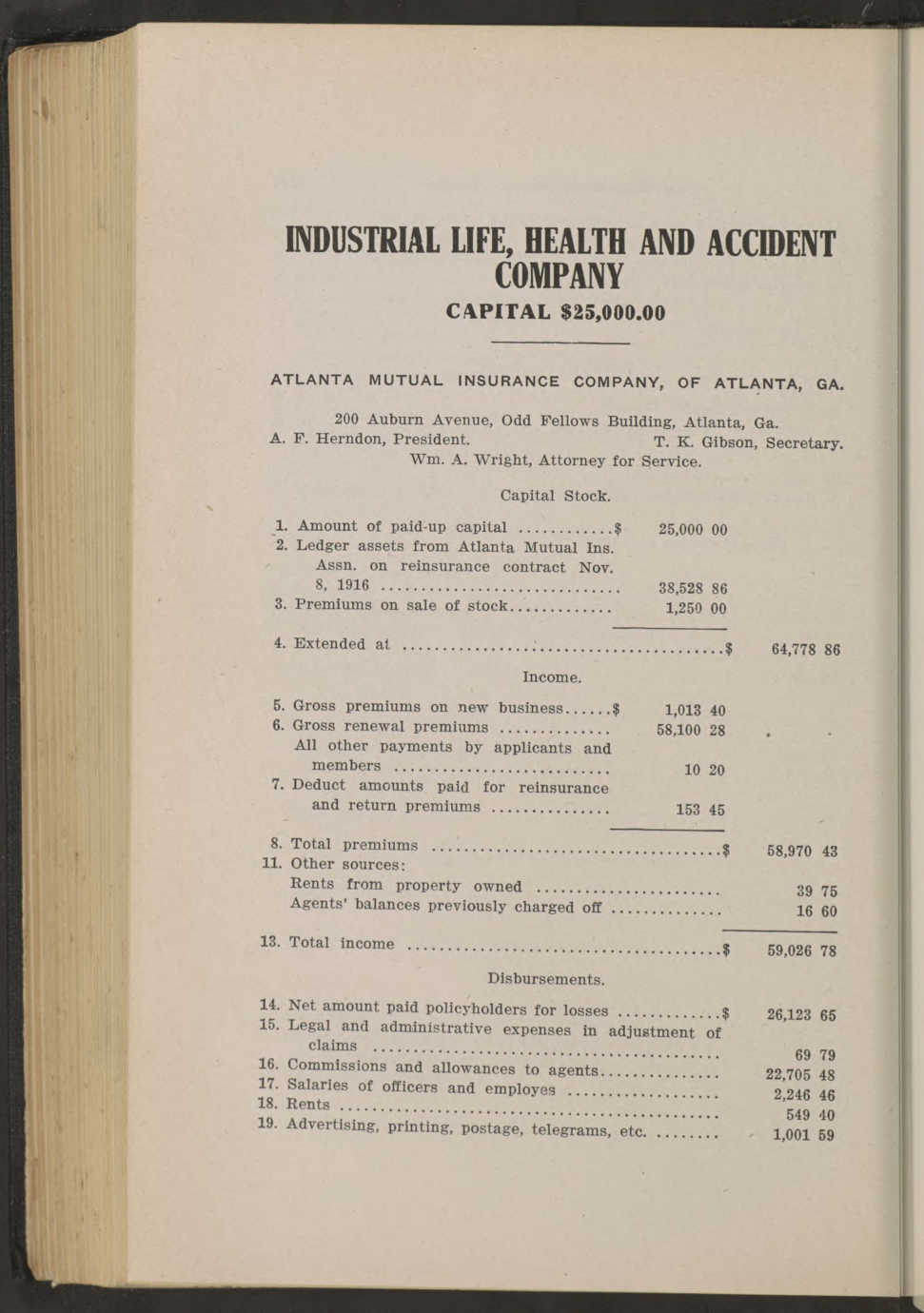
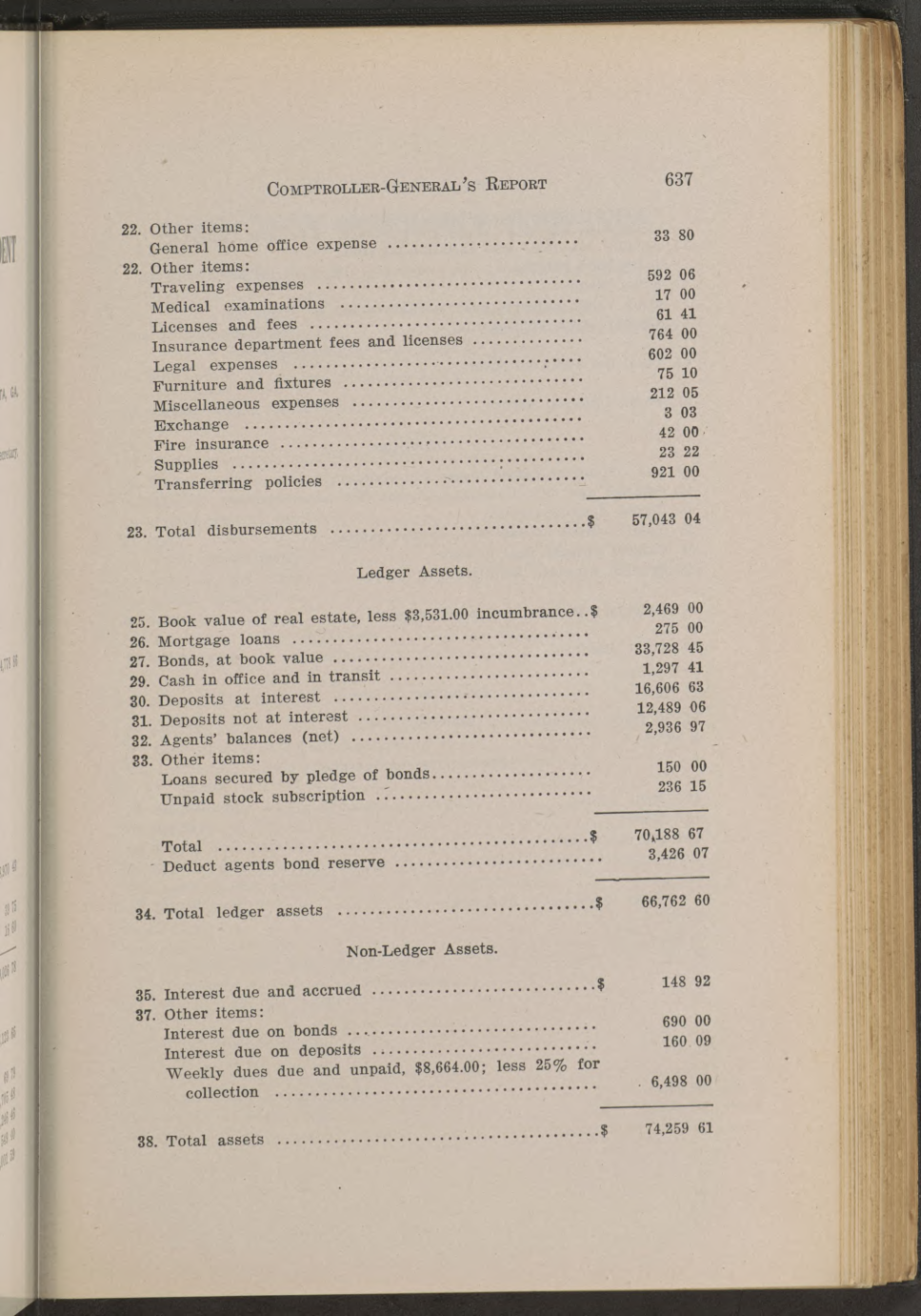
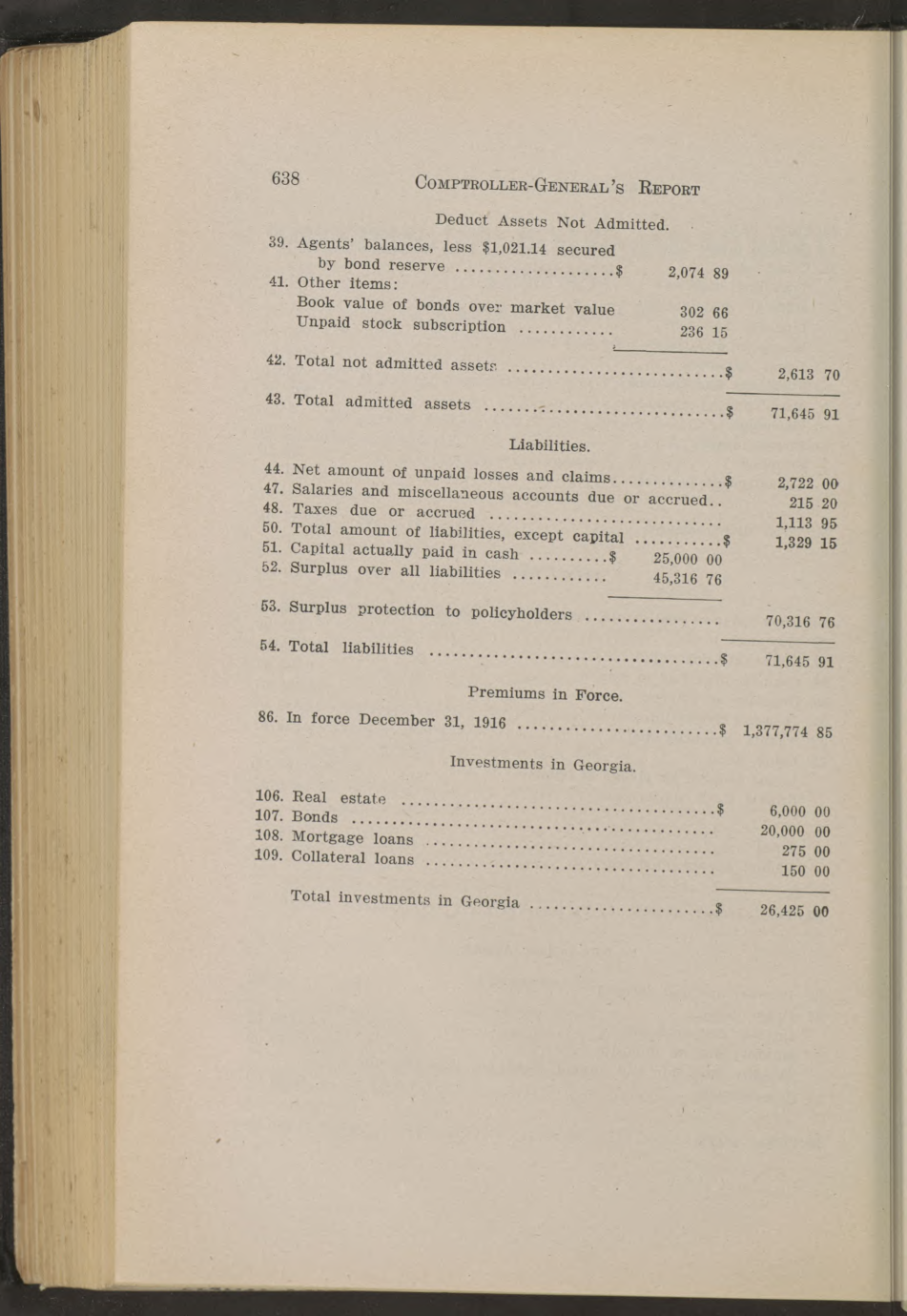
Full file: Open full-size page 1 · Open full-size page 2 · Open full-size page 3
Evidence classification: Contemporary regulatory statement; company-reported figures, not Herndon’s personal wealth.
Rights note: Historical government publication; source repository’s reproduction and reuse notices remain applicable.
Atlanta Life statement, 1927
Readable text — Selected financial extract
Read the Atlanta Life Insurance Company block at the top of page 103. The Atlantic Life and Bankers Health blocks lower on the page concern other companies.
| Entry | Recorded value |
|---|---|
| Admitted assets, December 31, 1927 | $1,154,927.79 |
| Liabilities excluding capital and surplus | $882,630.08 |
| Paid-up capital | $100,000.00 |
| Surplus | $172,297.71 |
| Premium income | $1,738,869.66 |
| Total income | $1,794,091.63 |
Selected entries only; labels shortened. These are company figures, not Herndon’s personal assets. Insurance in force is a separate measure and is not treated as revenue. Checked against the source images by BEHI, October 28, 2026.
Preview: Supplied document image; see citation for coverage.
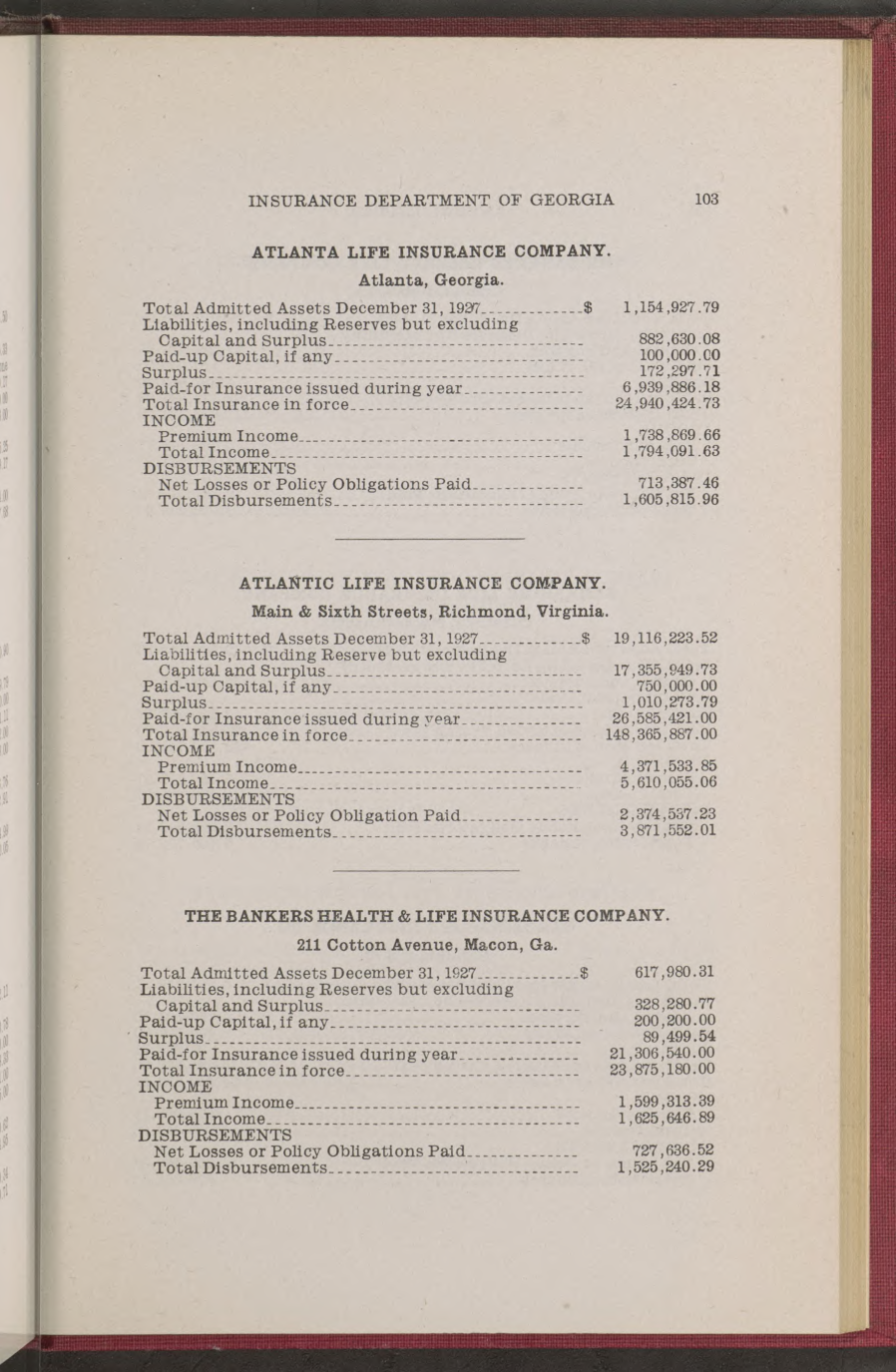
Full file: Open full-size file
Evidence classification: Contemporary regulatory statement; year-end operations include the period after Herndon’s death.
Rights note: Historical government publication; source repository’s reproduction and reuse notices remain applicable.
Barber-shop advertisement, 1927
Readable text — Selected transcription
HERNDON’S
BARBER SHOP
25 Barbers in Attendance.
A. F. Herndon, Proprietor
66 Peachtree St.
Selected lines from the lower-left advertisement; intervening slogan, service language and telephone number omitted. Line layout normalized. “25 Barbers” is the advertiser’s statement, not a checked payroll count. Checked against the source images by BEHI, October 28, 2026.
Preview: Supplied document image; see citation for coverage.
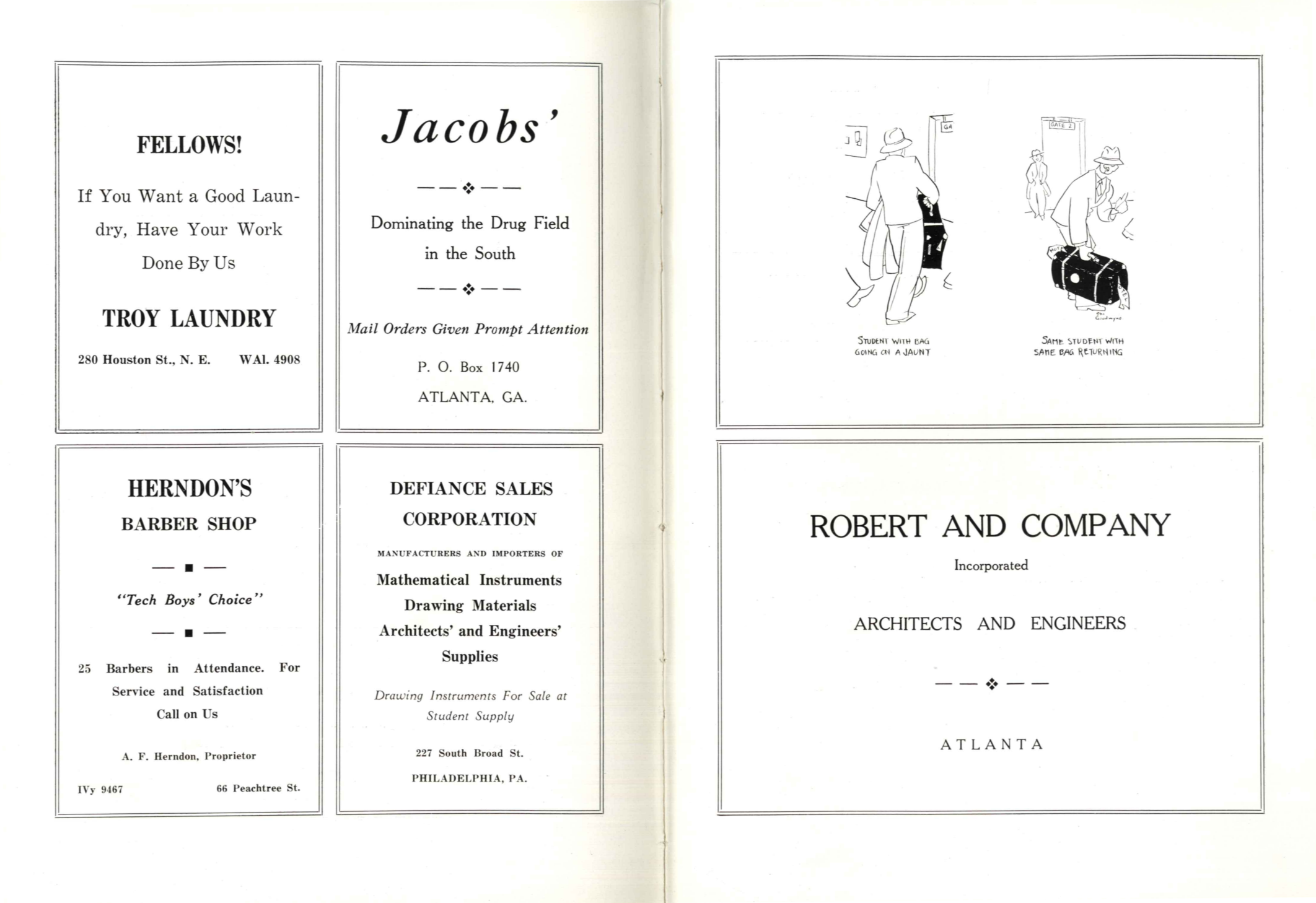
Full file: Open full-size file
Evidence classification: Contemporary advertisement; advertised capacity, not verified annual staffing or profit.
Rights note: Public-domain historical publication; credit Georgia Tech repository.
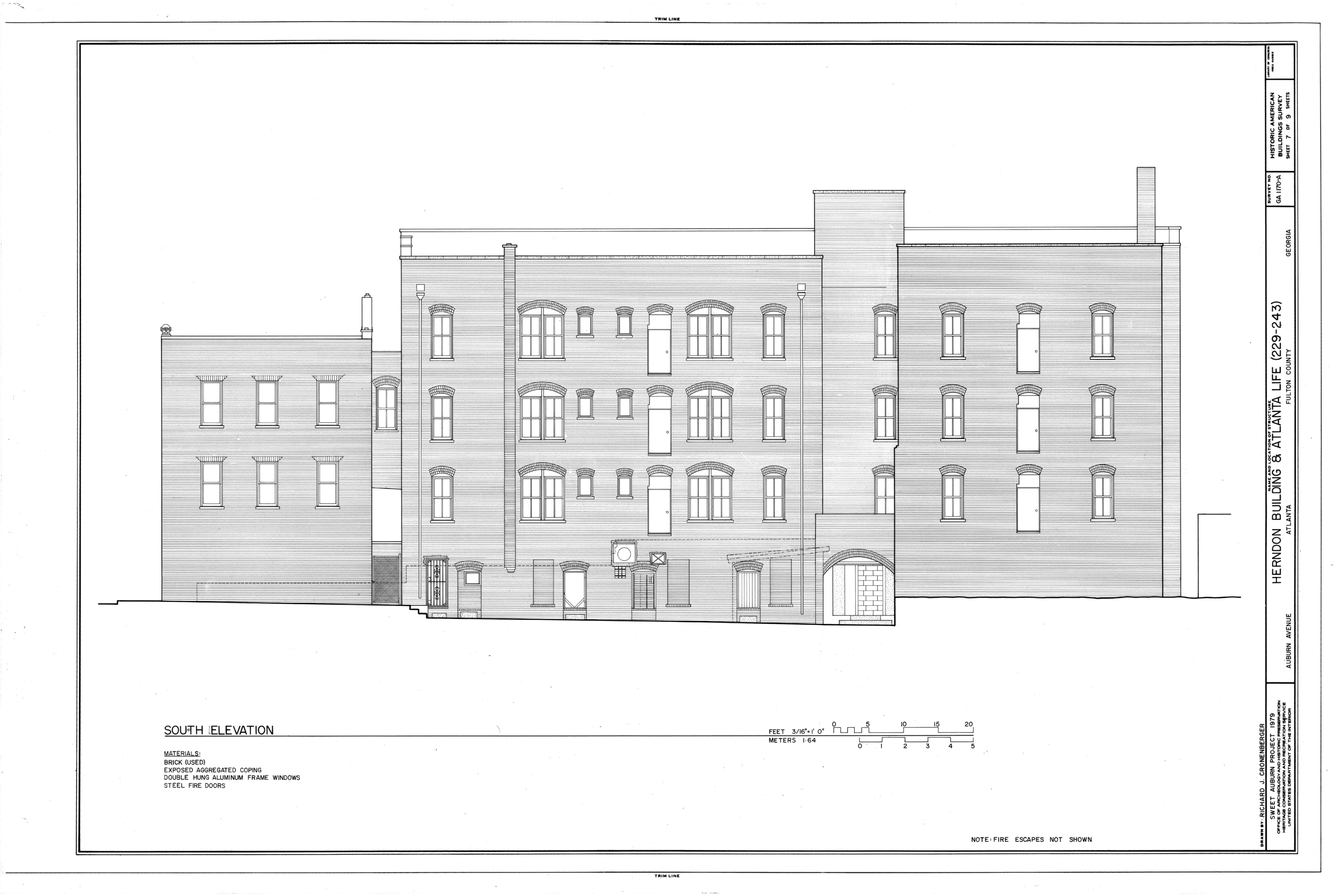
Visual historical record — Herndon & Atlanta Life Building
Herndon and Atlanta Life Building — HABS drawing
Readable text — Visual description
HABS sheet 7 of 9 shows the south elevation of the Herndon Building and Atlanta Life buildings on Auburn Avenue. The measured drawing records connected brick façades of different heights, windows, doorways, arches and roof details. Its notes identify materials and state that fire escapes are not shown.
Description of the displayed 1979 documentation sheet, not a transcription of all dimensions or an original construction plan. It documents buildings, not personal wealth. Checked against the source images by BEHI, October 28, 2026.
Preview: Supplied document image; see citation for coverage.
Full file: Open full-size file
Evidence classification: Later federal architectural survey; not a contemporary ownership or financing instrument.
Rights note: Federal HABS drawing: public domain in the United States.
Evidence boundary: This is a later federal architectural survey of a historically significant Herndon-related building, not a contemporary incorporation, financing, or ownership document. Federal HABS drawing: public domain in the United States.
A Receipt needs an entity, scope, date, and measure
Entity & scope
In 1920, Georgia-only premiums and company-wide net premiums describe different geographic coverage.
Date & image
The 1927 statement’s scanned year overrides the OCR reading of 1937. Preserve both the correction and its provenance.
Measure & interpretation
Assets, coverage, premiums, obligations paid, capital, and surplus answer different questions.
Sources: 1920 Georgia insurance report and 1927 Georgia insurance report. Evidence-reading diagram: match these fields before comparing numbers or calculating a trend. Repository links and exact PDF/printed-page locators in the register let readers trace each finding. Missing originals remain explicitly identified rather than represented as downloadable Receipts.
SOURCE REGISTER & EVIDENCE LIMITS
EVIDENCE & CONTEXT
| SOURCE | DESCRIPTION | DATE | EVIDENCE CLASSIFICATION | NOTES |
|---|---|---|---|---|
| Georgia insurance report — 1905 | Government statement | 1905 | VERIFIED | PDF p. 423; printed p. 405. Atlanta Mutual Insurance Association names A. F. Herndon as president, 202 Auburn Avenue. The $5,500 ledger bonds and stocks and $500 market-value excess are specific statement items, not total personal wealth. The later 6,324-policyholder / $5,446-income account is not verified by this page. |
| Georgia insurance report — 1915 | Government statement | 1915 | VERIFIED | PDF p. 645; printed p. 559. Atlanta Mutual Insurance Association reports $343,008.64 in net payments by members. Examination listing is an index to an examination, not the original examination report. |
| Georgia insurance report — 1916 | Government statement | 1916 | VERIFIED | PDF pp. 702–704; admitted-assets table printed p. 638. Atlanta Mutual Insurance Company: $25,000 paid capital; November 8 reinsurance item $38,528.86; admitted assets $71,645.91. |
| Georgia insurance report — 1917 | Government statement | 1917 | VERIFIED | PDF pp. 722–725. Net premiums $416,662.61; insurance at year end $1,235,318.00. These are company measures, not founder income. |
| Georgia insurance report — 1920 | Government statement | 1920 | VERIFIED | PDF p. 39, Table 9: Georgia-only premiums $817,213.64, losses paid $394,107.85, incurred $392,169.35. PDF pp. 538–539, printed pp. 513–514: company-wide net premiums $1,113,563.99 and admitted assets $201,347.74. The geographic scopes must remain separate. |
| Georgia insurance report — 1921 | Government examination index | 1921 | VERIFIED | PDF p. 12; printed p. 10. Examination listing identifies Atlanta Mutual. It does not supply the examination's substantive findings. |
| Georgia insurance report — 1922 | Government statement | 1922 | VERIFIED | PDF p. 57, folded table: Atlanta Life admitted assets $405,810.09; liabilities $263,841.39; capital $100,000; surplus $41,968.70; insurance $9,745,977.80. |
| Georgia insurance report — 1923 | Government statement | 1923 | VERIFIED | PDF p. 73, folded table: Atlanta Life admitted assets $495,342.82; liabilities $360,198.72; capital $100,000; surplus $35,144.10; insurance $10,861,687.10. |
| Georgia insurance report — 1926 | Government statement | 1926 | VERIFIED | PDF p. 115; printed p. 108: admitted assets $942,034.31; liabilities $723,688.69; capital $100,000; surplus $118,345.62; insurance $21,441,724.00. |
| Georgia insurance report — 1927 | Government statement | 1927 | VERIFIED | PDF p. 108; printed p. 103: admitted assets $1,154,927.79; liabilities $882,630.08; capital $100,000; surplus $172,297.71; insurance $24,940,424.73; premiums $1,738,869.66; total income $1,794,091.63; net policy obligations paid $713,387.46. The scan says 1927, although OCR reads 1937. Year-end figures extend beyond Herndon's July death. |
| The Crisis — Men of the Month | Contemporary magazine | March 1921 | ATTRIBUTED | PDF pp. 25–26; printed pp. 215–216. Contemporary account reports three shops valued at $30,000, $15,000 and $15,000; estimated real estate of $500,000; $3,000 income tax and a $10,000 nursery gift. These are published claims, not ledgers, appraisals, tax returns or payment instruments. |
| Georgia Tech — Herndon's barber-shop advertisement | Contemporary advertisement | 1927 | VERIFIED | The 1927 Tech Terror and Tatler, PDF p. 10, left page: A. F. Herndon, proprietor, 66 Peachtree Street, and advertised 25 barbers. Advertising establishes what was offered; it does not establish year-round payroll or profit. |
| Herndon Home — National Register nomination | Government heritage interpretation | Later historical account | ATTRIBUTED | PDF pp. 20–21 report 1905 policyholders 6,324, insurance $180,962 and income $5,446; September 27, 1916 charter; November 8 operations; September 29, 1922 charter/name transition. This nomination is not the original charter or 1905 operating ledger. |
| Passport application — reproduced image | Reproduced government record | May 24, 1912 | DISPUTED | Application 74574 names Alonzo Franklin Herndon, Walton County, and June 26, 1857 birth. Institutional biographies and The Crisis give 1858. Treat the birth year as unresolved; the application is a self-report. NARA series/roll and full original provenance remain to be reconciled. |
| Atlanta Constitution — nursery clipping | Reproduced newspaper clipping | Reported November 21, 1920 | ATTRIBUTED | Visible clipping reports $10,000 purchase and equipment for a nursery. Date and p. 12A are attributed to the reproduction citation; masthead and full original page were not recovered. |
| Undated barber-shop advertisement | Reproduced advertisement | Date unresolved | ATTRIBUTED | Visible advertisement states 25 chairs and 20 baths. These counts are capacity claims, not employment counts. Full issue, date, address transcription and provenance remain open. |
| Atlanta Georgian — 66 Peachtree sale | Prior transcription | 1919 lead | ATTRIBUTED | Earlier research describes a $165,000 building sale from the R. L. Worthen estate to Lee Hogan, with Herndon as tenant. Exact issue and original page remain unrecovered. No Herndon ownership or purchase price is verified. |
| Herndon Home — 1902 barber ledger | Archival acquisition pending | 1902 lead | ATTRIBUTED | Prior scholarship points to an unprocessed Herndon Home collection. The Herndon Home supplied representative photographs of the 1902 ledger on October 1, 2026, documenting the existence and format of surviving shop accounts. Additional-page selection, complete analysis, and any public-image reproduction permission are pending. No revenue, wage, or profit total is classified as verified from this preliminary material. |
| Directories, deeds, tax and probate | Archival acquisition pending | 1905–1927 leads | ATTRIBUTED | Directory locators require recovery; original deeds, tax returns and estate inventory remain missing. Repository correspondence and finding aids confirm research pathways, not transactions or net worth. Georgia Archives insurance holdings access remains constrained. |
| 1918 semiannual insurance account | Prior transcription | June 30, 1918 lead | ATTRIBUTED | Earlier figures of $236,376.11 income and $104,304.46 claims were not recovered in this audit. Retain only as a reinspection lead; exclude from verified financial tables. |
RESEARCH GAPS & OPEN QUESTIONS
The review below distinguishes inspected evidence, corrections and the original records still needed.
THE RECORD & ITS LIMITS
A verified publication does not make every quoted historical assertion independently verified.
Birth year, financial scope, wealth metric, shop values, tenancy and OCR year are corrected or qualified.
Reconcile passport provenance; obtain the remaining 1902 ledger pages and complete their analysis, plus charters, the 1919 full newspaper page, deeds, tax and estate records; secure portrait identity and usage rights.
RESEARCH UPDATES & RECONCILIATION
Evidence status: Inspected scans, attributed accounts, and outstanding original records remain distinct evidence categories.
Read full note: Previous research reconciled
Insurance statements, magazine and dated advertisement.
Heritage narrative and provenance-limited reproductions.
Ledgers, deeds, tax, probate and examination reports.
Have a document that could help? Contact BEHI with its source and provenance. Submissions are reviewed before inclusion.
No verified records are currently published in this category.
Cite This Profile
The Black Economic History Institute (BEHI) Digital Archive